Percentage Increase and Decrease Formula (With Real Examples)
The percentage increase formula with salary-hike and price examples, plus decreases, percentage difference, percentage points and back-to-back changes.

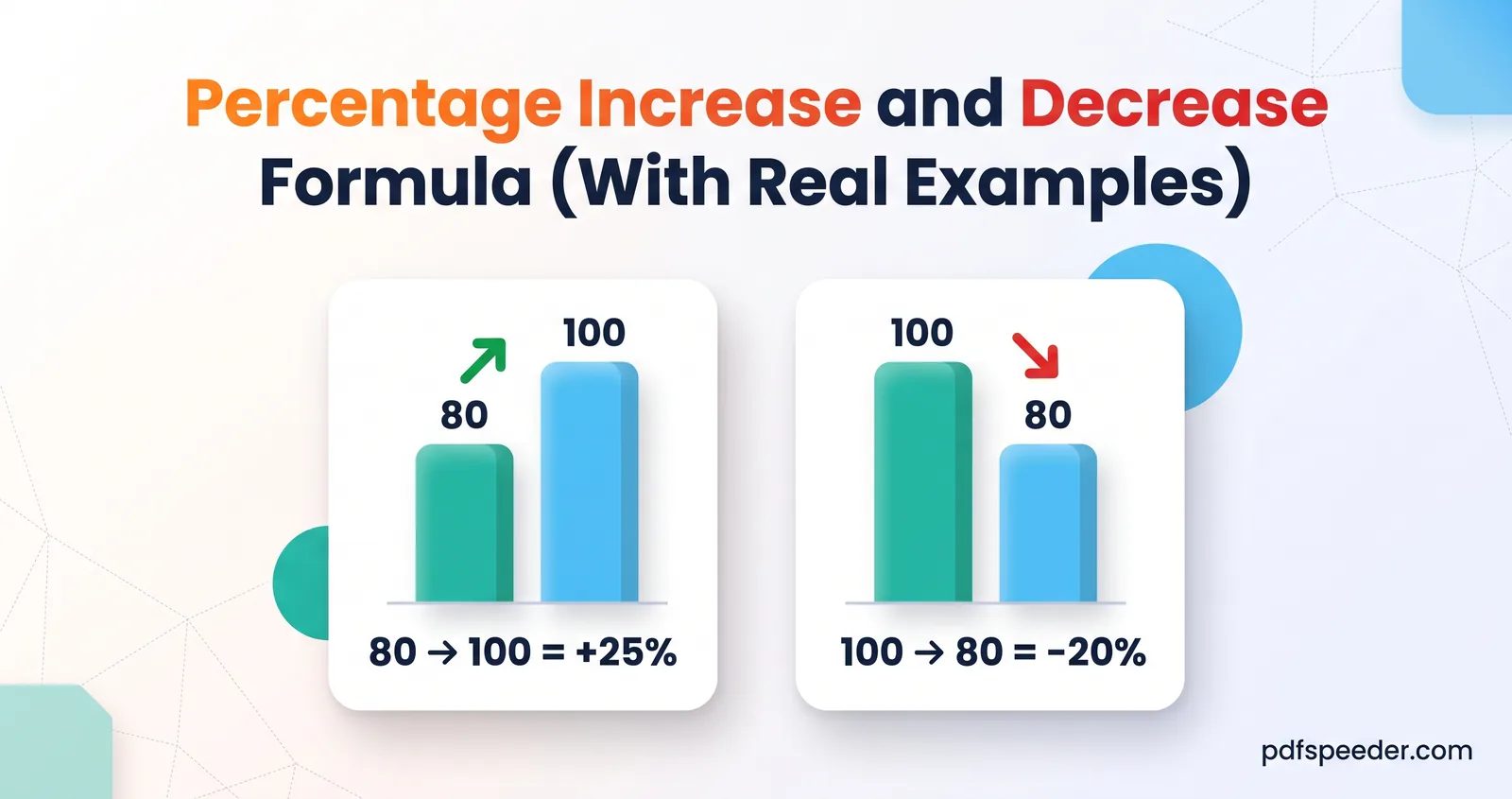
The percentage increase formula is (new value − old value) ÷ old value × 100. If your monthly salary goes from ₹38,500 to ₹43,120, that's 4,620 ÷ 38,500 × 100 = a 12% increase, and the same formula gives a negative answer when a value falls. Below you'll find worked examples for salary hikes, prices and bills, plus the three mix-ups that catch people out: percentage difference, percentage points and back-to-back changes.
On this page
The percentage increase and decrease formula
Every "how much did it change?" question uses one formula, measured against the starting value:
percentage change   = (new − old) ÷ old × 100
percentage increase = (new − old) ÷ old × 100    when the value went up
percentage decrease = (old − new) ÷ old × 100    when the value went down
The percentage change formula covers both directions at once: a positive answer is an increase, a negative one a decrease. The percentage decrease formula simply flips the subtraction so the answer comes out positive. Either way, the rule that matters is to divide by the old value, the one you started from.
The same relationship rearranges to answer the other questions you'll meet:
| You know | You want | Formula |
|---|---|---|
| The old and new values | The percentage change | (new − old) ÷ old × 100 |
| The old value and the % increase | The new value | old × (1 + % ÷ 100) |
| The old value and the % decrease | The new value | old × (1 − % ÷ 100) |
| The new value and the % increase | The old value | new ÷ (1 + % ÷ 100) |
| The new value and the % decrease | The old value | new ÷ (1 − % ÷ 100) |
Percentage increase: salary hikes and prices
Salary hike percentage calculation
Your salary rises from ₹38,500 to ₹43,120 a month. To find the hike:
- Find the increase: 43,120 − 38,500 = ₹4,620
- Divide by the old salary: 4,620 ÷ 38,500 = 0.12
- Multiply by 100: 0.12 × 100 = 12%
It works the same on yearly figures, as long as both numbers are of the same kind: monthly with monthly, CTC with CTC, in-hand with in-hand. Mixing them gives a meaningless answer.
Going the other way, an 8.5% hike on ₹52,000 adds 52,000 × 0.085 = ₹4,420, for a new salary of 52,000 × 1.085 = ₹56,420.
And if you only know the new figure, divide rather than subtract. A salary of ₹56,420 after an 8.5% hike was 56,420 ÷ 1.085 = ₹52,000 before it. Taking 8.5% off ₹56,420 instead gives ₹51,624.30, which is wrong, because the 8.5% was worked out on the smaller, older salary.
Price increases
A course fee goes up from ₹18,500 to ₹21,275. The increase is ₹2,775, and 2,775 ÷ 18,500 × 100 = 15%.
An increase has no ceiling. A price that doubles has risen by 100%, and one that triples has risen by 200%, because the increase is measured against the original price, not the new one.
Percentage decrease: discounts and drops
An electricity bill falls from ₹2,840 to ₹2,130. The drop is ₹710, and 710 ÷ 2,840 × 100 = a 25% decrease. In the percentage change formula, the same numbers give (2,130 − 2,840) ÷ 2,840 × 100 = −25%; the minus sign is just telling you the direction.
A phone reduced from ₹24,999 to ₹19,999 is ₹5,000 cheaper, and 5,000 ÷ 24,999 × 100 = 20.0008%, which rounds to 20%. Unlike an increase, a decrease can't go past 100%: a fall of 100% means the value has reached zero.
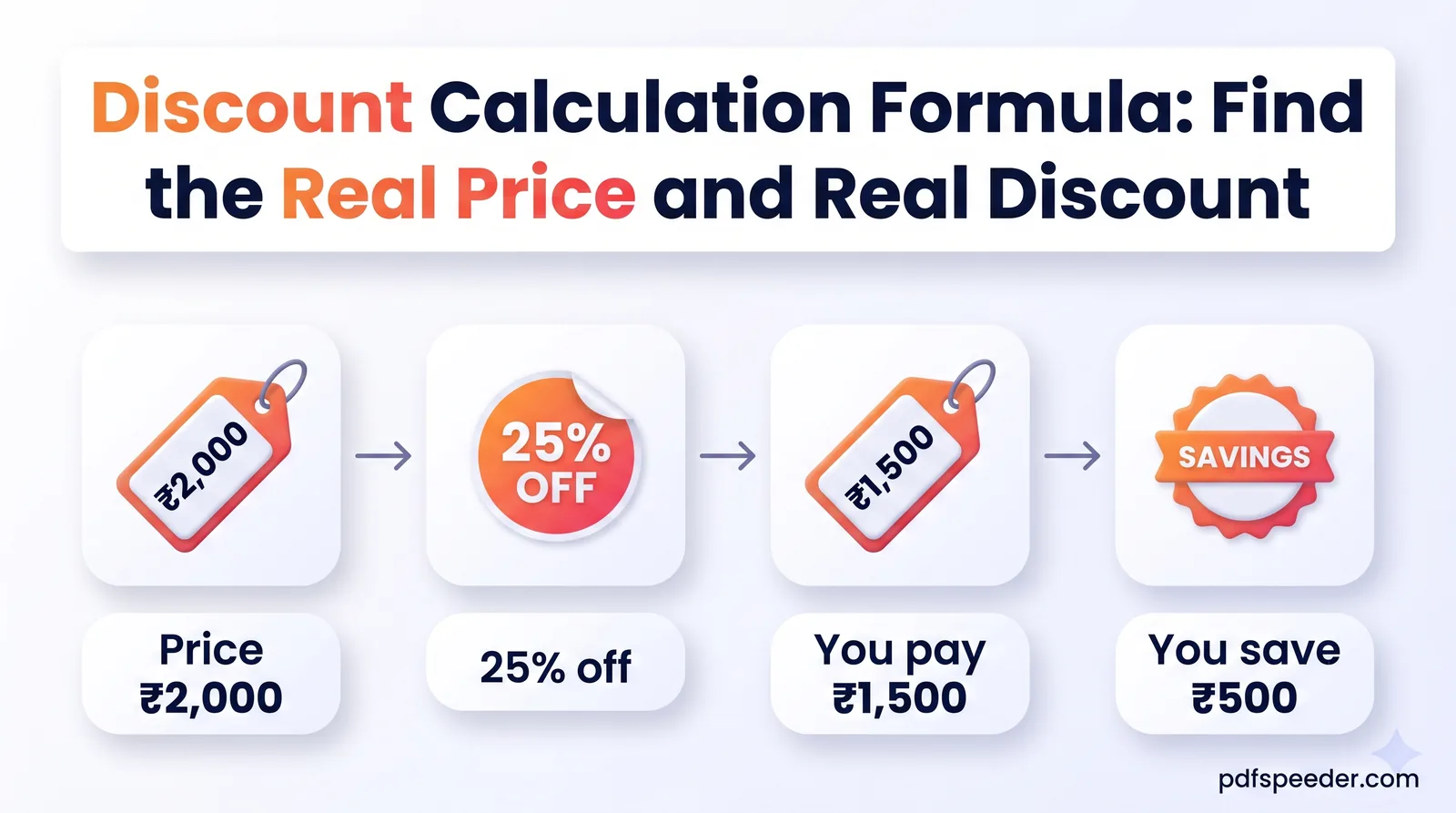
Sale prices are percentage decreases too, with a few traps of their own, such as stacked discounts and offers with caps, which our guide to the discount calculation formula works through. Our Percentage Calculator has rows for discounts in both directions, and it shows the formula with your numbers in it, so you can follow the working.
Percentage difference vs percentage change
Percentage change has a direction: it goes from an old value to a new one. Percentage difference compares two values when neither is the starting point, such as two quotes for the same job, so it measures the gap against their average:
percentage difference = |a − b| ÷ ((a + b) ÷ 2) × 100Here's why the distinction matters. Two shops quote ₹450 and ₹540 for the same item:
| Question | Calculation | Answer |
|---|---|---|
| Change from ₹450 to ₹540 | 90 ÷ 450 × 100 | +20% |
| Change from ₹540 to ₹450 | −90 ÷ 540 × 100 | −16.67% |
| Percentage difference between them | 90 ÷ 495 × 100 | 18.18% |
The same ₹90 gap is 20% or 16.67% depending on which price you start from, while the percentage difference gives one neutral figure. Use change for before-and-after comparisons, and difference when you're comparing two things side by side. The Percentage Calculator has a row for each.
Percent vs percentage points
When the numbers you're comparing are already percentages, such as interest rates, exam pass rates or vote shares, there are two ways to describe a change, and they give very different numbers.
Say a home loan rate rises from 8.4% to 8.9%:
- In percentage points, it rose by 8.9 − 8.4 = 0.5 points.
- In percent, the rate itself rose by 0.5 ÷ 8.4 × 100 = 5.95%.
Both are correct, but they answer different questions, and on a ₹30 lakh loan over 20 years that half-point raises the EMI from ₹25,845 to ₹26,799, or ₹954 a month (you can check those figures in our EMI Calculator). Likewise, a school pass rate that climbs from 62% to 71% is up 9 percentage points, which is a 14.52% increase in the pass rate.
When you read "up 9%" next to a figure that is itself a percentage, check which of the two is meant. Percentage points vs percent is an easy mix-up to make, in news reports and offer letters alike.
Why up 20% then down 20% isn't zero
Each percentage is worked out on a different base, so equal ups and downs don't cancel. Suppose an investment of ₹50,000 falls 20% to ₹40,000. A 20% rise from there adds only ₹8,000, because 20% of ₹40,000 is smaller than 20% of ₹50,000, leaving you at ₹48,000: still 4% below where you started.
The pattern holds for any size of move. A rise and fall of the same percentage, in either order, leaves you down by (percentage²) ÷ 100 percent: 1% for 10%, 6.25% for 25%, and 25% for 50%.
Losses need bigger gains to recover, and the gap grows fast:
| Fall | Rise needed to get back to the start |
|---|---|
| 10% | 11.11% |
| 20% | 25% |
| 30% | 42.86% |
| 50% | 100% |
| 80% | 400% |
The formula is fall ÷ (100 − fall) × 100. Successive increases compound in the same way: a 10% rise followed by another 10% rise is a total increase of 21%, not 20%.
Changes over several years
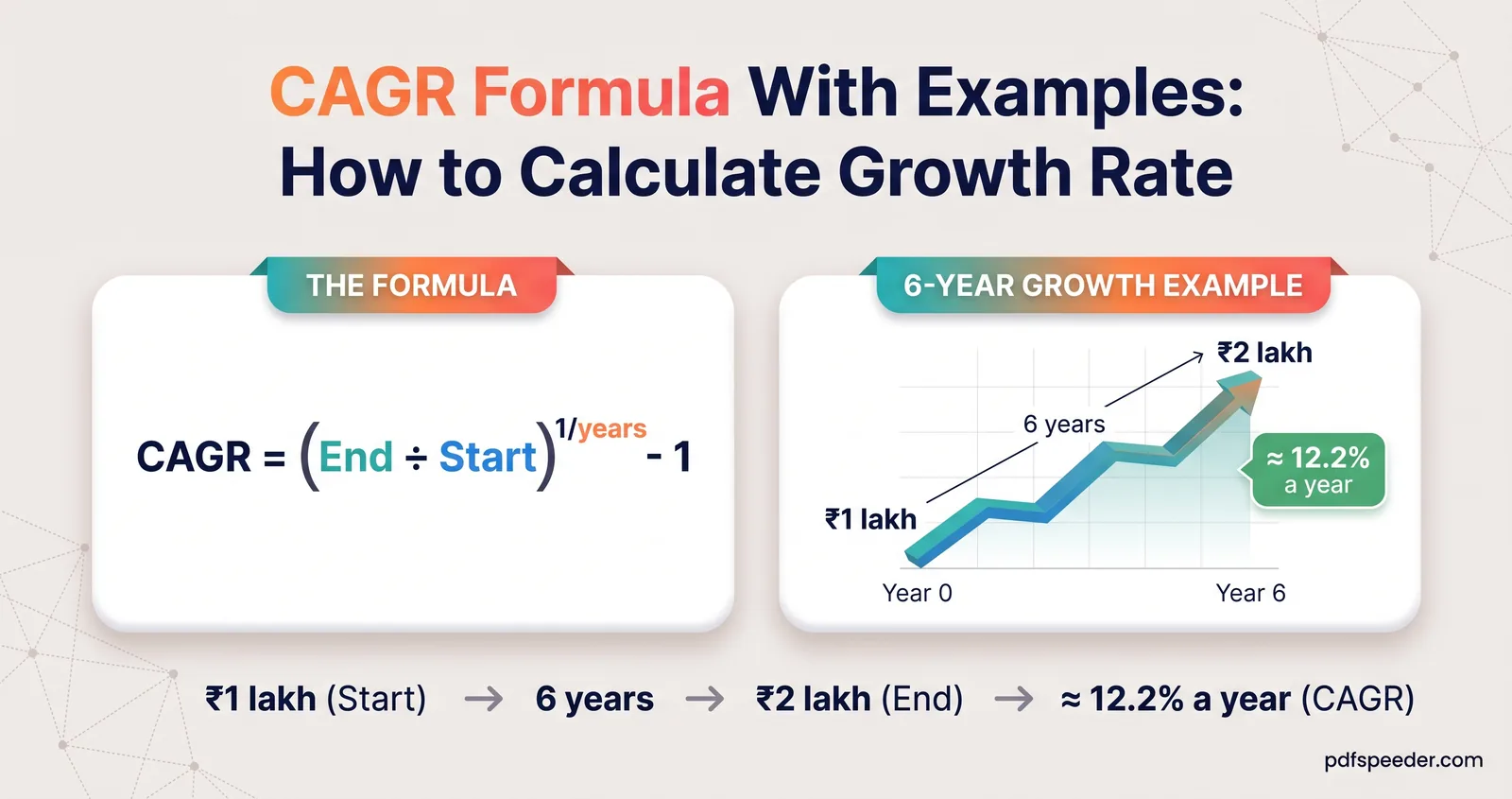
The same compounding catches people comparing growth over time. A salary that went from ₹4,80,000 to ₹7,20,000 in five years rose by 50% in total, but that isn't 10% a year: 10% compounded for five years would give ₹7,73,045. The steady yearly rate is (7,20,000 ÷ 4,80,000)^(1/5) − 1 = 8.45%. Our CAGR Calculator works this out from a start value, an end value and the number of years, and our guide to the CAGR formula explains it in detail.
Percentage change in Excel or Google Sheets
With the old value in A2 and the new value in B2, either of these gives the change:
=(B2-A2)/A2
=B2/A2-1
Format the cell as a percentage with the % button. If the old value could be zero, wrap it as =IF(A2=0,"n/a",(B2-A2)/A2), because a change from zero has no percentage. For the basics, such as finding X% of a number or what percentage one number is of another, see our guide on how to calculate percentage.
To check your own numbers, enter the old and new values in the change row of the Percentage Calculator, then work one example by hand with the formula above so you know the answer makes sense.
Frequently asked questions
What is the formula for percentage increase?
Percentage increase = (new value − old value) ÷ old value × 100. A rise from ₹18,500 to ₹21,275 is 2,775 ÷ 18,500 × 100 = 15%.
How do I calculate my salary hike percentage?
Subtract your old salary from the new one, divide by the old salary and multiply by 100. From ₹38,500 to ₹43,120 is 4,620 ÷ 38,500 × 100 = 12%.
What is the difference between percentage change and percentage difference?
Percentage change measures a move from an old value to a new one, so its direction matters. Percentage difference compares two values against their average, so ₹450 and ₹540 are 18.18% apart whichever you start from.
What is a percentage point?
It's the simple gap between two percentages. A rate rising from 8.4% to 8.9% is up 0.5 percentage points, which is a 5.95% increase in the rate itself.
Can a percentage increase be more than 100%?
Yes. A value that doubles has increased by 100%, and one that triples has increased by 200%. A decrease, though, can't go beyond 100%, which would take the value below zero.