BMI Formula: How to Calculate BMI and What It Means for Indians
The BMI formula in kg and pounds with worked examples, WHO categories beside the lower Indian cut-offs, a healthy weight table by height, and what BMI misses.

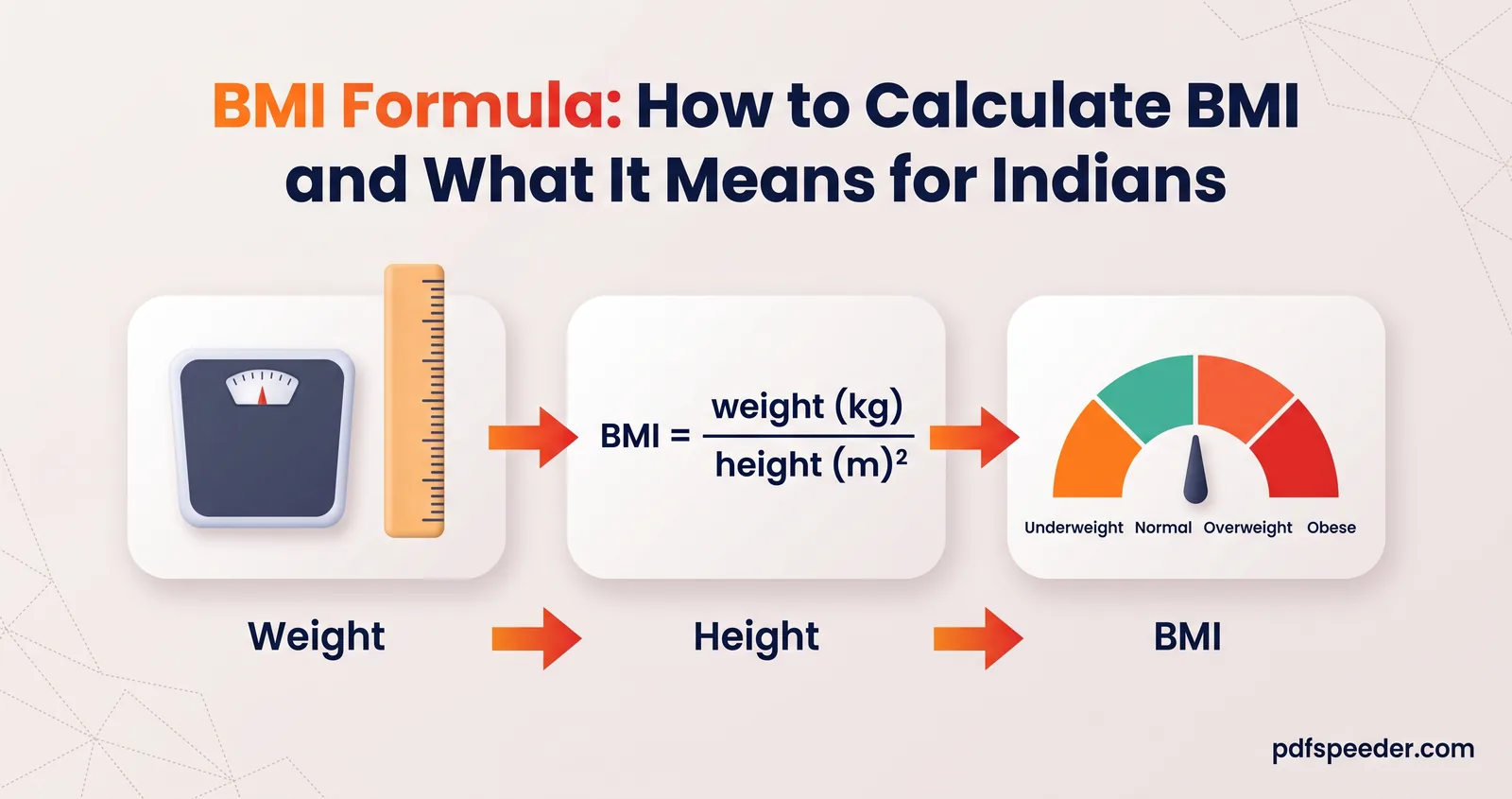
The BMI formula is your weight in kilograms divided by the square of your height in metres: BMI = kg ÷ m². For 70 kg at 1.70 m, that's 70 ÷ 2.89 = 24.2, which the WHO classes as a healthy weight but Indian guidelines class as overweight, because Asian Indians tend to carry more body fat at the same BMI. Below are the metric and pound formulas with worked examples, both sets of cut-offs and a healthy weight table for your height.
On this page
The BMI formula, in kilograms and in pounds
BMI = weight (kg) ÷ height (m)²
BMI = 703 × weight (lb) ÷ height (in)²- Height goes in metres, not centimetres: 170 cm is 1.70 m. Square it by multiplying it by itself, 1.70 × 1.70 = 2.89.
- The 703 converts pounds and inches. A pound is 0.45359237 kg and an inch is 0.0254 m, and 0.45359237 ÷ 0.0254² = 703.07, rounded to 703.
- One formula for every adult. The US Centers for Disease Control and Prevention publishes both BMI formulas and uses the same adult categories for everyone aged 20 and over. Children and teenagers are judged against age and sex percentile charts instead.
The answer is in kg/m², though it's usually written as a plain number such as 24.2.
Worked examples in kg and pounds
Kilograms and centimetres
Here's how to calculate BMI for someone who weighs 70 kg and is 170 cm tall:
- Convert the height to metres: 170 ÷ 100 = 1.70 m
- Square it: 1.70 × 1.70 = 2.89
- Divide the weight by it: 70 ÷ 2.89 = 24.22
Pounds, feet and inches
The BMI formula in pounds works the same way, with the 703 added. For 154 lb at 5 ft 7 in:
- Convert the height to inches: 5 × 12 + 7 = 67 inches
- Square it: 67 × 67 = 4,489
- Divide and multiply: 154 ÷ 4,489 × 703 = 24.12
That's almost the same person as the metric example (154 lb is 69.9 kg, and 67 inches is 170.2 cm), so the two formulas agree. If you have one unit and need the other, our Unit Converter uses the exact definitions of the pound and the inch and runs in your browser.
Our BMI Calculator has Metric and Imperial tabs. Enter your weight and height and select Calculate BMI. Age is optional, because BMI doesn't use it; if you enter an age under 20, the result reminds you that the adult categories don't apply.
You get your BMI to two decimals, its WHO category and the healthy weight range for your height, and the last 10 results stay in your browser's history. It uses the WHO cut-offs, so read the Indian column below alongside it.
BMI categories: WHO vs Asian Indian cut-offs
Here's the BMI chart for adults with both sets of cut-offs side by side:
| BMI | WHO and CDC category | Asian Indian category (2009 consensus) |
|---|---|---|
| Below 18.5 | Underweight | Underweight |
| 18.5 to 22.9 | Healthy weight | Normal |
| 23 to 24.9 | Healthy weight | Overweight |
| 25 to 29.9 | Overweight | Obesity |
| 30 and above | Obesity | Obesity |
The global standard comes from the WHO, whose obesity fact sheet defines overweight as a BMI of 25 or more and obesity as 30 or more. The CDC splits obesity further into class 1 (30 to under 35), class 2 (35 to under 40) and class 3 (40 or more).
The Indian column comes from a 2009 consensus statement by Indian experts, published in the Journal of the Association of Physicians of India. Asian Indians tend to have more body fat than many other ethnic groups at the same BMI, and type 2 diabetes appears at lower BMIs, so the statement moved the cut-offs down: overweight from 23 and obesity from 25. It also defined abdominal obesity as a waist of 90 cm or more for men and 80 cm or more for women.
A 2025 revision of that consensus goes further and drops "overweight" for Asian Indians altogether. A BMI above 23 counts as obesity, in two stages:
- Stage 1: BMI above 23 with no effect on organ function or daily activities.
- Stage 2: BMI above 23 plus a large waist (the same 90 cm and 80 cm limits, or a waist more than half your height), together with limits on daily activities or an obesity-related condition such as type 2 diabetes or high blood pressure.
That's expert guidance for doctors rather than a government rule, but it shows where Indian practice is heading: for BMI for Indians, 23 is the number to watch.
Healthy BMI range for your height
Turn the formula around to find the weight that matches a BMI: weight = BMI × height². At 165 cm, a BMI of 24.9 is 24.9 × 1.65 × 1.65 = 67.8 kg. Here's the healthy BMI range by height:
| Height | WHO healthy range (BMI 18.5 to 24.9) | Normal for Asian Indians (BMI 18.5 to 22.9) |
|---|---|---|
| 150 cm (4 ft 11 in) | 41.6 to 56.0 kg | 41.6 to 51.5 kg |
| 155 cm (5 ft 1 in) | 44.4 to 59.8 kg | 44.4 to 55.0 kg |
| 160 cm (5 ft 3 in) | 47.4 to 63.7 kg | 47.4 to 58.6 kg |
| 165 cm (5 ft 5 in) | 50.4 to 67.8 kg | 50.4 to 62.3 kg |
| 170 cm (5 ft 7 in) | 53.5 to 72.0 kg | 53.5 to 66.2 kg |
| 175 cm (5 ft 9 in) | 56.7 to 76.3 kg | 56.7 to 70.1 kg |
| 180 cm (5 ft 11 in) | 59.9 to 80.7 kg | 59.9 to 74.2 kg |
Example: At 170 cm and 80 kg, your BMI is 80 ÷ 2.89 = 27.7. Reaching a BMI of 24.9 means 72.0 kg, 8.0 kg less, while the Indian normal limit of 22.9 means 66.2 kg, 13.8 kg less.
Eight kilos off 80 is a 10% drop in body weight, worked out the way our guide on how to calculate percentage shows.
What BMI doesn't tell you
BMI is a quick screening number, and the WHO itself calls it "a surrogate marker of fatness". It can mislead you in a few common situations:
- Muscle counts as weight. A muscular athlete can have a BMI over 25 with little body fat.
- It ignores where fat sits. Fat around the waist carries more health risk than fat elsewhere, and BMI can't see it. Measure around your waist with a tape: 90 cm or more for men or 80 cm or more for women is a warning sign for Asian Indians, as is a waist more than half your height.
- Body composition differs. At the same BMI, women generally carry more fat than men, and older adults more fat than younger ones.
- It isn't for everyone. Children and teenagers need age-specific charts, and BMI doesn't apply during pregnancy.
So treat your BMI as a starting point. If it's above 23, or your waist is over the limit, a check-up with blood pressure, blood sugar and cholesterol tests tells you far more than the number alone.
Note: This article is for information only and is not medical advice. Talk to a doctor about what your BMI and waist measurement mean for you.
Work out your number now: open the BMI Calculator, enter your height and weight, then compare the result with both columns of the chart above.
Frequently asked questions
What is the formula for BMI?
BMI = weight in kilograms ÷ (height in metres)². In pounds and inches, it's 703 × weight in pounds ÷ (height in inches)².
What is a healthy BMI for Indians?
18.5 to 22.9. Indian guidelines treat 23 to 24.9 as overweight and 25 or more as obesity, and a 2025 expert revision counts any BMI above 23 as obesity.
How do I calculate BMI in pounds?
Multiply your weight in pounds by 703, then divide by your height in inches squared. For 154 lb at 5 ft 7 in (67 inches), that's 154 × 703 ÷ 4,489 = 24.12.
Is a BMI of 24 normal?
By the WHO's global cut-offs, yes: 18.5 to 24.9 is a healthy weight. For Asian Indians, 24 falls in the overweight range of 23 to 24.9.
Is BMI an accurate measure of body fat?
Not on its own. It can't tell muscle from fat or show where fat is stored, so pair it with a waist measurement and, if it's high, with a doctor's check-up.