How to Calculate Percentage: Formulas, Shortcuts and Examples
How to calculate percentage the easy way: the formula, X% of Y, what percent one number is of another, reversing a percentage, marks, and mental shortcuts.

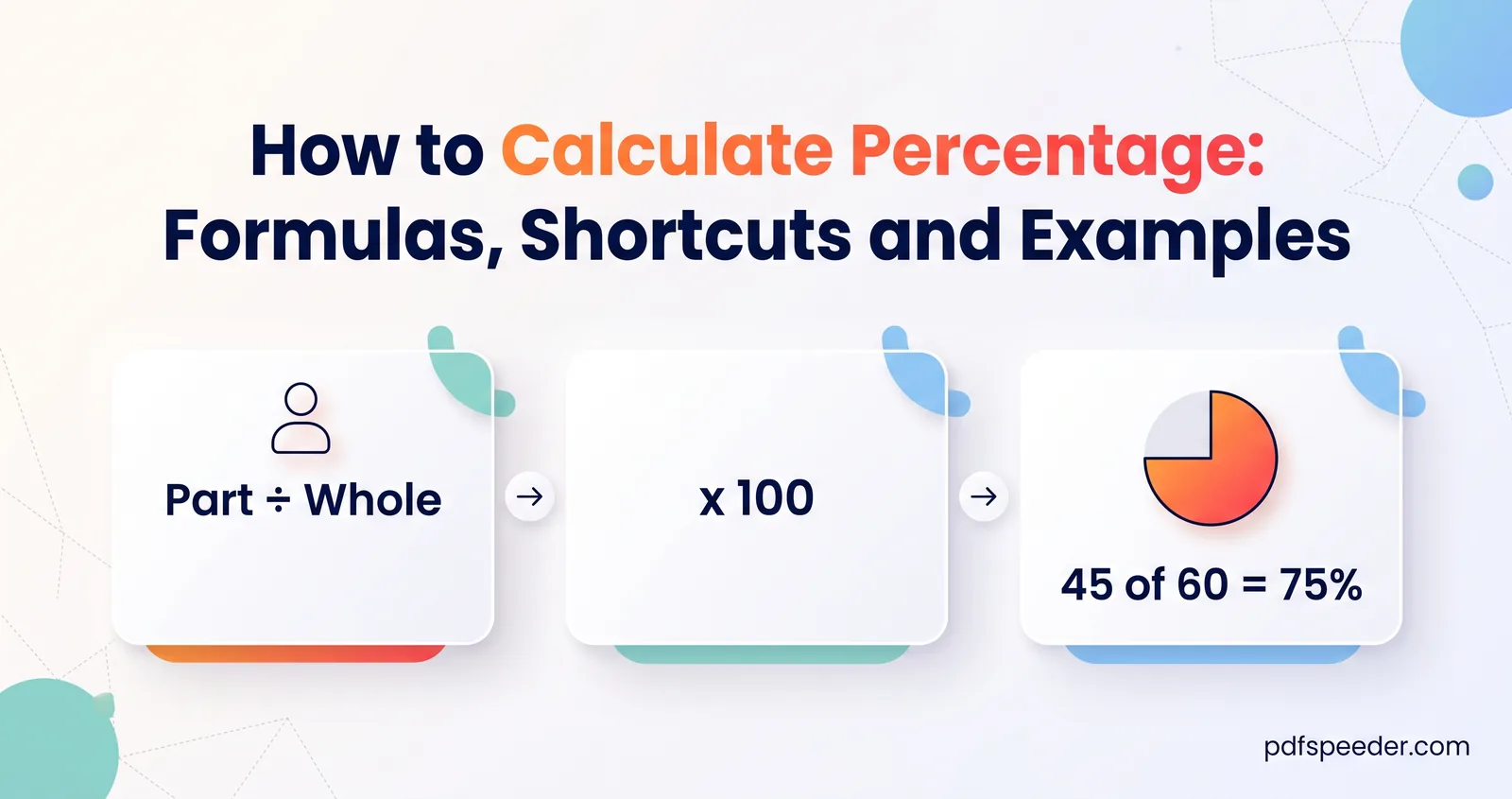
To calculate a percentage, divide the part by the whole and multiply by 100: 45 out of 60 is 45 ÷ 60 × 100 = 75%. Almost every percentage question is a rearrangement of that one formula, whether you're finding 18% of a price, working out your marks or recovering the original price from a discounted one. Below are the three core questions with worked examples, plus mental shortcuts that get you there without a calculator.
On this page
The percentage formula
"Per cent" means "per hundred", so 75% is 75 parts in every 100, or 0.75 as a decimal. To turn a percentage into a decimal, divide it by 100 (18% becomes 0.18); to turn a decimal back into a percentage, multiply by 100.
The percentage formula has three forms, one for each thing you might be missing:
percentage = part ÷ whole × 100
part       = percentage ÷ 100 × whole
whole      = part ÷ (percentage ÷ 100)
Those match the three everyday percentage questions:
| Question | Formula | Example |
|---|---|---|
| What is X% of Y? | X ÷ 100 × Y | 18% of 2,450 = 441 |
| X is what percent of Y? | X ÷ Y × 100 | 45 is 75% of 60 |
| X is P% of what number? | X ÷ (P ÷ 100) | 84 is 30% of 280 |
What is X% of Y?
To find a percentage of a number, turn the percentage into a decimal and multiply. For 18% of ₹2,450:
- Convert the percentage: 18 ÷ 100 = 0.18
- Multiply: 0.18 × 2,450 = ₹441
That's the GST on a ₹2,450 item at 18%, or the saving on an 18%-off sale. With awkward percentages the method is the same: 12.5% of 640 is 0.125 × 640 = 80.
On many phone calculators, typing 2450 × 18% gives 441. Our Scientific Calculator works the same way, and it follows a desk calculator's convention for plus and minus too: 2450 + 18% gives 2,891, which is 2,450 plus 18% of itself.
X is what percent of Y?
To find what percentage one number is of another, divide the part by the whole and multiply by 100. If you've paid ₹9,600 of a ₹12,000 fee:
9,600 ÷ 12,000 × 100 = 80%The usual mistake is dividing the wrong way round. For 35 out of 140, the right sum is 35 ÷ 140 × 100 = 25%; flip it and you get 400%. If your answer is over 100% when the part is smaller than the whole, swap the numbers.
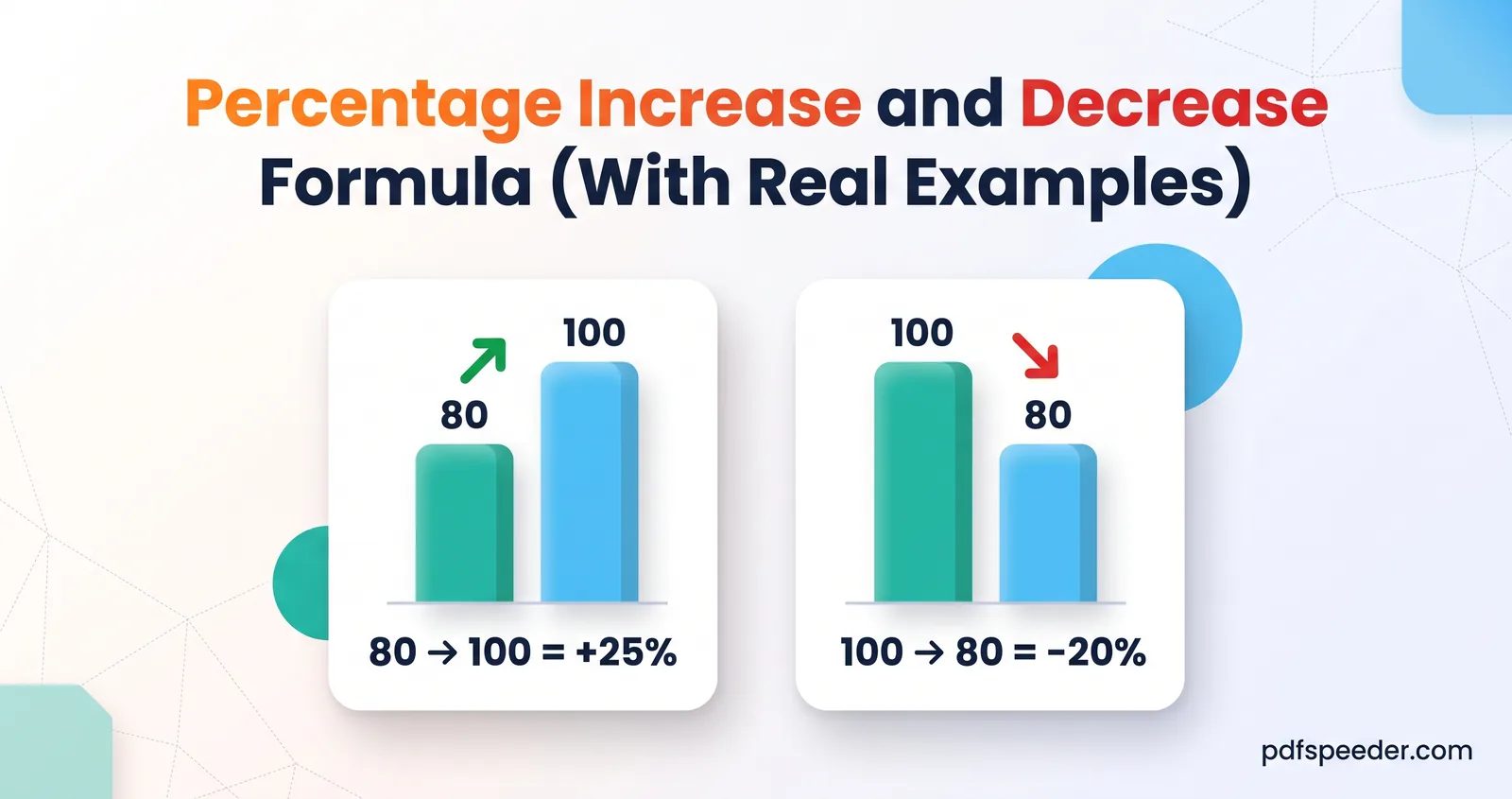
A close cousin is percentage change, where the old value is the whole: change = (new − old) ÷ old × 100. A salary that rises from ₹42,000 to ₹46,200 has gone up by 4,200 ÷ 42,000 × 100 = 10%. Two traps catch people here:
- Up then down isn't even. A price that rises 20% and then falls 20% ends lower: 100 becomes 120, then 96.
- Percentage points aren't percent. An interest rate going from 8% to 9% is a rise of 1 percentage point, but a 12.5% rise in the rate itself, because 1 ÷ 8 × 100 = 12.5.
Find the original number from a percentage
When you know a part and its percentage, divide to get the whole. If 30% of a number is 84, the number is 84 ÷ 0.30 = 280.
This is how you work back from a sale price. Say you paid ₹1,275 after 15% off. You paid 85% of the original price, because 100 − 15 = 85, so:
original price = 1,275 ÷ 0.85 = ₹1,500The tempting shortcut, adding 15% back on, gives 1,275 × 1.15 = ₹1,466.25, which is wrong. The 15% was taken from the original, bigger price, so it's worth more than 15% of the smaller one.
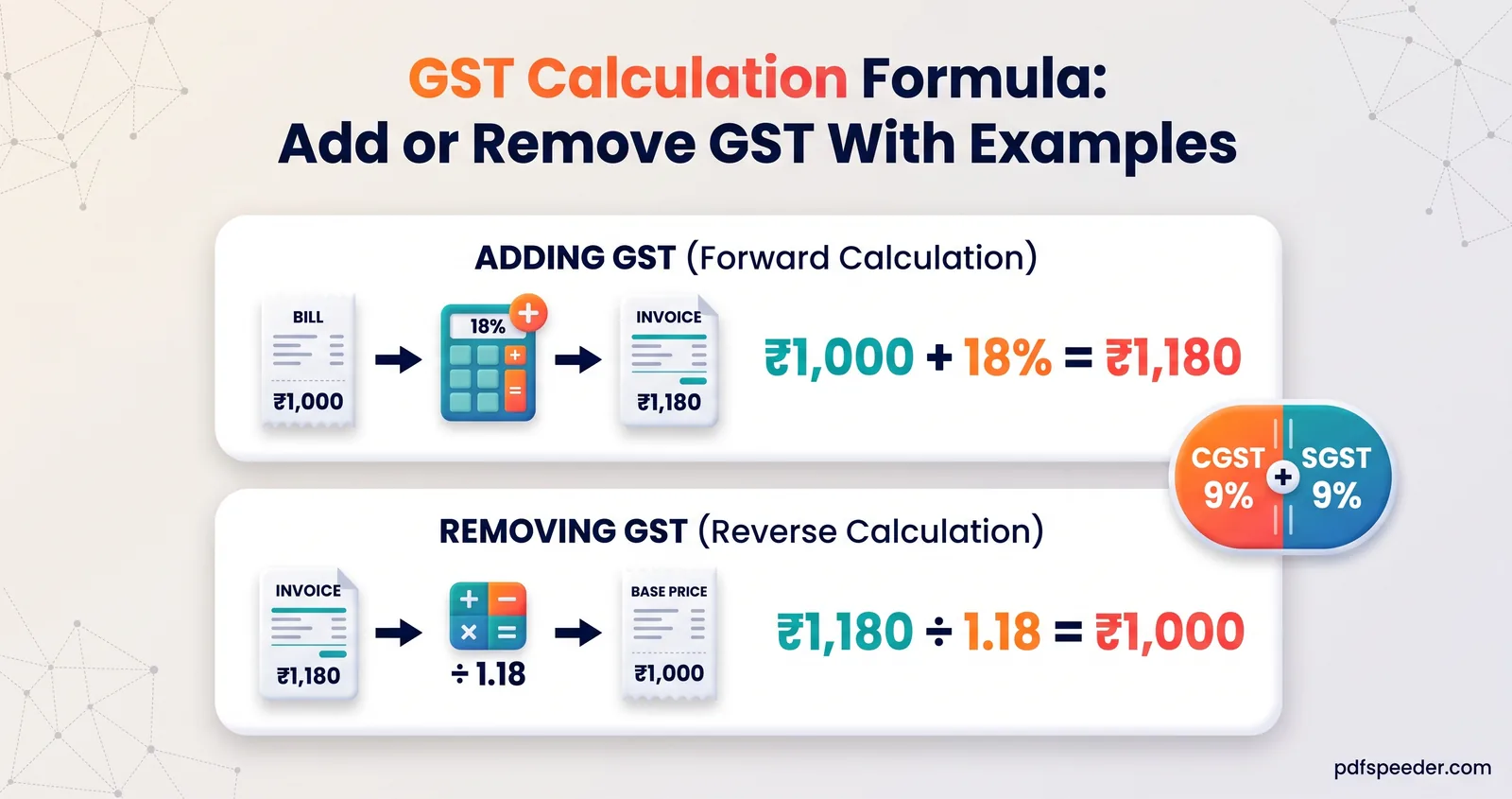
Prices that include tax work the same way: divide by 1 plus the rate, so a total that includes 18% GST is divided by 1.18. Our GST calculation formula guide has worked examples at 5% and 18%.
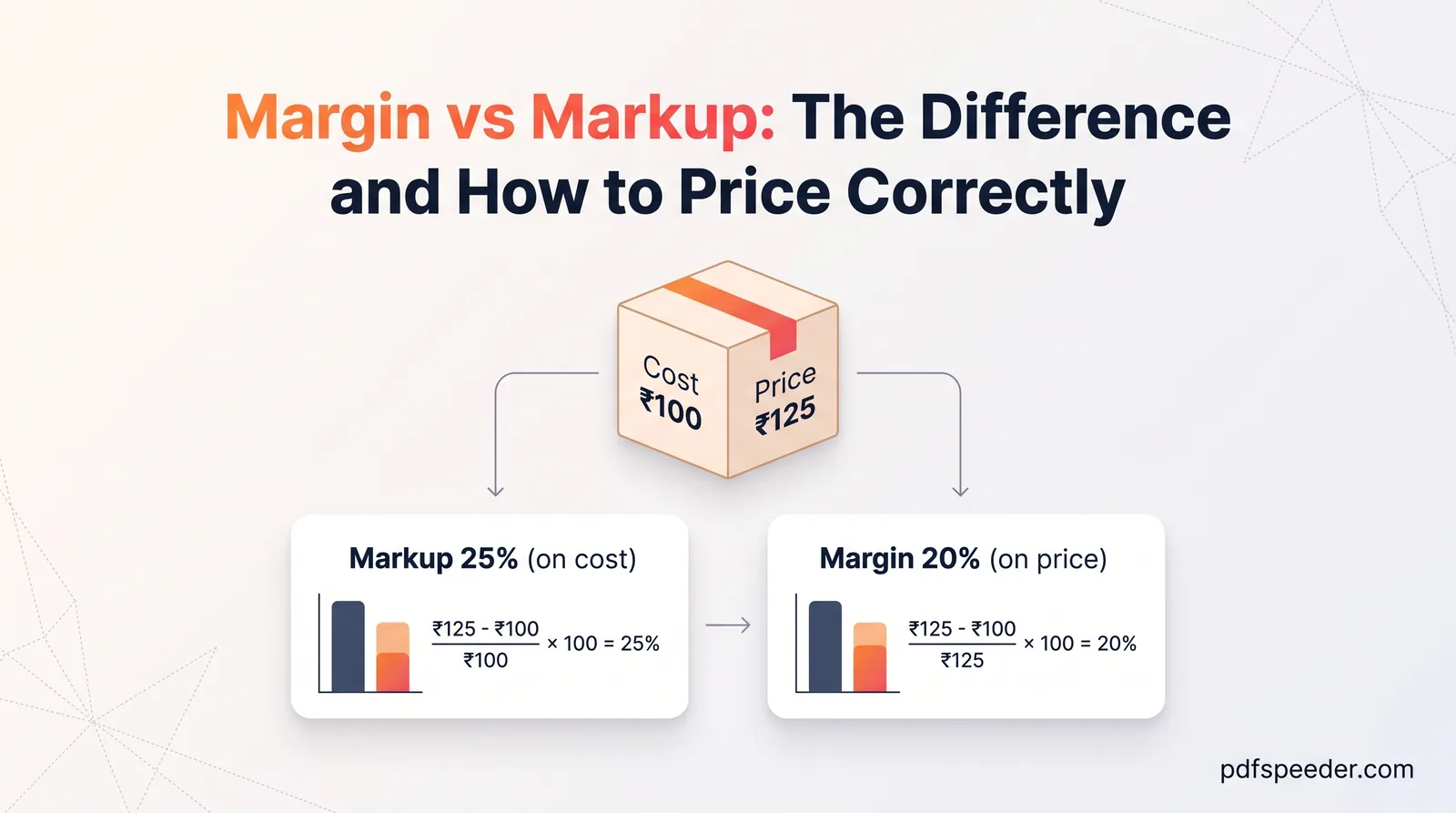
Discounts that stack follow the same logic. A 20% discount followed by another 10% takes ₹100 down to ₹80 and then ₹72, a total of 28% off, not 30%. Our Discount Calculator applies stacked coupons in order and can also work backwards from the price you paid. Profit margin is a percentage too, measured against the selling price rather than the cost, and our guide to margin vs markup shows why that difference matters when you set prices.
How to calculate percentage of marks, step by step
To calculate your percentage of marks, add up the marks you scored, add up the maximum marks, then divide and multiply by 100. For a single exam, 438 out of 500 is 438 ÷ 500 × 100 = 87.6%.
With several subjects, total everything before you divide:
| Subject | Marks scored | Maximum marks | Subject percentage |
|---|---|---|---|
| English | 78 | 100 | 78% |
| Mathematics | 85 | 100 | 85% |
| Physics (theory) | 64 | 80 | 80% |
| Lab work | 41 | 50 | 82% |
| Project | 23 | 30 | 76.67% |
| Total | 291 | 360 | 80.83% |
The overall percentage is 291 ÷ 360 × 100 = 80.83%. Averaging the five subject percentages instead gives 80.33%, which understates the result, because it treats the 30-mark project as if it counted as much as a 100-mark paper. When every subject has the same maximum, both methods agree.
Note: Boards and universities sometimes have their own rules, such as counting your best five subjects or converting a CGPA with a fixed factor. When a form asks for your percentage, use the method printed on your marksheet or in the form's instructions.
Mental maths shortcuts
You can get most percentages in your head by building them from 10% and 1%:
- 10%: move the decimal point one place left. 10% of 3,450 is 345.
- 1%: move it two places. 1% of 3,450 is 34.5.
- 5% is half of 10% (172.5), 15% is 10% plus 5% (517.5), 2% is double 1% (69), and 25% is a quarter (862.5).
For 17.5% of 1,280, add 10% (128), 5% (64) and 2.5% (32) to get 224.
Then there's the swap trick: X% of Y is always the same as Y% of X. So 8% of 50 equals 50% of 8, which is 4, and 16% of 25 equals 25% of 16, also 4. When one direction looks hard, try the other.
Some fractions turn up so often that their percentages are worth knowing by heart:
| Fraction | Percentage | Fraction | Percentage |
|---|---|---|---|
| 1/2 | 50% | 1/6 | 16.67% |
| 1/3 | 33.33% | 1/8 | 12.5% |
| 2/3 | 66.67% | 3/8 | 37.5% |
| 1/4 | 25% | 1/10 | 10% |
| 3/4 | 75% | 1/20 | 5% |
When you'd rather not do it by hand, our Percentage Calculator answers fourteen kinds of percentage question as you type, from marks and percentage change to discounts and tax, and shows the formula with your numbers in it. It runs in your browser, and you can choose how many decimal places to round to. Try it on your own numbers, then check one answer by hand with the formula above.
Frequently asked questions
What is the formula to calculate percentage?
Percentage = part ÷ whole × 100. For example, 45 out of 60 is 45 ÷ 60 × 100 = 75%.
How do I calculate the percentage of marks?
Add up the marks you scored and the maximum marks across all subjects, divide the first by the second and multiply by 100. For 291 out of 360, that's 80.83%.
How do I work out what percent X is of Y?
Divide X by Y and multiply by 100. So 35 is 25% of 140, because 35 ÷ 140 × 100 = 25.
How do I find a percentage of a number on a calculator?
Multiply the number by the percentage as a decimal, for example 2,450 × 0.18 = 441, or type 2450 × 18% on a calculator with a % key.
How do I calculate a percentage in Excel?
Divide the part by the whole, for example =B2/C2, and format the cell as a percentage with the % button on the Home tab. If you also multiply by 100, leave the cell as a plain number, or 75% will show as 7500%.