GST Calculation Formula: Add or Remove GST With Examples
The GST calculation formula both ways: add GST to a price or remove it from a total, with worked examples, the CGST and SGST split and invoice rounding tips.

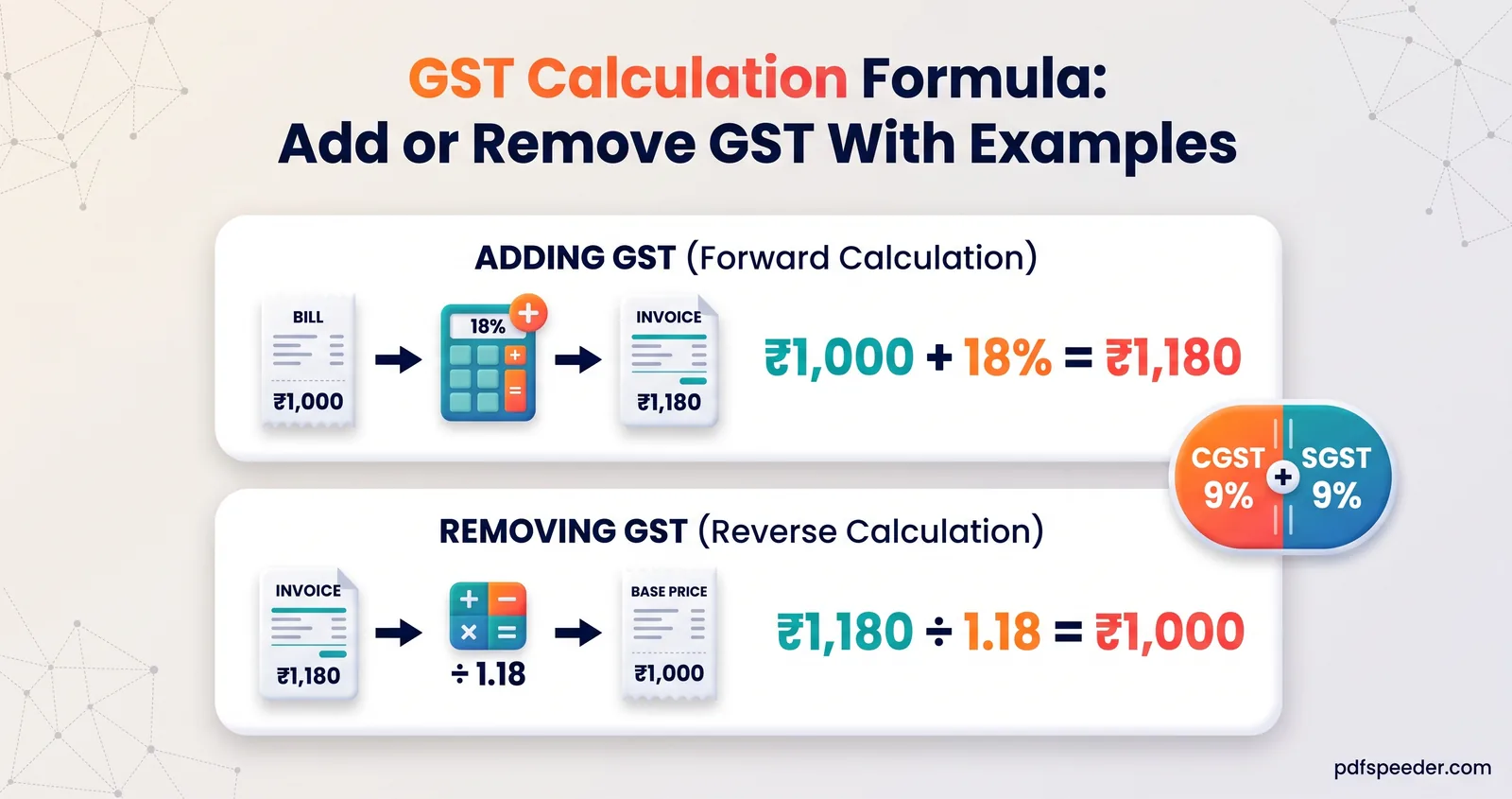
The GST calculation formula depends on which way you're going. To add GST to a price, GST = price × rate ÷ 100, so ₹1,000 at 18% carries ₹180 of GST and costs ₹1,180. To remove GST from a GST-inclusive total, GST = total × rate ÷ (100 + rate), so a ₹1,180 bill at 18% contains ₹180 of GST on a base price of ₹1,000. Below are worked examples at 5% and 18%, the CGST, SGST and IGST split, and how to round on an invoice.
On this page
The two GST calculation formulas
Adding GST (the price excludes GST)
GST amount        = Price × Rate ÷ 100
Total             = Price × (100 + Rate) ÷ 100

Removing GST (the total includes GST)
GST amount        = Total × Rate ÷ (100 + Rate)
Price before GST  = Total × 100 ÷ (100 + Rate)
The second pair is the GST inclusive price formula, and it trips people up because the divisor is 100 + rate, not 100. For the common rates, the shortcuts look like this:
| GST rate | To add GST, multiply by | To remove GST, divide by | GST's share of an inclusive total |
|---|---|---|---|
| 5% | 1.05 | 1.05 | 4.76% (5 ÷ 105) |
| 18% | 1.18 | 1.18 | 15.25% (18 ÷ 118) |
| 40% | 1.40 | 1.40 | 28.57% (40 ÷ 140) |
Which rate applies is set by notification for each item. Since 22 September 2025, most goods and services fall under a merit rate of 5% or a standard rate of 18%, with a special 40% rate for a select few, such as sweetened aerated drinks, larger cars and betting or casino services, according to the GST Council's announcement. Some items are exempt or Nil-rated. The rates in this article are examples: check the current rate for your item on CBIC's tax information portal before you price or invoice it.
How to calculate GST on a price
When your price doesn't include tax yet, it takes three steps:
- Start from the taxable value: the price after any discount shown on the invoice.
- Multiply it by the rate and divide by 100. That's the GST.
- Add the GST to the taxable value to get the total.
| Item | Taxable value | GST rate | GST | Total |
|---|---|---|---|---|
| Order A | ₹2,400 | 5% | ₹120.00 | ₹2,520.00 |
| Order B | ₹2,400 | 18% | ₹432.00 | ₹2,832.00 |
| 3 items at ₹849 | ₹2,547 | 18% | ₹458.46 | ₹3,005.46 |
Discounts deserve a moment. Under Section 15(3) of the CGST Act, a discount given before or at the time of supply and recorded on the invoice is left out of the value GST is charged on. So with a ₹200 discount on a ₹2,000 item, GST at 18% is due on ₹1,800: ₹324, for a total of ₹2,124. Charging GST on the full ₹2,000 and then knocking ₹200 off the bill would put ₹360 of tax on the invoice instead.
Our Discount Calculator does it in that order: enter the price and discounts, choose "Add tax on top of the discounted price" and type the rate. If you're setting your own prices, remember that GST sits on top of your profit, not inside it; our guide to margin vs markup shows how to price for a target margin before tax.
Removing GST from a GST-inclusive total
This is the reverse GST calculation, and you need it whenever a price already includes tax: a supplier's all-in quote, a restaurant bill, or a pack marked "inclusive of all taxes". To remove GST from a total of ₹1,770 at 18%:
Price before GST = 1,770 × 100 ÷ 118 = ₹1,500
GST amount       = 1,770 × 18 ÷ 118  = ₹270
At 5%, a ₹525 total splits into ₹500 plus ₹25 of GST.
The classic mistake is to take 18% of the inclusive total and subtract it. That treats ₹1,770 as if it were the price before tax:
| Total incl. 18% GST | Wrong: total − 18% of total | Right: total × 100 ÷ 118 | Error |
|---|---|---|---|
| ₹1,180 | ₹967.60 | ₹1,000.00 | ₹32.40 |
| ₹1,770 | ₹1,451.40 | ₹1,500.00 | ₹48.60 |
| ₹2,832 | ₹2,322.24 | ₹2,400.00 | ₹77.76 |
It's the same maths as finding an original number from a percentage, which our guide on how to calculate percentage covers with more examples. You can always check your answer by adding the GST back. ₹1,500 × 1.18 is ₹1,770, so that's right; ₹1,451.40 × 1.18 is only ₹1,712.65, so that's wrong. The mistake grows with the rate: at 40%, it would understate a ₹1,400 item's base price by ₹160.
CGST, SGST and IGST: how the split works
The rate you charge is the same wherever your customer is. What changes is how the tax is labelled and who collects it, according to CBIC's explainer on IGST:
- Within one state (intra-state supply): you charge CGST plus SGST, or UTGST in a Union Territory, each at half the rate. At 18% that's 9% + 9%.
- Between states (inter-state supply): you charge IGST at the full rate, which works out to CGST plus SGST combined.
For a CGST and SGST calculation, work each half out from the taxable value:
CGST = SGST = Taxable value × (Rate ÷ 2) ÷ 100
IGST = Taxable value × Rate ÷ 100| GST rate | CGST | SGST or UTGST | IGST |
|---|---|---|---|
| 5% | 2.5% | 2.5% | 5% |
| 18% | 9% | 9% | 18% |
| 40% | 20% | 20% | 40% |
So a ₹10,000 service at 18% carries ₹900 CGST and ₹900 SGST if the customer is in your state, or ₹1,800 IGST if they're in another. Either way, the customer pays ₹11,800.
Rounding and invoice tips
Small rounding choices can leave an invoice a few paise out, so it pays to be consistent:
- Calculate each line to the paisa. Three items at ₹99.90 with 18% GST give ₹17.98 per line, or ₹53.94 in total, while taxing the ₹299.70 subtotal in one go gives ₹53.95. Either can be defended; just use the same method on every invoice.
- Work CGST and SGST out separately. 9% of ₹299.70 is ₹26.97 for each half. Halving a rounded total of ₹53.95 leaves you with 26.975, which doesn't split cleanly.
- Don't apply one rate to a mixed bill. ₹1,200 of goods at 5% and ₹3,500 at 18% carry ₹60 + ₹630 = ₹690 of GST, not ₹846 at a flat 18%.
- Show any round-off on its own line. If you round the grand total to the nearest rupee, list the difference separately so the figures still add up.
When the tax itself is paid, the law rounds it. Section 170 of the CGST Act says tax and other sums payable are rounded to the nearest rupee: 50 paise or more goes up to the next rupee, and anything less is ignored.
Check it with a calculator
Our GST Calculator handles both directions, in rupees. Type the amount, pick 5%, 18% or 40%, or type any other rate (such as 3% for gold) in the Other rate box, and choose Add GST or Remove GST. It shows the GST amount, the net amount and the gross amount, and it runs in your browser.
It also splits the tax for you: CGST plus SGST for a sale within your state, or IGST for one to another state. Enter ₹10,000 at 18% with Add GST and it shows ₹900.00 + ₹900.00, or ₹1,800.00 as IGST, the same as the worked example above.
Note: This article is for information only and is not financial advice or tax advice. GST rates are set by notification and can change, so confirm the rate for your goods or service, and ask a tax professional about anything specific to your business.
For your next invoice, run the taxable value through the GST Calculator, then check the total by multiplying it back: if the numbers match, your invoice is right.
Frequently asked questions
What is the formula to calculate GST?
To add GST, multiply the price by the rate and divide by 100: ₹1,000 at 18% has ₹180 of GST. To remove GST from an inclusive total, multiply the total by the rate and divide by 100 plus the rate: ₹1,180 × 18 ÷ 118 = ₹180.
How do I remove 18% GST from a total?
Divide the total by 1.18 to get the price before GST, and subtract that from the total to get the GST. For ₹1,770, that's ₹1,500 plus ₹270 of GST.
Why is taking 18% off a GST-inclusive price wrong?
Because the 18% was charged on the smaller, pre-tax price, not on the total. Taking 18% of the total overstates the GST, so on a ₹1,770 bill you'd get ₹1,451.40 instead of the correct ₹1,500.
How is GST split into CGST and SGST?
For a sale within one state, the rate is split equally: 18% becomes 9% CGST plus 9% SGST, and 5% becomes 2.5% plus 2.5%. For a sale to another state, the full rate is charged as IGST.
Are the 12% and 28% GST slabs still used?
Largely not. From 22 September 2025, most items moved to 5% or 18% and a select few to 40%, although pan masala and tobacco products were kept at their earlier rates for a transition period, so check the rate for your specific item.