EMI Formula Explained: How to Calculate Your Loan EMI (With Examples)
The EMI calculation formula worked through step by step, how rate and tenure change your EMI and total interest, and what a prepayment really saves you.

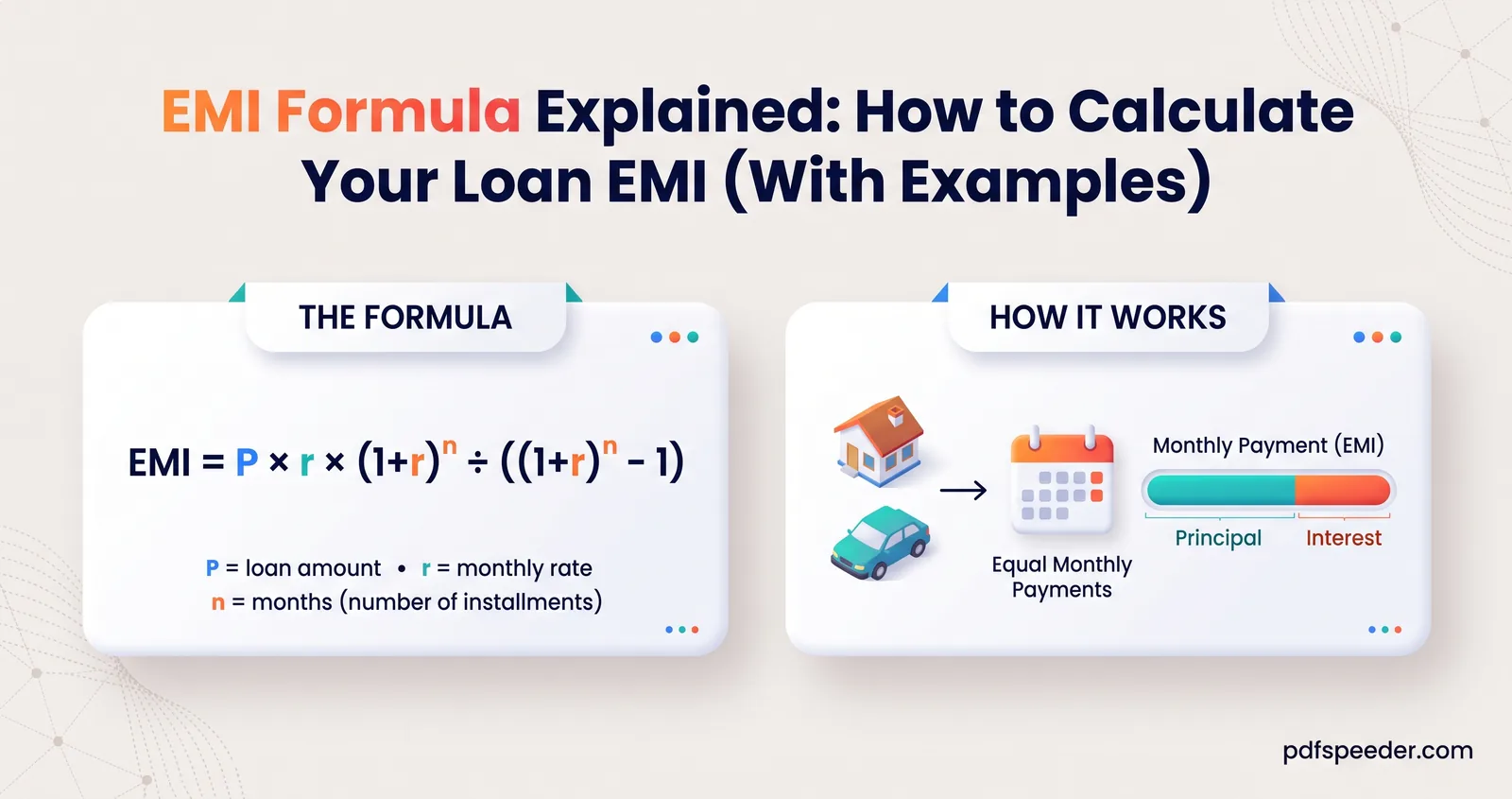
The EMI calculation formula is EMI = P × r × (1 + r)^n ÷ [(1 + r)^n − 1], where P is the loan amount, r is the monthly interest rate and n is the number of monthly instalments. For a ₹20 lakh loan at 8.5% a year over 20 years, it works out to ₹17,356 a month. Below, that example is worked through step by step, followed by tables that show how the rate, the tenure and a prepayment change what you pay.
On this page
The EMI calculation formula, term by term
EMI = P × r × (1 + r)^n ÷ [(1 + r)^n − 1]- P is the principal: the amount you borrow, after any down payment.
- r is the monthly interest rate: the annual rate divided by 12, then by 100. For 8.5% a year, r = 8.5 ÷ 12 ÷ 100 = 0.0070833.
- n is the number of monthly instalments: the tenure in years multiplied by 12. Twenty years is 240 EMIs.
The formula assumes a reducing balance. Each month you pay interest only on what you still owe, and the rest of the EMI pays the loan down. Home loans and most bank loans work this way; some car and consumer loans quote a flat rate instead, which is covered further down.
The most common mistake is plugging in the annual rate (8.5, or 0.085) instead of the monthly one. If your answer is wildly off, check r first.
Worked example: ₹20 lakh at 8.5% for 20 years
Here is the formula applied one step at a time, so you can follow along on any calculator:
- Monthly rate: r = 8.5 ÷ 12 ÷ 100 = 0.00708333
- Number of EMIs: n = 20 × 12 = 240
- Growth factor: (1 + r)^n = 1.00708333^240 = 5.441243
- Top of the fraction: P × r × (1 + r)^n = 20,00,000 × 0.00708333 × 5.441243 = 77,084.27
- Bottom of the fraction: (1 + r)^n − 1 = 4.441243
- EMI = 77,084.27 ÷ 4.441243 = ₹17,356.46
Over 240 months you repay ₹41,65,552 in total, so the interest comes to ₹21,65,552. That's 108% of the amount you borrowed, which is the best argument for reading the tables below before you pick a tenure.
Tip: At 8.5% over 20 years, every ₹1 lakh you borrow costs ₹867.82 a month. Multiply that by the number of lakhs for a quick estimate of any loan size at the same rate and tenure.
You can check this in seconds with our EMI Calculator. It opens at ₹20 lakh and 8.5%, so you only need to move the tenure slider to 20 years. It shows the same EMI, total interest and total payable, plus a year-by-year schedule, and it runs entirely in your browser.
How to calculate EMI in Excel or Google Sheets
Spreadsheets have the formula built in as PMT:
=PMT(8.5%/12, 20*12, -2000000)The three arguments are the monthly rate, the number of payments and the loan amount, and the result is 17,356.46. The minus sign is there because PMT treats money you pay out as negative; leave it off and you get −17,356.46. Put the amount, rate and years in their own cells and point PMT at them, and you have a reusable loan EMI calculation for comparing offers.
How tenure changes your EMI and total interest
Here is the same ₹20 lakh loan at 8.5% over different tenures:
| Tenure | Monthly EMI | Total interest | Total paid |
|---|---|---|---|
| 10 years | ₹24,797 | ₹9,75,657 | ₹29,75,657 |
| 15 years | ₹19,695 | ₹15,45,062 | ₹35,45,062 |
| 20 years | ₹17,356 | ₹21,65,552 | ₹41,65,552 |
| 25 years | ₹16,105 | ₹28,31,363 | ₹48,31,363 |
| 30 years | ₹15,378 | ₹35,36,177 | ₹55,36,177 |
Stretching the loan from 20 to 30 years lowers the EMI by ₹1,978 a month but adds ₹13,70,625 of interest. Going the other way, from 20 years to 15, raises the EMI by ₹2,339 and saves ₹6,20,490. A longer tenure makes each EMI easier to carry, but you pay for that comfort every month for an extra decade.
How the interest rate changes your EMI
Now keep the tenure at 20 years and change only the rate:
| Interest rate | Monthly EMI | Total interest over 20 years |
|---|---|---|
| 7.5% | ₹16,112 | ₹18,66,847 |
| 8.0% | ₹16,729 | ₹20,14,912 |
| 8.5% | ₹17,356 | ₹21,65,552 |
| 9.0% | ₹17,995 | ₹23,18,685 |
| 9.5% | ₹18,643 | ₹24,74,230 |
| 10.0% | ₹19,300 | ₹26,32,104 |
On this loan, each half a percentage point adds roughly ₹620 to ₹660 to the EMI and about ₹1.5 lakh to ₹1.6 lakh to the total interest. A small gap between two lenders' rates is worth negotiating, and if your home loan EMI is on a floating rate, it's worth checking what a reset would do to it.
Where each EMI goes: a short amortisation schedule
Your EMI stays the same, but what it pays for changes every month. Interest is charged on the balance you still owe, so the early EMIs are mostly interest:
| Month | Opening balance | Interest | Principal | Closing balance |
|---|---|---|---|---|
| 1 | ₹20,00,000 | ₹14,167 | ₹3,190 | ₹19,96,810 |
| 2 | ₹19,96,810 | ₹14,144 | ₹3,212 | ₹19,93,598 |
| 3 | ₹19,93,598 | ₹14,121 | ₹3,235 | ₹19,90,363 |
Month 1's interest is simply 20,00,000 × 0.0070833 = ₹14,167, and the other ₹3,190 of the EMI reduces the loan. Across the whole first year you pay ₹1,68,473 in interest and only ₹39,805 towards the principal, so about 81% of your first year's EMIs goes on interest. The principal part only overtakes the interest part in month 143, during the 12th year. After 10 years you still owe ₹13,99,876, about 70% of the original loan.
All figures are rounded to the nearest rupee and use the unrounded EMI, as the calculator does. Your lender may round the EMI itself, which moves the totals by a few rupees.
What a prepayment does to your EMI and interest
Suppose you pay an extra ₹2,00,000 straight after your 36th EMI. By then you've repaid ₹1,30,280 of principal (and ₹4,94,553 of interest), so you owe ₹18,69,720, and the prepayment brings that down to ₹16,69,720. Depending on your lender, the loan then either ends sooner or the EMI drops:
| Option | Monthly EMI | EMIs left | Total interest over the loan | Interest saved |
|---|---|---|---|---|
| No prepayment | ₹17,356 | 204 | ₹21,65,552 | None |
| Keep the EMI, shorten the tenure | ₹17,356 | 163 | ₹16,37,696 | ₹5,27,855 |
| Keep the tenure, lower the EMI | ₹15,500 | 204 | ₹19,86,808 | ₹1,78,743 |
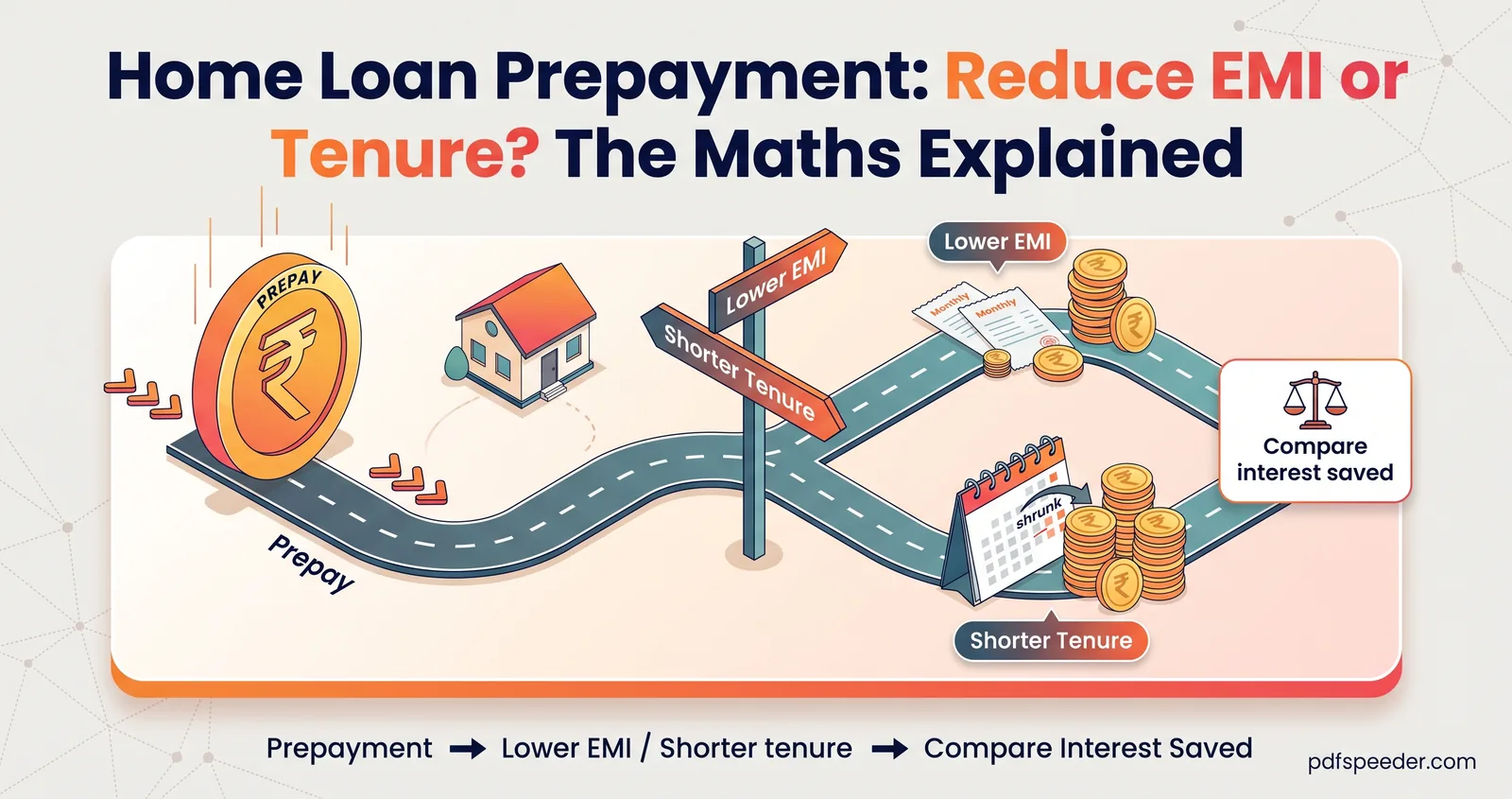
Keeping the EMI and shortening the tenure saves about three times as much interest, because the full ₹17,356 keeps working on a smaller balance and the loan ends 41 months early. A lower EMI still saves money if your monthly budget needs the room; it just saves less. Before you prepay, check your loan agreement for any prepayment charges. Our guide to home loan prepayment: reduce EMI or tenure? takes both options further, including whether to prepay at all or invest the money instead.
Flat rate vs reducing balance: why the formula matters
Some car, two-wheeler and consumer loans quote a flat rate, where interest is charged on the full original amount for the whole tenure, however much you've repaid. The EMI looks similar, but the cost isn't:
- 10% flat on ₹5,00,000 for 3 years: interest = 5,00,000 × 10% × 3 = ₹1,50,000, so the EMI is (5,00,000 + 1,50,000) ÷ 36 = ₹18,056.
- 10% reducing balance on the same loan: the EMI formula gives ₹16,134, and total interest of ₹80,809.
Expressed as a reducing balance EMI rate, that flat 10% really costs about 17.9% a year. Whenever a lender quotes a rate, ask whether it's flat or reducing, and compare offers with our Flat vs Reducing Rate Calculator. The article on flat vs reducing interest rates shows how to convert any flat rate to its reducing equivalent.
Why your bank's EMI may not match exactly
The formula is the same everywhere, but a few practical details can make your lender's figure differ from yours:
- Rounding. Lenders round the EMI to the rupee, so the totals can differ by a few rupees.
- The first instalment. If your first EMI date isn't exactly a month after the loan is paid out, interest for the extra days is added to the first EMI or charged separately as pre-EMI interest.
- A bigger principal than you expected. Processing fees or an insurance premium added to the loan increase P, and with it the EMI.
- Floating rates. When the rate changes, the lender recalculates the EMI or the remaining tenure, using this same formula on the balance left.
Note: This article is for information only and is not financial advice. Your loan agreement and your lender's repayment schedule are the final word on what you owe.
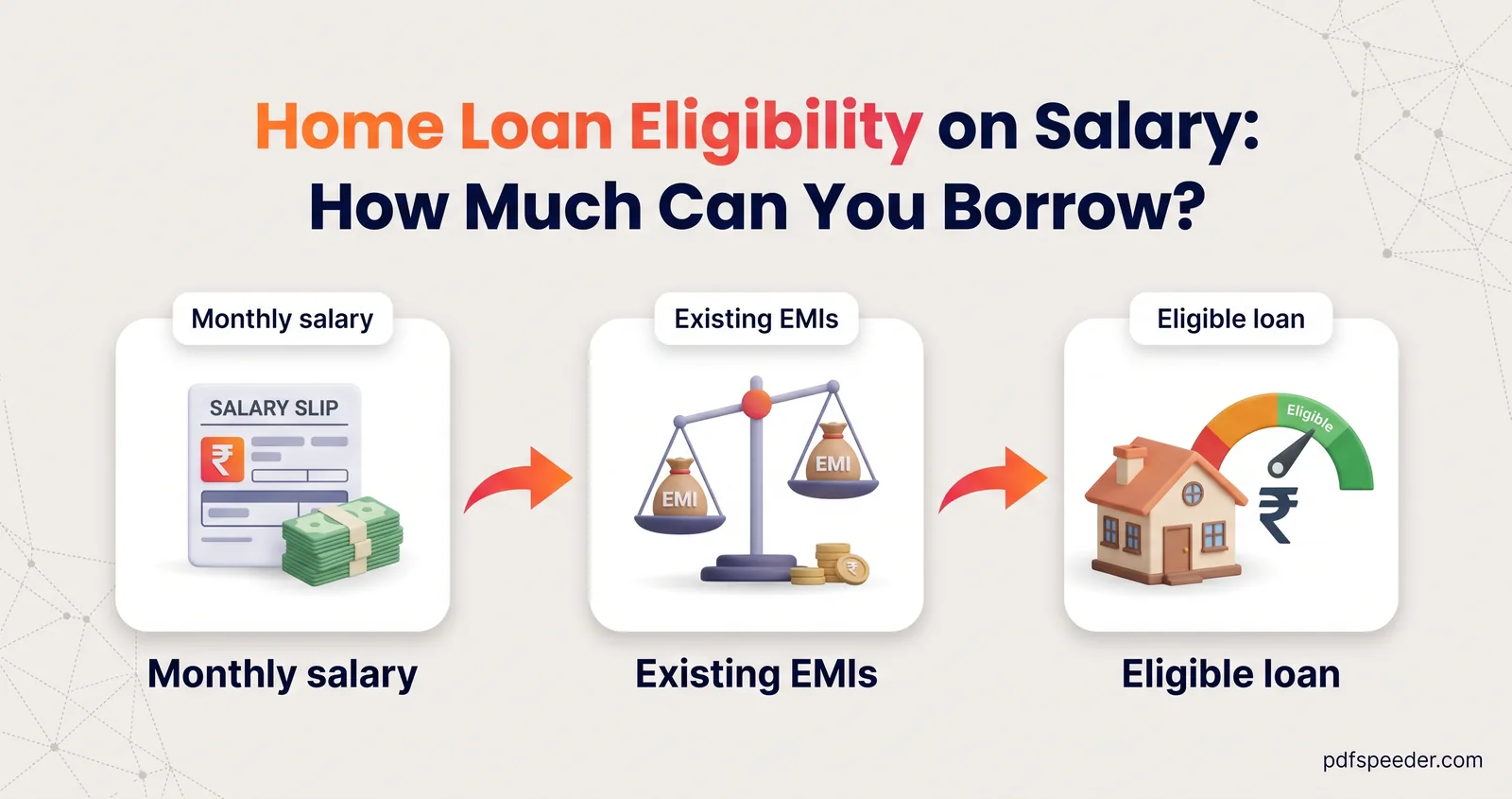
Now run your own numbers: try your real loan amount and two or three tenures in the EMI Calculator, then see how much you could borrow on your income with the Loan Eligibility Calculator. How banks work that out is explained in home loan eligibility on salary.
Frequently asked questions
What is the formula to calculate EMI?
EMI = P × r × (1 + r)^n ÷ [(1 + r)^n − 1], where P is the loan amount, r is the annual rate ÷ 12 ÷ 100 and n is the number of monthly instalments. In Excel or Google Sheets, =PMT(rate/12, months, −amount) gives the same result.
Is the EMI formula the same for home, car and personal loans?
Yes, for any loan calculated on a reducing balance, which covers home loans and most bank loans. A loan quoted at a flat rate works differently and costs more than the same headline rate on a reducing balance.
Does a longer tenure always mean more interest?
Yes. At the same rate, every extra year adds interest: on ₹20 lakh at 8.5%, a 30-year loan costs ₹35,36,177 in interest, against ₹21,65,552 over 20 years.
Is it better to reduce the EMI or the tenure after a prepayment?
Reducing the tenure saves more interest. In the example above it saves ₹5,27,855, against ₹1,78,743 for a lower EMI, so choose the lower EMI only if you need the room in your monthly budget.
Why is my first EMI different from the rest?
Interest is charged for the actual days between the loan being paid out and your first EMI date. If that gap is longer or shorter than a month, the first instalment changes, or the extra interest is billed separately as pre-EMI interest.