Flat vs Reducing Interest Rate: Why 8% Flat Isn't 8%
Flat vs reducing interest rate on one ₹5 lakh loan: 8% flat costs ₹1.2 lakh in interest, the same as 14.55% reducing. Convert any rate and compare offers.

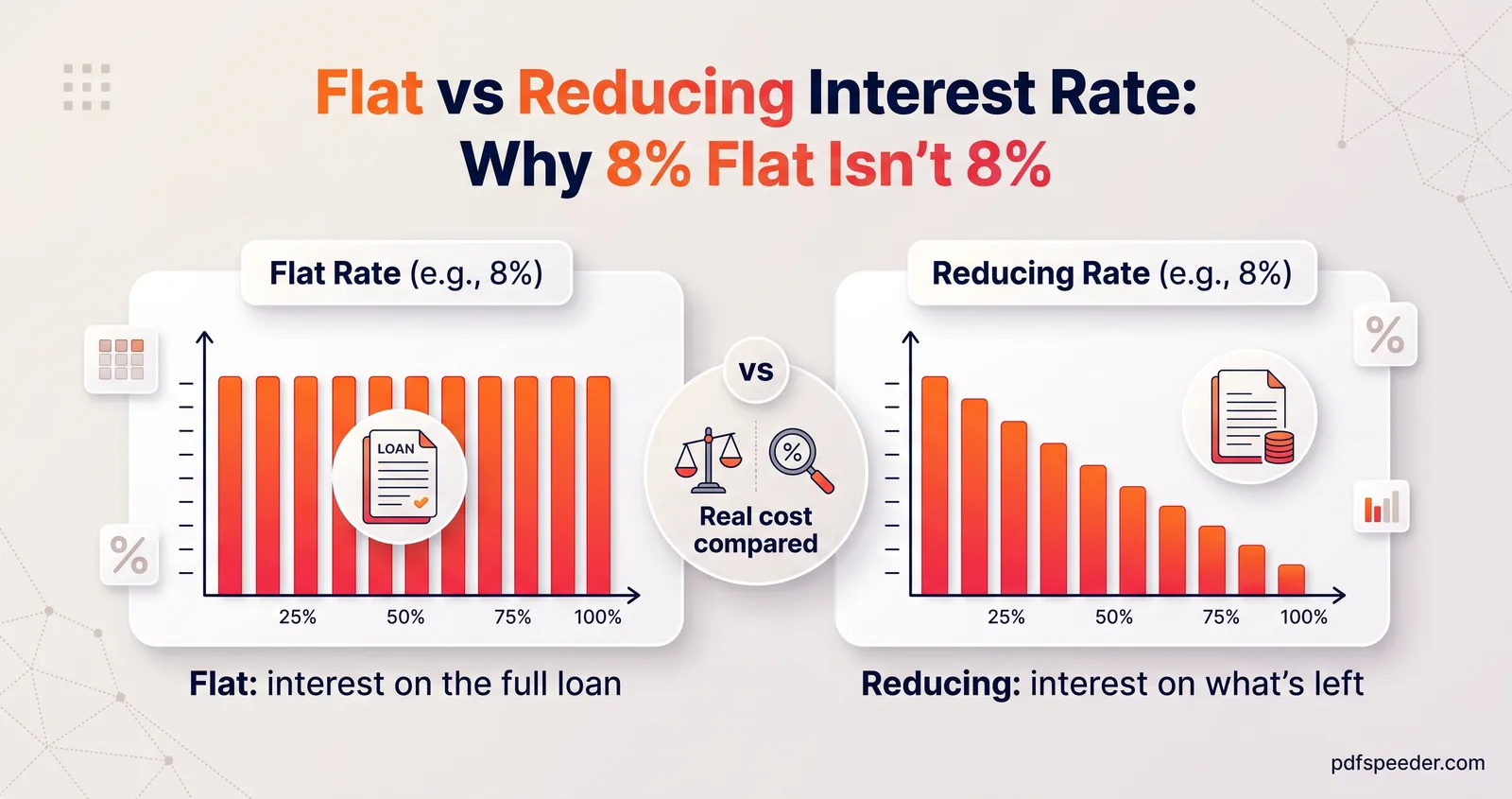
The difference between a flat vs reducing interest rate is what the rate is charged on: a flat rate applies to the full loan amount for the whole tenure, while a reducing rate applies only to what you still owe each month. So the same headline number costs far more when it's flat. A ₹5 lakh loan over 3 years at 8% flat costs ₹1,20,000 in interest, against ₹64,055 at 8% reducing, and that 8% flat is really a 14.55% reducing-balance rate.
On this page
Flat vs reducing interest rate in one minute
Here are the two methods side by side, for a loan amount P over n months:
Flat rate:       Interest = P × annual rate × years
                 EMI      = (P + interest) ÷ n

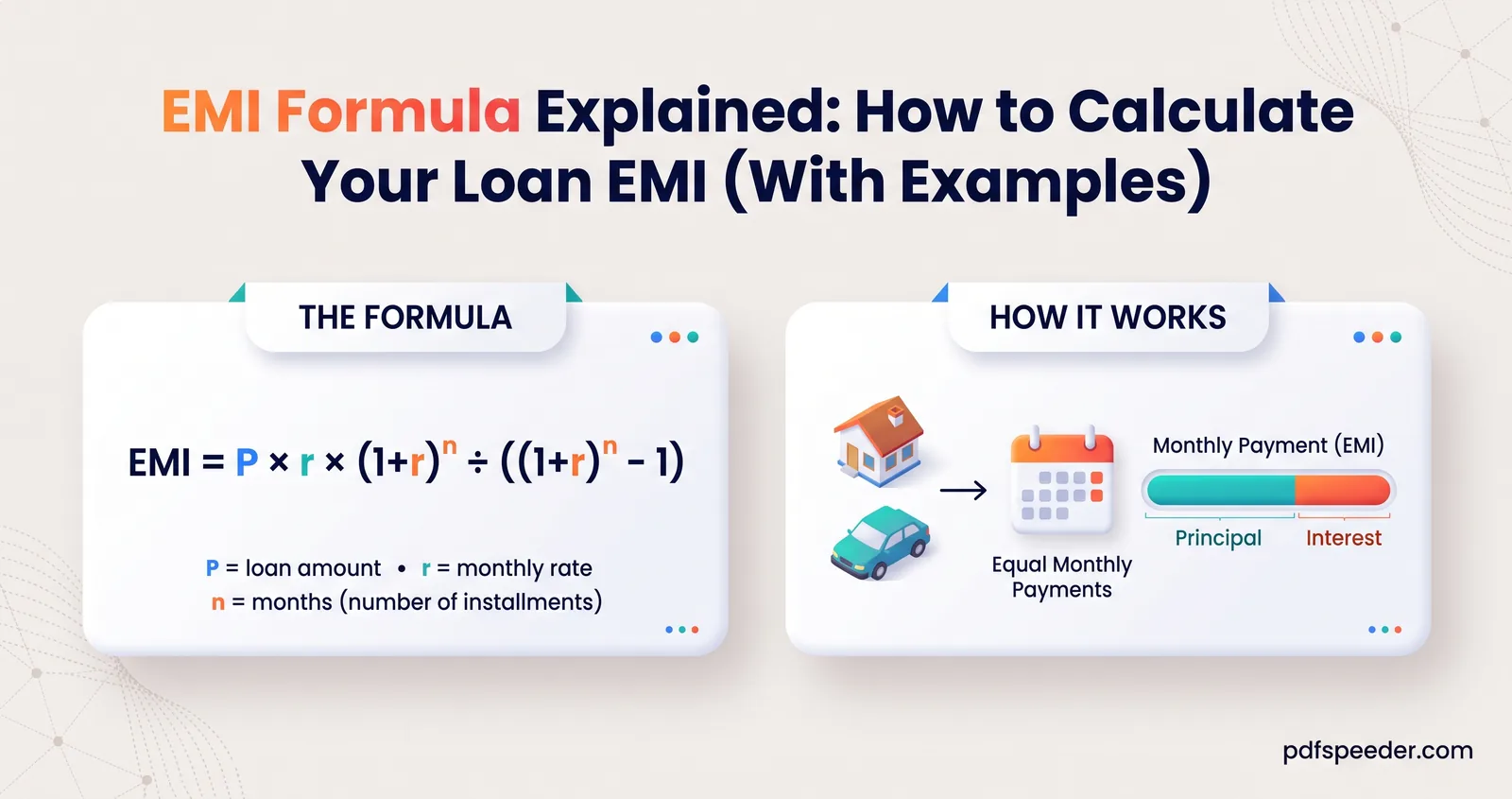
Reducing rate:   EMI      = P × r × (1 + r)^n ÷ [(1 + r)^n − 1],  where r = annual rate ÷ 12 ÷ 100
                 Interest for a month = balance still owed × r
That's the flat interest rate meaning in plain terms: you keep paying interest on money you've already repaid. With a reducing balance, every EMI shrinks the balance, so next month's interest is a little smaller and more of the EMI goes to the loan itself.
Home loans and most bank loans use the reducing method. Our guide to the EMI calculation formula works through the reducing balance EMI step by step.
Same loan, both methods: a worked example
Take ₹5,00,000 over 3 years (36 EMIs) at 8%, first as a flat rate:
- Interest: 5,00,000 × 8% × 3 = ₹1,20,000
- Total to repay: 5,00,000 + 1,20,000 = ₹6,20,000
- EMI: 6,20,000 ÷ 36 = ₹17,222
Now at 8% on a reducing balance, the EMI formula gives ₹15,668. Over 36 months you repay ₹5,64,055, so the interest is ₹64,055.
| ₹5 lakh over 3 years | 8% flat | 8% reducing |
|---|---|---|
| Monthly EMI | ₹17,222 | ₹15,668 |
| Total interest | ₹1,20,000 | ₹64,055 |
| Total repaid | ₹6,20,000 | ₹5,64,055 |
| Interest in month 1 | ₹3,333 | ₹3,333 |
| Interest in month 24 | ₹3,333 | ₹1,297 |
| Interest in month 36 | ₹3,333 | ₹104 |
The flat column splits each EMI the simplest way, ₹13,889 of principal and ₹3,333 of interest every month. Both loans charge the same ₹3,333 in month 1, when you owe the full ₹5 lakh. By month 36, the reducing loan charges ₹104 on a tiny balance, while the flat loan still charges ₹3,333 on the last ₹13,889 you owe: 24% in a single month.
Our Flat vs Reducing Rate Calculator shows this comparison for any loan. It opens with ₹10,00,000 at 10% over 5 years, in rupees in India (elsewhere, switch the currency to INR). Set ₹5,00,000, 8% and 3 years: it shows both EMIs, both totals and the ₹55,945 difference, and it runs in your browser. It compares the two methods at the same headline rate; it doesn't convert a flat rate into its reducing equivalent, so use the method below for that.
Converting a flat rate to its reducing equivalent
To convert a flat rate to a reducing rate, find the reducing rate that produces the same EMI on the same loan. There's no neat formula for that, so solve it numerically. A spreadsheet's RATE function does it in one line:
=RATE(36, -17222.22, 500000) * 12      returns 0.1455, or 14.55% a year
=EFFECT(14.55%, 12)                    returns 0.1556, the effective annual rate
RATE takes the number of EMIs, the EMI as a negative number and the loan amount, and returns the monthly rate; multiplying by 12 gives the annual reducing rate a bank would quote. Check it the other way: an EMI at 14.55% reducing on ₹5 lakh over 36 months comes to ₹17,223, within a rupee of the flat EMI because the rate is rounded.
Here's what 8% flat works out to over different tenures, on any loan amount:
| Tenure at 8% flat | Equivalent reducing rate | Multiple of the flat rate |
|---|---|---|
| 1 year | 14.45% | 1.81 |
| 2 years | 14.68% | 1.84 |
| 3 years | 14.55% | 1.82 |
| 5 years | 14.13% | 1.77 |
| 7 years | 13.69% | 1.71 |
And here are common flat rates over 3 years:
| Flat rate, 3 years | Equivalent reducing rate | Multiple |
|---|---|---|
| 6% | 11.08% | 1.85 |
| 7% | 12.83% | 1.83 |
| 8% | 14.55% | 1.82 |
| 10% | 17.92% | 1.79 |
| 12% | 21.20% | 1.77 |
Why roughly double? In a reducing loan, your average balance over the tenure is only about half the original amount (53% in this example), while a flat rate charges interest on all of it. The often-quoted shortcut of "flat rate × 1.85" is close for short, low-rate loans, but it drifts to 1.71 at 8% over 7 years, so solve the rate properly before you compare close offers.
Where you'll still see flat rates
Flat rates are often quoted for two-wheeler and used-car finance arranged at the dealer, consumer-durable loans at the shop counter, and some personal and small-business loans. Two extras can push the true cost higher still:
- Advance EMIs. If the lender collects two EMIs upfront, you effectively borrow less but still make 36 payments. On the 8% flat example, the equivalent reducing rate rises from 14.55% to 16.45%.
- Processing fees. A 2% fee comes out of the money you receive. It lifts an 8% reducing loan to about 9.38% a year, and the 8% flat loan to about 15.98%.
The good news is that lenders now have to show you the real figure. Under the RBI's Key Facts Statement directions of 15 April 2024, banks, co-operative banks and NBFCs must give you a Key Facts Statement for every retail and MSME term loan sanctioned from 1 October 2024. It includes the annual percentage rate (APR), "the annual cost of credit to the borrower which includes interest rate and all other charges associated with the credit facility", with a computation sheet and a repayment schedule, and fees not listed in it can't be charged without your explicit consent. Credit cards are exempt.
How to compare loan offers fairly
With the KFS in hand, comparing a car loan flat rate with a bank's reducing rate takes five checks:
- Ask which method the rate uses. If it's flat, convert it with RATE or the tables above.
- Compare APRs, not headline rates. The APR on each Key Facts Statement already includes fees and third-party charges such as insurance.
- Keep the amount and tenure identical. Then the EMI and the total repaid are directly comparable.
- Count everything paid upfront. Processing fees, bundled insurance and advance EMIs all raise the true rate.
- Read the early-closure terms. On a flat-rate loan, ask how interest is split if you close early; some lenders assign more of it to the early months, so prepaying can save less than you'd expect.
Here's how an 8% flat offer stacks up against two reducing-rate offers on the same ₹5 lakh over 3 years:
| Offer | Monthly EMI | Total interest |
|---|---|---|
| 8% flat | ₹17,222 | ₹1,20,000 |
| 14% reducing | ₹17,089 | ₹1,15,197 |
| 15% reducing | ₹17,333 | ₹1,23,976 |
The "8%" loan costs more than a 14% reducing-balance loan. To run reducing-rate offers yourself, the EMI Calculator opens in rupees and covers loans from ₹1 lakh, and the Car Loan EMI Calculator handles 1 to 7-year car loans and opens in rupees in India. Both work on a reducing balance, so enter the equivalent rate, not the flat one. If you'd rather pay off an existing loan early, our guide to prepaying a loan: reduce EMI or tenure shows what each choice saves.
Note: This article is for information only and is not financial advice. The rates are examples; the Key Facts Statement and loan agreement from your lender are what count.
Next step: before you sign, ask each lender for its Key Facts Statement, line up the APRs, and convert any flat rate with =RATE(months, −EMI, loan) × 12.
Frequently asked questions
What is the difference between flat and reducing interest rates?
A flat rate charges interest on the original loan amount for the whole tenure. A reducing rate charges interest only on the balance still owed, so the interest falls as you repay.
How do I convert a flat rate to a reducing rate?
Work out the flat-rate EMI, then find the reducing rate that gives the same EMI, for example with =RATE(months, −EMI, loan amount) × 12 in Excel or Google Sheets. At 8% flat over 3 years, that's 14.55%.
Is 8% flat a cheap rate?
Not necessarily. Over 3 years it costs the same as a 14.55% reducing-balance loan, so it's dearer than a 14% reducing offer on the same amount.
Why do some car loans quote a flat rate?
A flat rate is easy to work out and looks lower than the equivalent reducing rate. Since October 2024, lenders regulated by the RBI must also show the APR in a Key Facts Statement, which makes fair comparison easier.
Is a reducing balance EMI always lower than a flat-rate EMI?
At the same headline rate, yes, because interest is charged on a shrinking balance. Compare the equivalent rates or APRs, though, because a flat offer with a much lower headline can still beat a reducing one with a higher headline.