Gratuity Calculation Formula With Examples (and What Changed)
The gratuity calculation formula, 15/26 of last wages for each year, worked through with examples, plus what the 2025 labour codes changed and the tax rules.

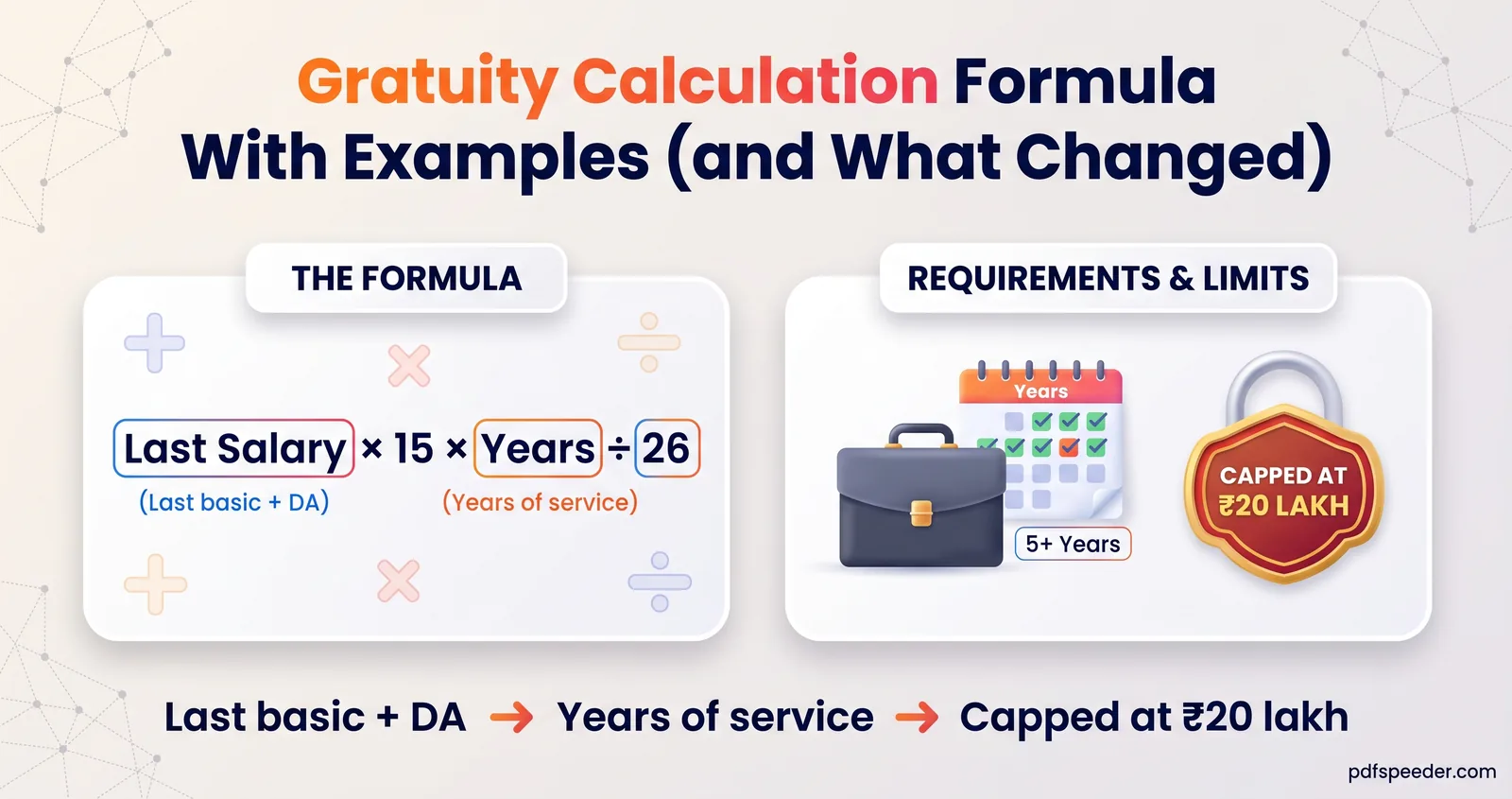
The gratuity calculation formula is gratuity = last drawn monthly wages × 15 ÷ 26 × years of service, where wages means basic pay plus dearness allowance (DA), and a final part-year of more than six months counts as a full year. Ten years on ₹50,000 a month works out to ₹2,88,462. Since 21 November 2025, the Code on Social Security, 2020 has replaced the Payment of Gratuity Act, 1972; it changed who qualifies and what counts as wages, but not the formula itself.
On this page
The gratuity calculation formula
Gratuity = last drawn monthly wages × 15 ÷ 26 × years of service- Last drawn monthly wages are your basic pay plus DA (and retaining allowance, if you get one) in your final month, not your CTC or gross salary.
- 15 is fifteen days' wages for every year you've worked.
- 26 treats a month as 26 working days, so fifteen days' wages are 15/26 of a month's pay, about 57.7%.
- Years of service are your completed years, plus one more if the final part-year runs past six months.
The labour ministry's FAQs on the labour codes set this out: 15 days' wages "based on the rate of wages last drawn" for every completed year of service or part of a year over six months, up to a maximum that the government notifies, currently ₹20 lakh. If your contract, an agreement or an award promises more generous gratuity, those better terms still apply.
Worked example: 10 years at ₹50,000 basic + DA
Say your basic pay plus DA was ₹50,000 in your last month, and you leave after exactly 10 years. Here's how to calculate gratuity step by step:
- Fifteen days' wages: 50,000 × 15 ÷ 26 = ₹28,846.15, the gratuity you earn for each year of service.
- Multiply by the years: 28,846.15 × 10 = ₹2,88,461.54.
- Round to the rupee: ₹2,88,462.
The 15/26 is the whole trick behind the "gratuity formula 15/26" you'll see quoted. Because it's applied to your last wages, every raise lifts the gratuity for all your earlier years too.
Here's what the formula gives for some common wage levels:
| Last drawn basic + DA | 5 years | 10 years | 20 years | 30 years |
|---|---|---|---|---|
| ₹30,000 | ₹86,538 | ₹1,73,077 | ₹3,46,154 | ₹5,19,231 |
| ₹50,000 | ₹1,44,231 | ₹2,88,462 | ₹5,76,923 | ₹8,65,385 |
| ₹1,00,000 | ₹2,88,462 | ₹5,76,923 | ₹11,53,846 | ₹17,30,769 |
| ₹1,50,000 | ₹4,32,692 | ₹8,65,385 | ₹17,30,769 | ₹20,00,000 (formula: ₹25,96,154) |
The ₹20 lakh ceiling only bites at the top end: after 30 years, it caps anyone whose last wages were above ₹1,15,556 a month.
You can check the 10-year example with our Gratuity Calculator. It opens in rupees at a salary of ₹50,000 and 10 years of service, so just keep "covered under the Gratuity Act" on Yes. It shows ₹2,88,461, because it rounds down, plus a year-by-year table, and it runs in your browser. It takes whole years only, so round your service yourself, and it caps the result at the ₹20 lakh ceiling, with a note giving the uncapped formula figure.
How years of service are counted
Only the final part-year matters, and it counts as a full year only if it's more than six months. On ₹50,000 a month:
| Service | Years counted | Gratuity |
|---|---|---|
| 10 years 5 months | 10 | ₹2,88,462 |
| 10 years 6 months | 10 | ₹2,88,462 |
| 10 years 7 months | 11 | ₹3,17,308 |
If you're close to the line, a few extra weeks of service can be worth a full year's gratuity, ₹28,846 here.
The rounding is part of the calculation, not the eligibility test. The gratuity eligibility rule for a permanent employee is five years of continuous service, except when employment ends through death or disablement, where no minimum applies. You may read that 4 years and 240 days is enough; that comes from court rulings on how continuous service is counted, and employers don't all apply it, so check with HR before you plan around it.
If your employer isn't covered
The gratuity law covers every factory, mine, oilfield, plantation, port and railway company, and every shop or other establishment with ten or more employees. A small shop or office outside it doesn't have to pay gratuity, though many do under their own policy or your contract, and then the contract decides the amount.
For tax, gratuity from an employer outside the law is measured differently: half a month's average salary for each completed year, with no rounding up, where the average covers the ten months before you leave:
Tax formula (not covered) = ½ × average monthly salary of the last 10 months × completed yearsTake 10 years 7 months of service, with ₹45,000 a month until a raise to ₹50,000 three months before you leave. The ten-month average is (7 × 45,000 + 3 × 50,000) ÷ 10 = ₹46,500, so the formula gives ½ × 46,500 × 10 = ₹2,32,500. A covered employer would owe ₹3,17,308 for the same service, because of 15/26 instead of ½, the last wages instead of an average, and the rounding up.
Choosing "No" in the Gratuity Calculator applies 15/30, which is the same half-month figure but uses your last salary rather than the ten-month average: ₹2,50,000 here. Use the average for an exact tax figure.
What the new labour codes change
The four labour codes took effect on 21 November 2025, and the Code on Social Security, 2020 absorbed the Payment of Gratuity Act, 1972, according to the PIB backgrounder on the reforms. The 15/26 formula and the ₹20 lakh ceiling carried over. Two things changed.
Gratuity for fixed-term employees
Fixed-term employees now become eligible for gratuity after one year of continuous service, where permanent staff still need five, and the labour ministry's FAQs say it's paid on a pro rata basis. If pro rata means the same 15 days' wages for each year served, a two-year contract at ₹40,000 a month would earn 40,000 × 15 ÷ 26 × 2 = ₹46,154. Check your contract and HR's method, because the detailed rules decide the exact figure.
A wider definition of wages
Wages now means basic pay, DA and retaining allowance, but if your other allowances add up to more than 50% of your total pay, the excess is added back to wages. Performance incentives, ESOPs and reimbursements stay out.
Example: Your fixed monthly pay is ₹1,00,000: basic ₹30,000 plus ₹70,000 of HRA and allowances. Allowances may be at most 50%, or ₹50,000, so the extra ₹20,000 counts as wages: ₹50,000 instead of ₹30,000. Gratuity for 10 years rises from ₹1,73,077 to ₹2,88,462.
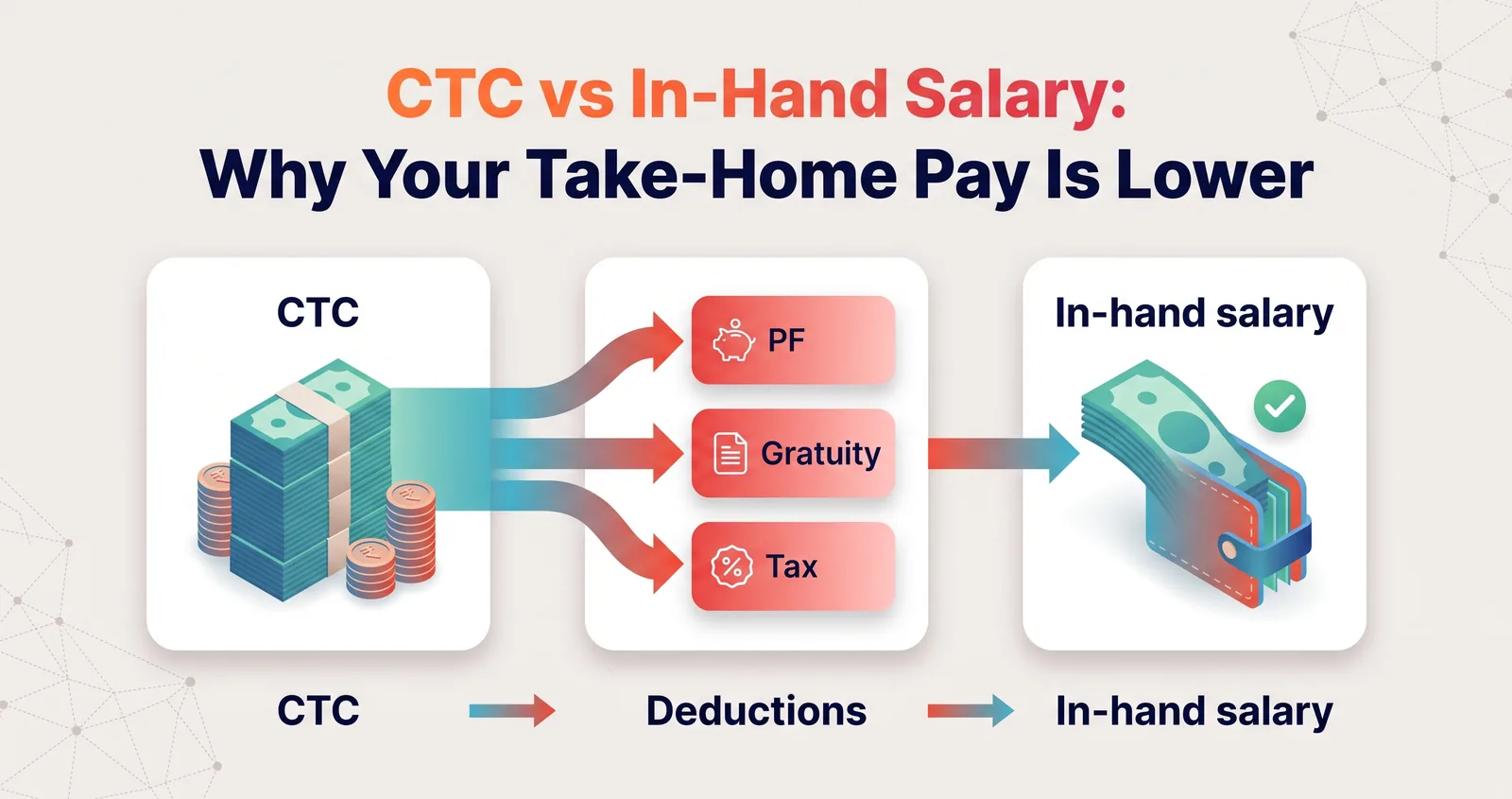
Because gratuity is worked out on your last drawn wages, a higher wage figure at exit raises the payout for all your years of service, not just the recent ones. The same definition affects PF, which our guide to CTC vs in-hand salary works through, including the 4.81% of basic that many employers set aside for gratuity inside your CTC. Our Salary Calculator shows that gratuity slice in a full CTC breakup.
The Gratuity Calculator still follows the 1972 Act's rules: it shows ₹0 below five years of service, so work out a fixed-term payout by hand, and it doesn't apply the 50% rule, so enter your wages after the add-back.
Tax on gratuity: what to check
From 1 April 2026, the Income-tax Act, 2025 deals with gratuity in Section 19, which took over from Section 10(10) of the old Act. The broad structure is unchanged:
- Government employees: death-cum-retirement gratuity is fully exempt.
- Employees covered by the gratuity law: exempt up to the amount the law's formula and ceiling allow.
- Everyone else: exempt up to the lowest of the gratuity received, the half-month formula above and a limit the government notifies. That limit is for your whole working life, across every employer.
The notified limit for private-sector employees is widely applied as ₹20 lakh, from a 2019 notification. Confirm the current figure on the Income Tax Department's portal before you file, and remember that anything above the exempt amount is taxed as salary at your slab rate.
Note: This article is for information only and is not financial advice or legal advice. Labour-code rules are still being notified; your employer's policy, your contract and the official sources linked above are what count.
Next step: find your last payslip, add basic pay and DA, apply the 50% check if your allowances are large, and multiply by 15/26 and your years of service.
Frequently asked questions
How do I calculate gratuity?
Multiply your last drawn monthly basic pay plus DA by 15, divide by 26, and multiply by your years of service, counting a final part-year of more than six months as a full year. Ten years on ₹50,000 gives ₹2,88,462.
Is gratuity paid before 5 years of service?
For permanent employees, generally no: they need five years of continuous service. The minimum doesn't apply on death or disablement, and fixed-term employees qualify after one year, on a pro rata basis.
Do fixed-term employees get gratuity after one year?
Yes. Since the labour codes took effect on 21 November 2025, fixed-term employees qualify after one year of continuous service, with gratuity paid pro rata.
What is the maximum gratuity amount?
₹20 lakh under the gratuity law, as notified by the government. An employer can pay more under a contract or policy, but the extra may be taxable.
Why is 26 used in the gratuity formula?
The law treats a month as 26 working days, so a monthly wage divided by 26 gives one day's wages. Fifteen days' wages are therefore 15/26 of a month's pay.
Is gratuity taxable?
Only above the exempt amount. Government employees' gratuity is fully exempt, while for others the exemption is limited by a formula and a cap, widely applied as ₹20 lakh; check the current limit with the Income Tax Department.