CTC vs In-Hand Salary: Why Your Take-Home Pay Is Lower
CTC vs in-hand salary with a ₹12 lakh breakup: what employer PF, gratuity, tax and variable pay take out of your CTC, and what to ask HR before you accept.

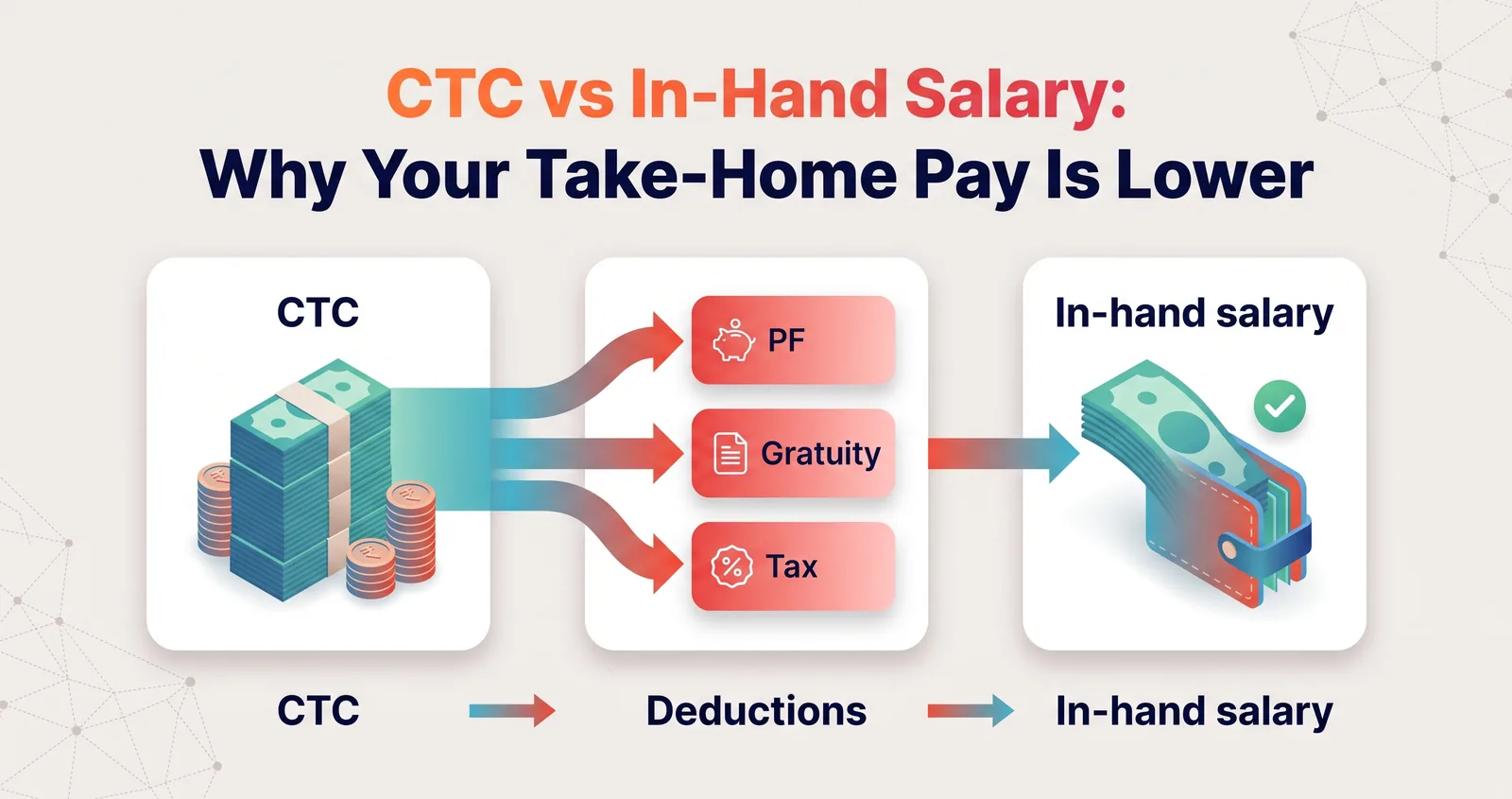
CTC vs in-hand salary is the gap between what your job costs your employer and what reaches your bank account each month. CTC, or cost to company, counts everything the employer spends on you in a year, including its own PF contribution, gratuity and any variable pay, while in-hand salary is your monthly pay after your PF, professional tax and income tax are deducted. On a ₹12 lakh CTC with a common structure, that works out to about ₹85,400 a month, not the ₹1 lakh the headline suggests, and the sample breakup below shows where the other ₹14,600 goes.
On this page
CTC vs in-hand salary: three different numbers
If you've wondered what CTC is and why it never matches your payslip, it helps to separate three figures:
- CTC is the total annual cost of employing you: your gross salary plus the employer's PF contribution, gratuity, variable pay and any benefits it pays for.
- Gross salary is what your payslip lists as earnings before deductions: basic pay, HRA and allowances.
- In-hand salary (also called take-home or net pay) is what's left after your own deductions.
Gross salary   = CTC − employer PF − gratuity − variable pay and other benefits
In-hand salary = Gross salary − employee PF − professional tax − income tax
That's the gross vs net salary difference in two lines: gross is what you earn, net is what you receive.
A sample salary breakup for a ₹12 lakh CTC
Here's a full salary breakup built on assumptions many employers use: basic pay at 50% of CTC, HRA at 50% of basic, PF at 12% of the full basic, gratuity at 4.81% of basic and no variable pay. Your offer letter can differ on every one of these, so treat it as an example, not a rule.
| Component | Annual | Monthly |
|---|---|---|
| Basic salary | ₹6,00,000 | ₹50,000 |
| House rent allowance (HRA) | ₹3,00,000 | ₹25,000 |
| Special allowance (the balancing figure) | ₹1,99,140 | ₹16,595 |
| Gross salary | ₹10,99,140 | ₹91,595 |
| Employer's PF contribution (12% of basic) | ₹72,000 | ₹6,000 |
| Gratuity provision (4.81% of basic) | ₹28,860 | ₹2,405 |
| CTC | ₹12,00,000 | ₹1,00,000 |
The special allowance is simply whatever is left once the other parts are fixed. The gratuity figure of 4.81% is 15/26 ÷ 12: gratuity is worked out as 15 days' wages for each year of service, on a 26-working-day month, and employers set aside a twelfth of that every month.
From CTC to gross salary
The first cut comes from money your employer spends on you but doesn't pay you as salary: 12,00,000 − 72,000 − 28,860 = ₹10,99,140 of gross salary a year, or ₹91,595 a month.
The employer's PF isn't lost: it goes to your EPF and pension accounts. Of the employer's 12%, 8.33% goes to the Employees' Pension Scheme and 3.67% to your provident fund account, as the Press Information Bureau notes. Two recent changes affect how big this slice is:
- The PF wage ceiling rose from ₹15,000 to ₹25,000 a month from 17 September 2026. Employers can calculate PF on that capped wage instead of the full basic. On the cap, PF is 12% of ₹25,000 = ₹3,000 a month from each side, against ₹6,000 in the example, which would lift the monthly in-hand to ₹91,395.
- The labour codes changed what counts as wages. Since 21 November 2025, wages for PF and gratuity mean basic pay, dearness allowance and retaining allowance, and if your other allowances exceed 50% of your total pay, the excess is added back to wages, according to the labour ministry's FAQs. In a simplified case, with ₹1,00,000 of monthly pay and a ₹40,000 basic, the allowances are ₹10,000 over half, so wages count as ₹50,000. A low basic no longer keeps gratuity, or PF worked out on full wages, small.
From gross to in-hand: the deductions
Now the take-home salary calculation for the same month:
| Monthly figure | Amount |
|---|---|
| Gross salary | ₹91,595 |
| Employee's PF (12% of basic) | −₹6,000 |
| Professional tax | −₹200 |
| Income tax deducted at source | ₹0 |
| In-hand salary | ₹85,395 |
Employee PF. You contribute 12% of basic (plus DA) too, matching the employer. It's your savings, but it leaves your salary every month.
Professional tax. This is a state tax, so the amount depends on where you work. Article 276 of the Constitution caps it at ₹2,500 a year per person; ₹200 a month is used here as an example.
Income tax. The example uses the new regime at FY 2025-26 rates, the latest our calculator applies. Taxable income is the gross salary minus the ₹75,000 standard deduction: ₹10,24,140. According to the Income Tax Department's page for salaried individuals, taxable income up to ₹12 lakh under the new regime gets a rebate of up to ₹60,000, which wipes this tax out.
Under the old regime, the same salary would pay ₹1,11,746 unless HRA and other deductions brought it down. Tax rules change with every Budget, and the Income-tax Act, 2025 applies from April 2026, so check the rules for the year you're in.
If your monthly wages are ₹21,000 or less, ESI (Employees' State Insurance) contributions are deducted as well.
Here's how the gap grows with salary, using the same assumptions:
| CTC | Gross salary | Income tax a year | In-hand per month | In-hand as a share of CTC |
|---|---|---|---|---|
| ₹6 lakh | ₹5,49,570 | ₹0 | ₹42,598 | 85% |
| ₹12 lakh | ₹10,99,140 | ₹0 | ₹85,395 | 85% |
| ₹18 lakh | ₹16,48,710 | ₹1,20,699 | ₹1,18,134 | 79% |
| ₹25 lakh | ₹22,89,875 | ₹2,63,868 | ₹1,56,134 | 75% |
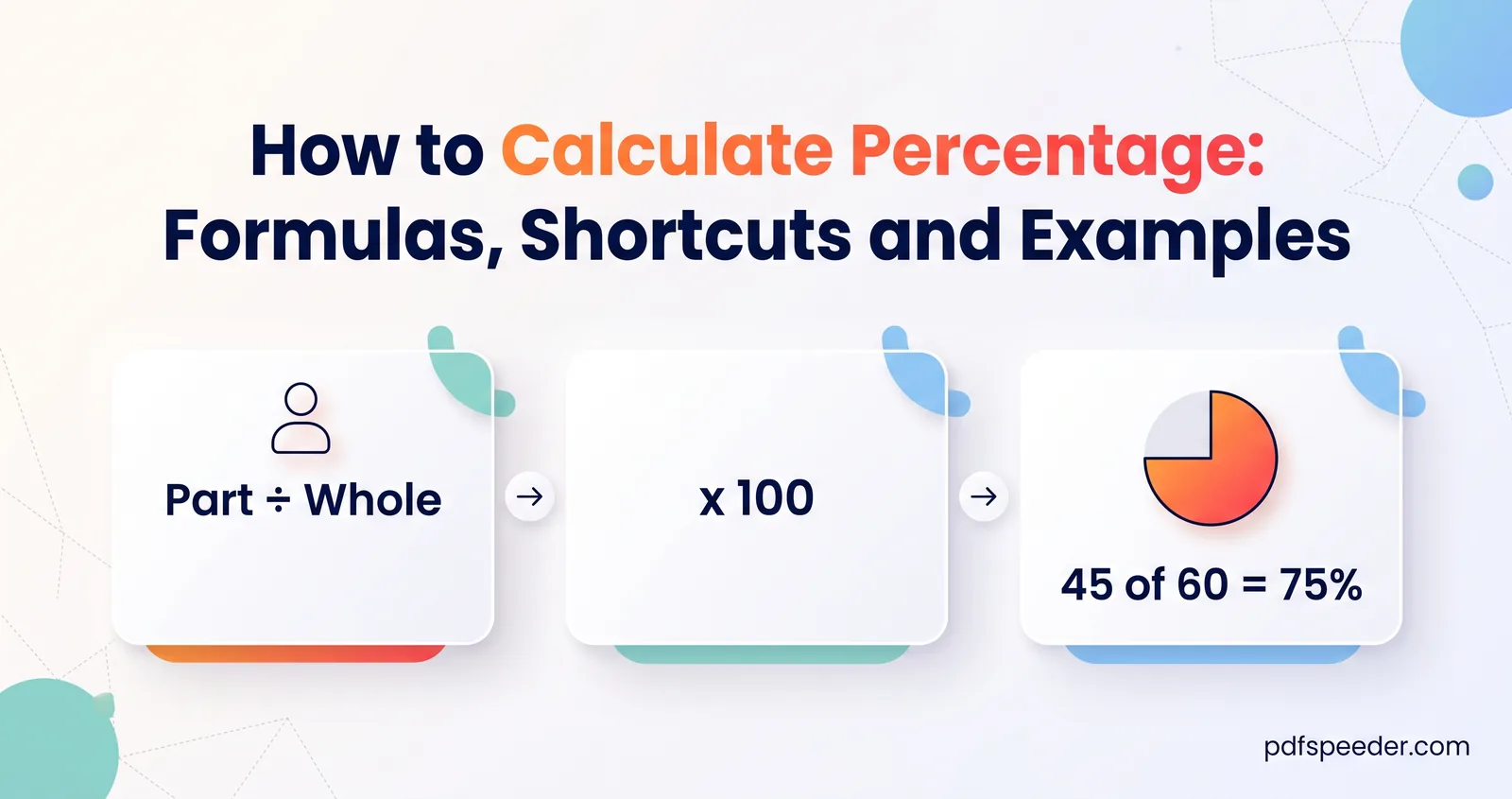
Below the rebate limit, PF, gratuity and professional tax take a steady 15% or so. Above it, income tax widens the gap, and on ₹25 lakh a quarter of the CTC never reaches your account each month. To find the share for your own offer, divide the annual in-hand by the CTC, as our guide on how to calculate percentage shows.
Parts of CTC you don't get every month
Some of your CTC arrives late, conditionally or never in cash:
- Employer PF. It builds your retirement savings and earns interest, as our guide to how EPF interest is calculated shows, but you can only withdraw it under the scheme's rules. The EPF Calculator projects the balance at an interest rate you choose.
- Gratuity. It's paid when you leave, and normally only after five years of continuous service; under the Code on Social Security, fixed-term employees qualify after one year, on a proportionate basis. Leave after four years as a permanent employee and the ₹28,860 a year in this CTC is usually never paid. The Gratuity Calculator shows what you'd receive for a given salary and length of service.
- Variable pay. A performance bonus is paid only if targets are met, often once a year. If ₹1.2 lakh of the ₹12 lakh were variable, the monthly in-hand would drop from ₹85,395 to ₹76,836, with the rest arriving later, if at all.
- One-off items. A joining bonus or relocation allowance can inflate the first year's CTC. Check whether you'd have to repay it if you leave early.
- Benefits in kind. Group health insurance premiums and similar perks have real value, but they aren't cash.
Negotiate with in-hand in mind
A higher CTC doesn't always mean a higher salary. Compare two offers with the same assumptions as above:
- Offer A: ₹12 lakh CTC, all fixed, PF on the full basic. In-hand: ₹85,395 a month, with ₹1,44,000 a year going into PF.
- Offer B: ₹12.5 lakh CTC, of which ₹1.5 lakh is variable, with PF on the ₹25,000 ceiling. In-hand: ₹83,262 a month, with ₹72,000 a year going into PF.
Offer B looks ₹50,000 richer but pays ₹2,133 less every month and saves half as much in PF. Counting PF and gratuity at full value, it only comes out ahead if at least two-thirds of its variable pay is actually paid.
Before you accept an offer, ask HR:
- Is PF calculated on the full basic or on the ₹25,000 wage ceiling?
- Is gratuity included in the CTC?
- How much is variable, when is it paid, and what has the typical payout been?
- Are any one-off payments counted in the CTC, and do they have repayment conditions?
- What will the monthly in-hand be in the first full month?
To run the numbers yourself, our Salary Calculator builds this breakup from any CTC. You set the basic and HRA percentages, the PF method and professional tax; it compares the old and new regimes at FY 2025-26 rates, picks the cheaper one and lets you download the breakup as a PDF.
Choose "12% of full basic" to match this example. The capped PF option still uses the old ₹15,000 ceiling at the time of writing, so for capped PF, use the ₹3,000-a-month figure above. If you'll claim HRA under the old regime, the HRA Calculator works out the exempt amount.
Note: This article is for information only and is not financial advice. Salary structures, tax rules and contribution limits change; your offer letter, payslip and the official sources linked above are what count.
Your in-hand figure also decides how much you can borrow later; our guide to home loan eligibility on salary starts from exactly this number. Next step: put your offer's CTC into the Salary Calculator and ask HR the five questions above before you sign.
Frequently asked questions
What is the difference between CTC and in-hand salary?
CTC is the total yearly cost of employing you, including the employer's PF, gratuity and variable pay. In-hand salary is the monthly amount credited to your account after your PF, professional tax and income tax.
How much is the in-hand salary on a ₹12 lakh CTC?
About ₹85,395 a month, with basic at 50% of CTC, PF on the full basic, ₹200 of professional tax and the new tax regime at FY 2025-26 rates. If PF is calculated on the ₹25,000 ceiling instead, it's about ₹91,395.
Is gratuity part of CTC?
It often is, shown as about 4.81% of basic. It's paid only when you leave, normally after five years of continuous service, or one year for fixed-term employees.
Why is my in-hand salary lower than CTC divided by 12?
Because CTC includes money that isn't paid to you monthly, such as the employer's PF, gratuity and variable pay, and because your own PF, professional tax and income tax are deducted from what remains.
Does the new PF wage ceiling reduce my take-home pay?
Only if your employer calculates PF on the ceiling. Then the deduction can rise from ₹1,800 to as much as ₹3,000 a month, lowering take-home pay but adding the same amount to your PF savings.