FD vs RD: Which Earns More? Interest Formulas and Examples
FD vs RD compared on the same ₹1.2 lakh: the interest formulas, why an RD earns about half the interest, which suits your savings, and the TDS and exit rules.

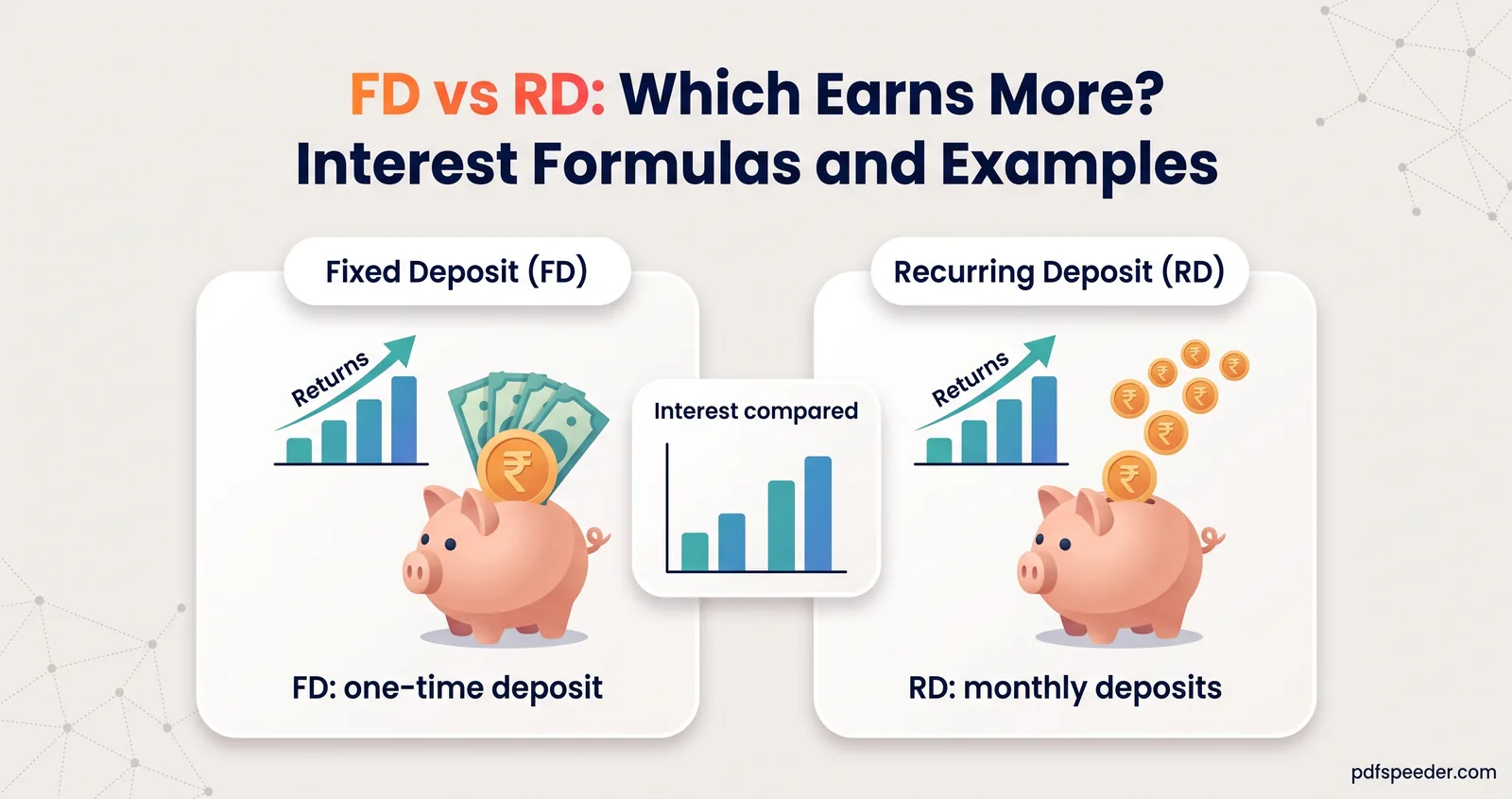
FD vs RD comes down to timing, not the interest rate: SBI, for one, pays its recurring deposits the same rate as its fixed deposits. An FD puts your whole amount to work on day one, while an RD adds money month by month, so the same total earns roughly half the interest. At an example 6.5% a year compounded quarterly, ₹1.2 lakh in a one-year FD earns ₹7,992, while ₹10,000 a month in a one-year RD earns ₹4,286, which is why the right choice depends on whether you have a lump sum or a monthly surplus.
On this page
FD and RD in a nutshell
| Fixed deposit (FD) | Recurring deposit (RD) | |
|---|---|---|
| How you pay in | One lump sum | A fixed amount every month |
| Interest rate | Fixed when you open it | Fixed when you open it; at SBI, the same as its term deposits |
| Interest paid | At maturity (cumulative FD), or monthly or quarterly | At maturity |
| Missed payments | Not applicable | Penalty; at SBI, ₹1.50 per ₹100 for each month of delay on RDs of up to 5 years |
| Early withdrawal | Allowed, with a lower rate | Allowed, with a lower rate |
| Best for | Money you already have | Money you'll save from your income |
The SBI details come from its recurring deposit page, last updated in April 2026. Other banks set their own terms, so check yours before you open either.
The interest formulas
In a cumulative FD, interest is added to the balance at regular intervals instead of being paid out; SBI, for example, says interest on its Reinvestment Plan deposits is compounded quarterly. With quarterly compounding and r as the annual rate in per cent:
FD maturity = P × (1 + r/400)^(4 × years)Here's the FD interest calculation, quarterly, for ₹1,20,000 at 6.5% for one year:
- Rate per quarter: 6.5 ÷ 4 ÷ 100 = 0.01625
- Number of quarters: 4
- Growth factor: 1.01625^4 = 1.066602
- Maturity value: 1,20,000 × 1.066602 = ₹1,27,992
That growth factor means a 6.5% FD really yields 6.66% over a year, because each quarter's interest earns interest too. Our guide to the compound interest formula shows how much the compounding frequency adds in general.
An RD is a series of small deposits, each compounding for a different time. The RD interest calculation formula our RD Calculator uses treats every instalment as its own small FD:
RD maturity = Σ M × (1 + r/400)^(m ÷ 3)    for m = 1, 2, … n

M = monthly instalment
m = months that instalment stays invested (the first stays n months, the last 1)
m ÷ 3 turns months into quarters
The same sum can be written in one line: M × [(1 + i)^q − 1] ÷ [1 − (1 + i)^(−1/3)], where i = r/400 and q is the number of quarters. Both give identical answers; banks' exact rounding can move the result by a few rupees.
Worked example: ₹1.2 lakh FD vs ₹10,000-a-month RD
Both deposits earn the same example rate of 6.5% a year, and both total ₹1,20,000 over a year. For reference, SBI's card rate for deposits of 1 year to less than 2 years was 6.25% for the public and 6.75% for senior citizens, effective 15 December 2025, when this was written. Rates differ between banks and change often.
Here's what happens to some of the RD's twelve instalments:
| RD instalment | Months invested | Value at maturity |
|---|---|---|
| 1st | 12 | ₹10,666 |
| 4th | 9 | ₹10,495 |
| 7th | 6 | ₹10,328 |
| 10th | 3 | ₹10,163 |
| 12th | 1 | ₹10,054 |
| All twelve together | 1 to 12 | ₹1,24,286 |
And the two side by side:
| FD of ₹1,20,000 | RD of ₹10,000 a month | |
|---|---|---|
| Total deposited | ₹1,20,000 | ₹1,20,000 |
| Average time each rupee is invested | 12 months | 6.5 months |
| Maturity value | ₹1,27,992 | ₹1,24,286 |
| Interest earned | ₹7,992 | ₹4,286 |
The RD earns 54% of the FD's interest because, on average, its money is in the bank for just over half the time. The gap is about the same over longer terms: ₹6 lakh in a 5-year FD grows to ₹8,28,252 (₹2,28,252 of interest), while ₹10,000 a month for 60 months grows to ₹7,09,908 (₹1,09,908 of interest).
So an RD isn't a worse product. It earns almost exactly what an FD would on its average balance: a ₹65,000 FD for a year would earn ₹4,329, close to the RD's ₹4,286. The fair comparison for an RD isn't an FD you can't afford yet; it's leaving each month's ₹10,000 in a savings account, which at an example 2.5% a year would earn only about ₹1,625 over the same year.
To check these figures, use our FD Calculator (enter ₹1,20,000, 6.5% and 1 year; it starts on quarterly compounding) and our RD Calculator (₹10,000 a month, 6.5%, 1 year). Both open in rupees and run in your browser. To see how monthly or yearly compounding would change the FD, try the Compound Interest Calculator.
FD vs RD: which is better for you?
The answer to "FD vs RD, which is better?" depends on how your money arrives and when you'll need it:
| Your situation | Better fit | Why |
|---|---|---|
| You have a lump sum, such as a bonus or maturity proceeds | FD | All of it earns interest from day one |
| You save a fixed amount from each month's salary | RD | It turns monthly savings into a deposit with a fixed rate |
| You're saving towards a goal 1 to 3 years away | RD | Regular instalments build the amount on schedule |
| You might need part of the money early | Several smaller FDs | You can break one without touching the rest |
| Your goal is 5 years or more away and you can accept ups and downs | Consider a SIP alongside | Market-linked returns can beat deposits over long periods, with no guarantee |
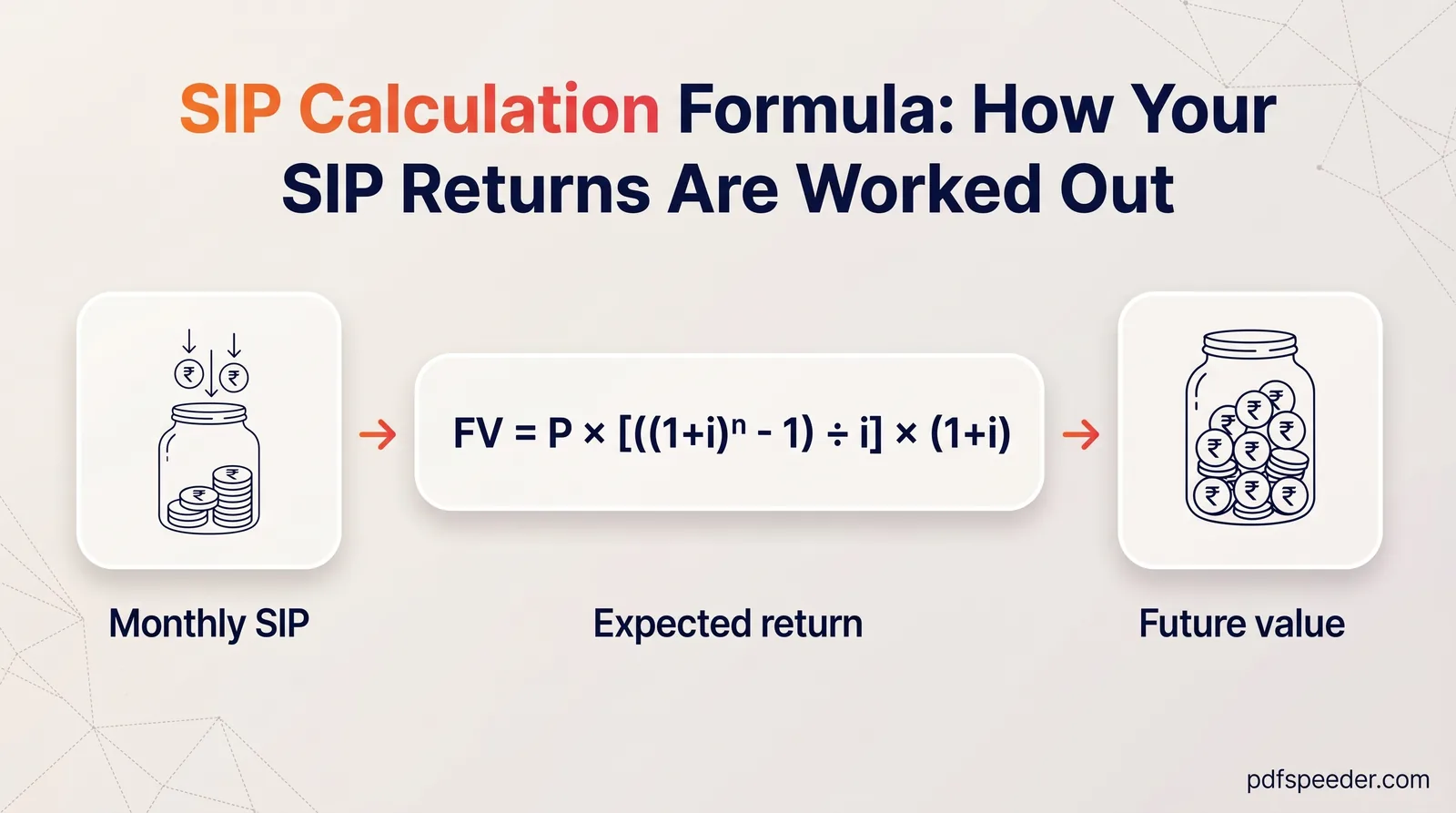
On RD vs SIP: an RD's rate is fixed for the whole term and your capital is not exposed to the market, while a SIP in a mutual fund can earn more or less than a deposit, and can lose value. Our guide to the SIP calculation formula shows how SIP projections are worked out, using a return you assume rather than one that's promised.
Tip: If you're comparing a fixed deposit vs a recurring deposit for the same goal, compare the maturity amounts at the same rate and date, not the headline rates. A slightly higher RD rate still earns less interest than an FD on the same total.
Tax, TDS and premature withdrawal
Tax. Interest from both FDs and RDs is added to your income and taxed at your slab rate.
TDS. A bank deducts tax at source from deposit interest once the interest it pays you in a year crosses a threshold, which is higher for senior citizens. Thresholds can change with any Budget, and the Income-tax Act, 2025 has applied since April 2026, so check the current figures on the Income Tax Department's portal or with your bank. If your total income is below the taxable limit, you can give your bank a self-declaration asking it not to deduct TDS; ask the bank which form it needs.
Premature withdrawal. You can usually close either deposit early, but at a lower rate. At SBI, you get 0.50% less (1% less above ₹5 lakh) than the rate for the period the money actually stayed, or than your original rate if that's lower. Shorter deposits usually carry lower rates, so an early exit can cost more than the penalty alone suggests.
Missed RD instalments. SBI charges ₹1.50 per ₹100 for each month an instalment is late on RDs of up to 5 years (₹150 a month on a ₹10,000 instalment), and closes the account early after six consecutive missed instalments.
Note: This article is for information only and is not financial advice. The 6.5% rate is an example; check your bank's current rates and terms before you deposit.
Next step: decide which deposit matches how your money arrives, then run your real amount and your bank's actual rate through the FD or RD Calculator before you book it.
Frequently asked questions
Which is better, FD or RD?
An FD is better when you already have a lump sum, because all of it earns interest from day one. An RD suits money you'll save each month, since you can't put money you haven't earned yet into an FD.
Why does an RD earn less interest than an FD?
Because the money arrives gradually: in a one-year RD, each rupee is invested for 6.5 months on average. At the same 6.5% rate, ₹1.2 lakh earns ₹7,992 in an FD and ₹4,286 in an RD.
How is RD interest calculated?
Each monthly instalment compounds quarterly for the months it stays invested, and the results are added up. ₹10,000 a month for 12 months at 6.5% matures at ₹1,24,286.
Is FD interest compounded quarterly?
For cumulative FDs, often yes: SBI compounds interest on its Reinvestment Plan deposits quarterly. Check your own bank's terms, because the frequency changes the maturity value slightly.
RD vs SIP: which is better?
An RD gives a fixed, guaranteed rate, while a SIP in a mutual fund is market-linked and can earn more or less. Use an RD for short-term goals and money you can't put at risk, and consider a SIP for long-term goals if you can accept ups and downs.