Compound Interest Formula With Examples (Yearly, Quarterly, Monthly)
The compound interest formula worked on ₹1 lakh with yearly, quarterly and monthly compounding, plus simple vs compound interest and the effective rate.

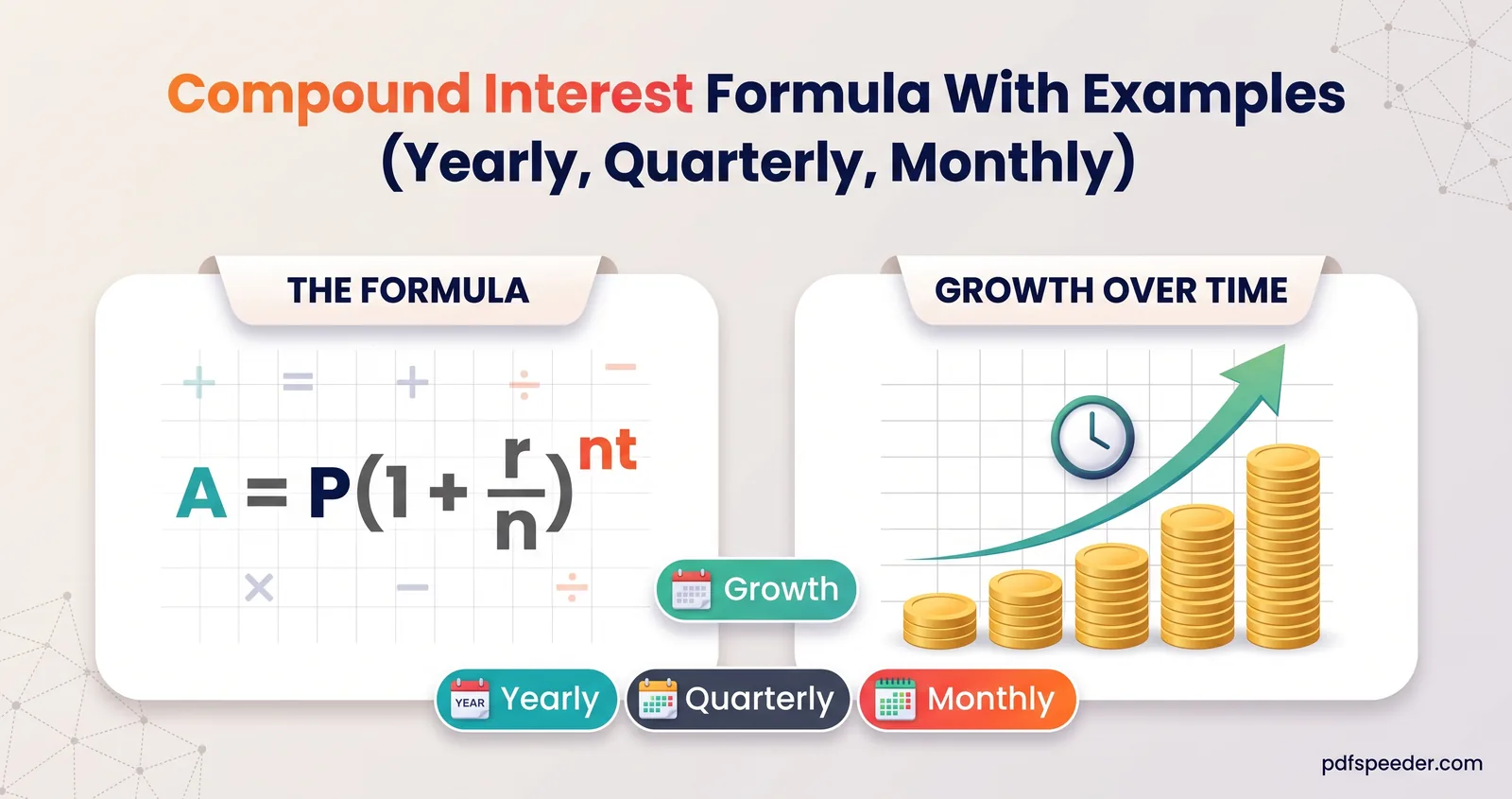
The compound interest formula is A = P × (1 + r/n)^(n × t), where P is the amount you invest, r is the annual interest rate as a decimal, n is the number of times interest is added each year and t is the number of years. Put ₹1 lakh at 7% for 10 years into it and you get ₹1,96,715 with yearly compounding, ₹2,00,160 with quarterly compounding and ₹2,00,966 with monthly compounding. This guide works through each case step by step, compares compound and simple interest, and shows how the same maths runs your FDs, PPF, SIPs and loans.
On this page
The compound interest formula, term by term
A = P × (1 + r/n)^(n × t)
Compound interest = A − P- A is the amount you end up with: the maturity value.
- P is the principal: the amount you put in at the start.
- r is the annual interest rate as a decimal, so 7% is 0.07.
- n is how many times a year interest is added: 1 for yearly, 2 for half-yearly, 4 for quarterly, 12 for monthly and 365 for daily.
- t is the time in years. Eighteen months is 1.5.
Two parts do all the work: r/n is the rate for one period, and n × t is the number of periods. At the end of each period the interest joins the balance, so the next period's interest is worked out on a slightly bigger amount. That's the whole difference between compound and simple interest.
The two classic slips are typing 7 instead of 0.07, and dividing the rate by n without multiplying the years by n (or the other way round). If your answer is absurdly large, or barely above P, check those first.
Worked example: ₹1 lakh at 7% for 10 years
Here's how to calculate compound interest with quarterly compounding, one step at a time:
- Rate per quarter: r/n = 0.07 ÷ 4 = 0.0175, or 1.75%
- Number of quarters: n × t = 4 × 10 = 40
- Growth factor: (1 + 0.0175)^40 = 1.0175^40 = 2.001597
- Amount: A = 1,00,000 × 2.001597 = ₹2,00,159.73
- Compound interest: 2,00,159.73 − 1,00,000 = ₹1,00,159.73
So the deposit just about doubles in 10 years. With yearly compounding, the growth factor is 1.07^10 = 1.967151 and the amount comes to ₹1,96,715.14.
To see why the money grows faster than "7% a year" suggests, follow the yearly version for three years:
| Year | Opening balance | Interest at 7% | Closing balance |
|---|---|---|---|
| 1 | ₹1,00,000.00 | ₹7,000.00 | ₹1,07,000.00 |
| 2 | ₹1,07,000.00 | ₹7,490.00 | ₹1,14,490.00 |
| 3 | ₹1,14,490.00 | ₹8,014.30 | ₹1,22,504.30 |
The extra ₹490 in year 2 is interest earned on year 1's interest. By year 3, that interest on interest has grown to ₹1,014.30. The snowball gets a little bigger every year, which is why the gap with simple interest keeps widening.
You can check all of this with our Compound Interest Calculator. It opens on this exact example, ₹1,00,000 at 7% for 10 years, and in rupees in India (elsewhere, switch the currency to INR). Choose a compounding frequency and it shows the future value, the total interest and a year-by-year growth table, and it runs in your browser.
How compounding frequency changes the result
Same ₹1 lakh, same 7%, same 10 years. Only n changes:
| Compounding | n | Rate per period | Periods | Amount after 10 years | Interest earned |
|---|---|---|---|---|---|
| Yearly | 1 | 7% | 10 | ₹1,96,715 | ₹96,715 |
| Half-yearly | 2 | 3.5% | 20 | ₹1,98,979 | ₹98,979 |
| Quarterly | 4 | 1.75% | 40 | ₹2,00,160 | ₹1,00,160 |
| Monthly | 12 | 0.5833% | 120 | ₹2,00,966 | ₹1,00,966 |
| Daily | 365 | 0.0192% | 3,650 | ₹2,01,362 | ₹1,01,362 |
Moving from yearly to quarterly compounding adds ₹3,445. Quarterly to monthly adds just ₹806, and monthly to daily another ₹396. The gains shrink because there's a ceiling: compounding continuously, at every instant (A = P × e^(r × t)), gives ₹2,01,375, only ₹14 more than daily.
The lesson is that the rate matters far more than the frequency. The same ₹1 lakh at 7.5%, compounded just once a year, grows to ₹2,06,103 in 10 years, comfortably ahead of 7% compounded daily.
Compound interest vs simple interest
Simple interest is paid only on the original principal:
Simple interest = P × r × t
Amount = P × (1 + r × t)
Here is ₹1 lakh at 7% a year under both methods, with compound interest added yearly:
| Years | Amount with simple interest | Amount with compound interest | Compounding earns extra |
|---|---|---|---|
| 1 | ₹1,07,000 | ₹1,07,000 | ₹0 |
| 3 | ₹1,21,000 | ₹1,22,504 | ₹1,504 |
| 5 | ₹1,35,000 | ₹1,40,255 | ₹5,255 |
| 10 | ₹1,70,000 | ₹1,96,715 | ₹26,715 |
| 20 | ₹2,40,000 | ₹3,86,968 | ₹1,46,968 |
| 30 | ₹3,10,000 | ₹7,61,226 | ₹4,51,226 |
In the first year the two are identical, because there's no earlier interest to earn on yet. After 30 years, compounding has produced ₹6,61,226 of interest against ₹2,10,000 of simple interest, more than three times as much. Simple interest grows in a straight line; compound interest follows a curve that keeps getting steeper.
You'll still meet simple interest. A non-cumulative FD that pays out its interest every month or quarter works like simple interest on your principal, because the payouts earn nothing unless you reinvest them. Flat-rate loans charge interest the same way, on the original amount for the whole term. Our Simple Interest Calculator handles those cases.
Effective annual rate explained
Because more frequent compounding earns a little more, a headline rate of 7% doesn't mean the same thing everywhere. The effective annual rate (EAR) turns any compounding frequency into the single yearly rate that would give the same result:
EAR = (1 + r/n)^n − 1
example: (1 + 0.07/4)^4 − 1 = 0.07186, or 7.19%| 7% compounded | Effective annual rate |
|---|---|
| Yearly | 7.00% |
| Half-yearly | 7.12% |
| Quarterly | 7.19% |
| Monthly | 7.23% |
| Daily | 7.25% |
Use it to compare offers that compound differently. Say one deposit pays 7.10% compounded yearly and another pays 7.00% compounded quarterly. The second looks worse, but its effective rate is 7.19%, so it pays more: on ₹1 lakh over 10 years, ₹2,00,160 against ₹1,98,561.
The same maths applies to loans. A loan at 8.5% a year, charged at 8.5 ÷ 12 per cent each month, is equivalent to an effective annual rate of 8.84%.
Compound interest in Excel or Google Sheets
Both have the formula built in:
=FV(7%/4, 40, 0, -100000)     returns 200159.73
=100000*(1+7%/4)^40           the same result, written out
=EFFECT(7%, 4)                returns 0.07186, the effective annual rate
FV takes the rate per period, the number of periods, any regular payment (0 here) and the starting amount, entered as a negative number because it's money you pay in. Put P, r, n and t in their own cells and you can compare scenarios in seconds.
Work backwards: find the principal, rate or time
Rearranging the formula answers the other questions people ask:
- How much to invest today: P = A ÷ (1 + r/n)^(n × t). To have ₹5,00,000 in 10 years at 7% compounded quarterly, you need 5,00,000 ÷ 2.001597 = ₹2,49,800 today.
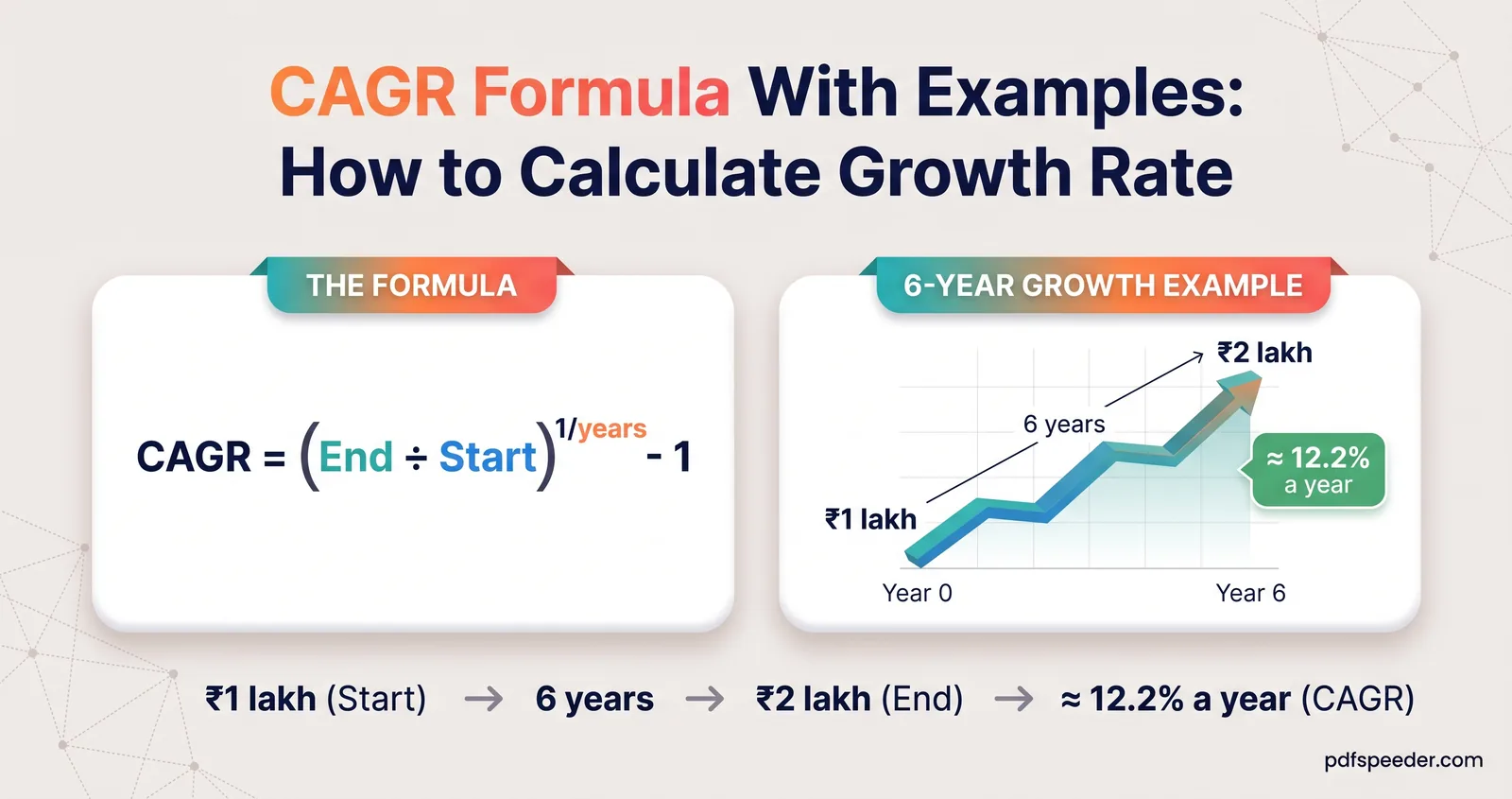
- What rate you earned: r = n × [(A ÷ P)^(1 ÷ (n × t)) − 1]. With yearly compounding (n = 1) this is the CAGR, which our CAGR formula guide works through with examples, and our CAGR Calculator does in one step.
- How long it takes: t = ln(A ÷ P) ÷ [n × ln(1 + r/n)]. At 7% compounded yearly, money doubles in ln 2 ÷ ln 1.07 = 10.24 years. The rule of 72 gets close in your head: 72 ÷ 7 = 10.3 years.
Where compounding shows up: FD, PPF, SIP and loans
Fixed deposits
A cumulative FD adds the interest to your deposit instead of paying it out, and many Indian banks compound it quarterly. SBI, for example, says interest on its Reinvestment Plan deposits "is compounded quarterly". At an example rate of 7%, ₹1 lakh for 5 years grows to ₹1,41,478. Our FD Calculator uses this formula and starts on quarterly compounding; check your bank's current rate and compounding terms before you rely on a figure.
PPF
Under the PPF Scheme, 2019, interest for each month is worked out on the lowest balance between the close of the 5th day and the end of the month, and credited at the end of the financial year. So PPF compounds yearly, and money deposited after the 5th misses that month's interest. The government reviews the rate every quarter and kept it at 7.1% a year for October to December 2026, according to the Ministry of Finance's small savings notifications.
If the rate stayed at 7.1%, ₹1,50,000 deposited by 5 April every year for 15 years would grow to ₹40,68,209, of which ₹18,18,209 is interest.
SIPs
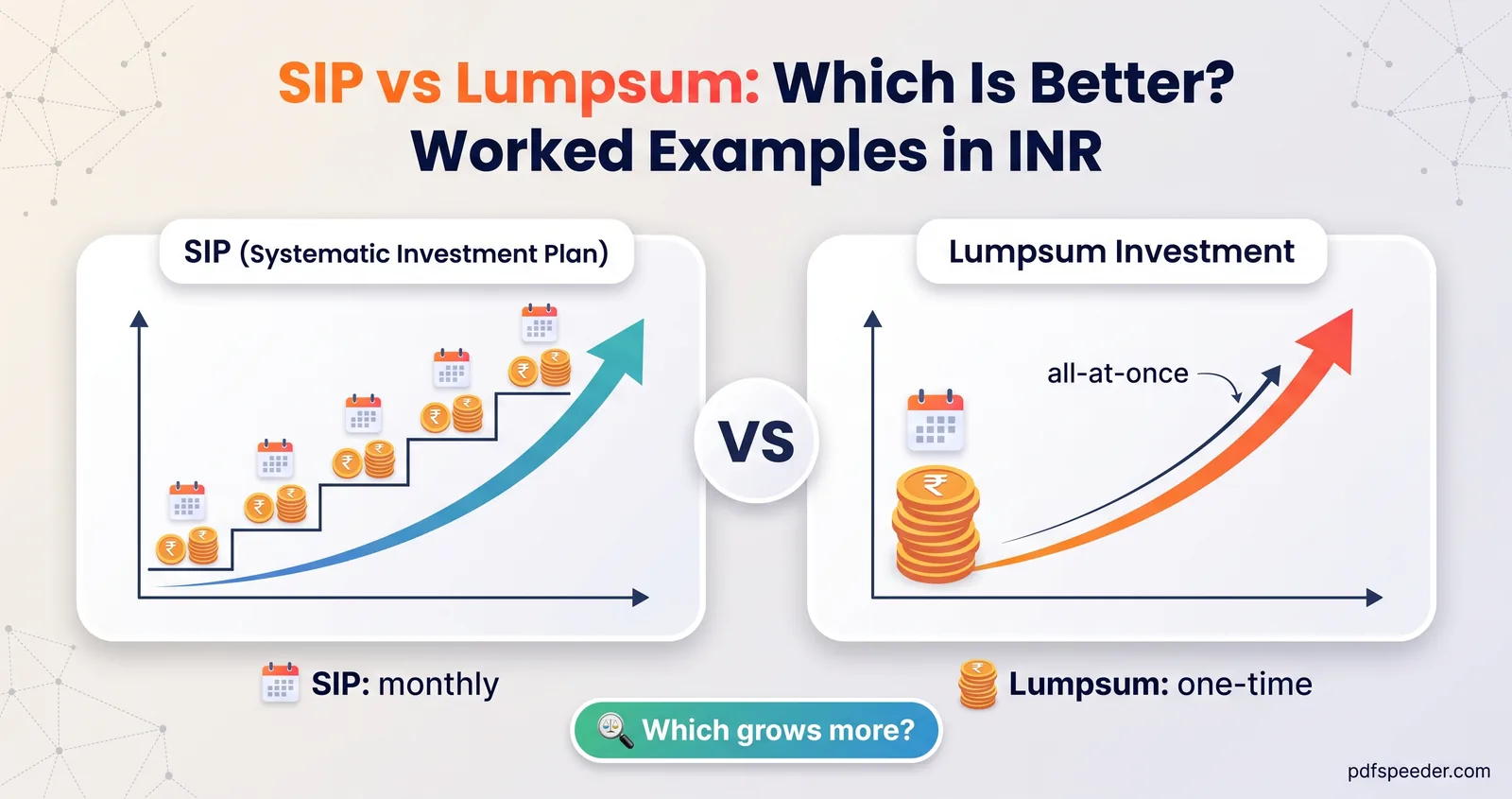
A SIP is a string of small lump sums, each compounding for a different length of time. In a 10-year SIP of ₹10,000 a month at an assumed 12% a year (1% a month), the first instalment compounds for 120 months and grows to ₹33,004, while the last compounds for one month and becomes ₹10,100. Mutual fund returns aren't fixed, so treat any rate you plug in as an assumption, not a forecast. Whether that beats investing the same money all at once is worked through in our SIP vs lumpsum comparison.
Loans
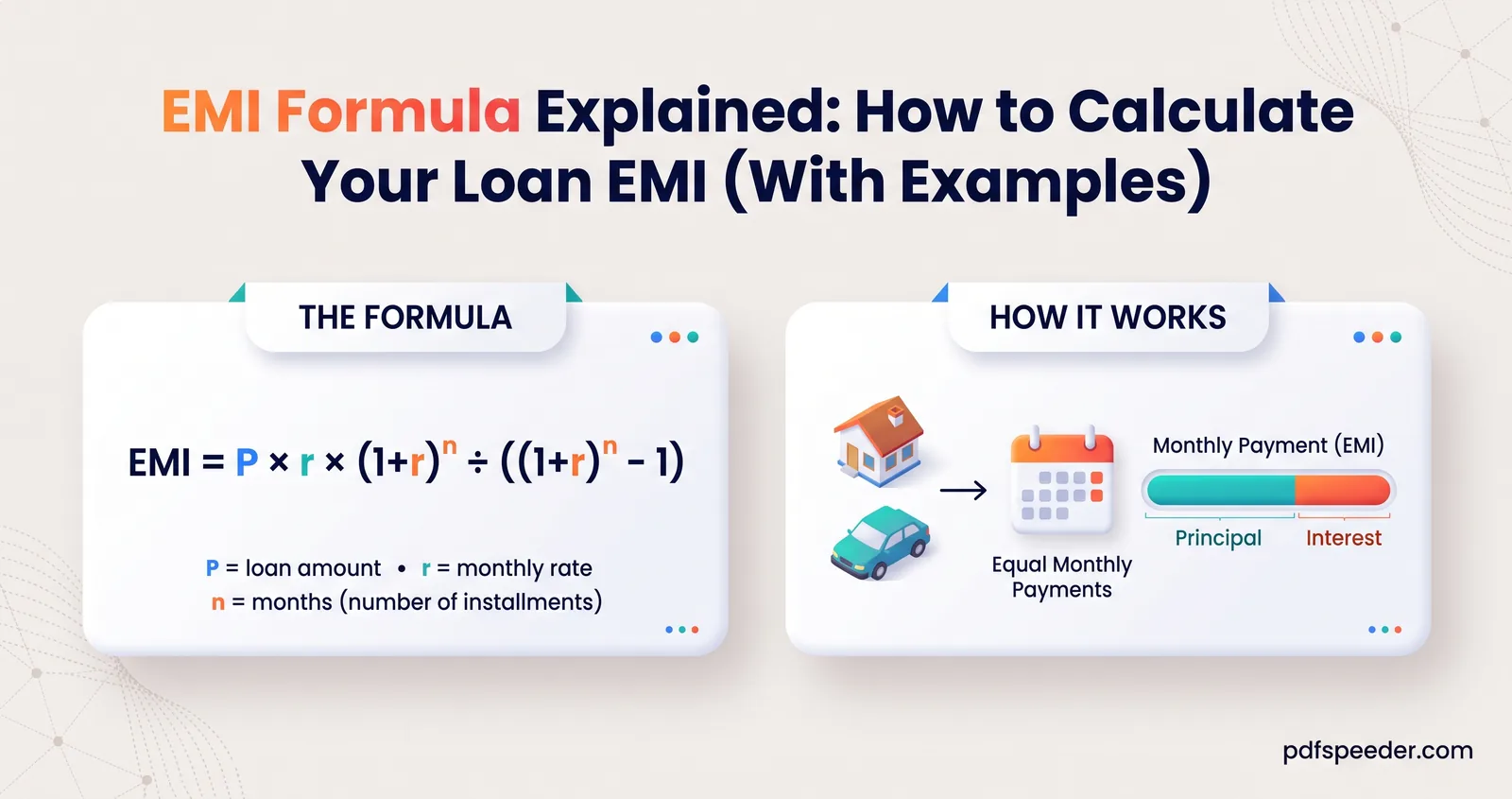
Loans run the same maths against you. Interest is charged every month on the balance you still owe, and the EMI itself comes from compound interest formulas; our guide to how the EMI formula works walks through a ₹20 lakh example. Interest you leave unpaid is added to the balance and then charged interest itself, which is how a rolled-over credit card bill snowballs.
Note: This article is for information only and is not financial advice. The rates above are examples; check the current rate with your bank, post office or fund house before you decide.
To try it on your own numbers, open the Compound Interest Calculator, check that the currency is INR and compare yearly, quarterly and monthly compounding for your amount and rate.
Frequently asked questions
What is the compound interest formula?
A = P × (1 + r/n)^(n × t), where P is the principal, r the annual rate as a decimal, n the number of compounding periods a year and t the number of years. The compound interest itself is A − P.
How do I calculate quarterly compound interest?
Divide the annual rate by 4 and multiply the years by 4. For ₹1 lakh at 7% for 10 years, that's 1,00,000 × 1.0175^40 = ₹2,00,160, so the interest is ₹1,00,160.
Is monthly compounding much better than quarterly?
Only slightly. On ₹1 lakh at 7% for 10 years, monthly compounding earns ₹806 more than quarterly, while a rate just half a point higher, compounded yearly, earns about ₹5,100 more than 7% monthly.
What is the difference between simple and compound interest?
Simple interest is charged only on the original principal, while compound interest is also charged on interest already added. Over one year with yearly compounding they're equal; over 30 years at 7%, compound interest earns more than three times as much.
How long does it take money to double at 7%?
About 10.24 years with yearly compounding, from t = ln 2 ÷ ln 1.07. The rule of 72 gives a quick estimate: 72 ÷ 7, or about 10.3 years.