How EPF Interest Is Calculated: Monthly Example With Numbers
How EPF interest is calculated on your monthly running balance and credited each March, with a 12-month worked example, the EPS split and how VPF adds to it.

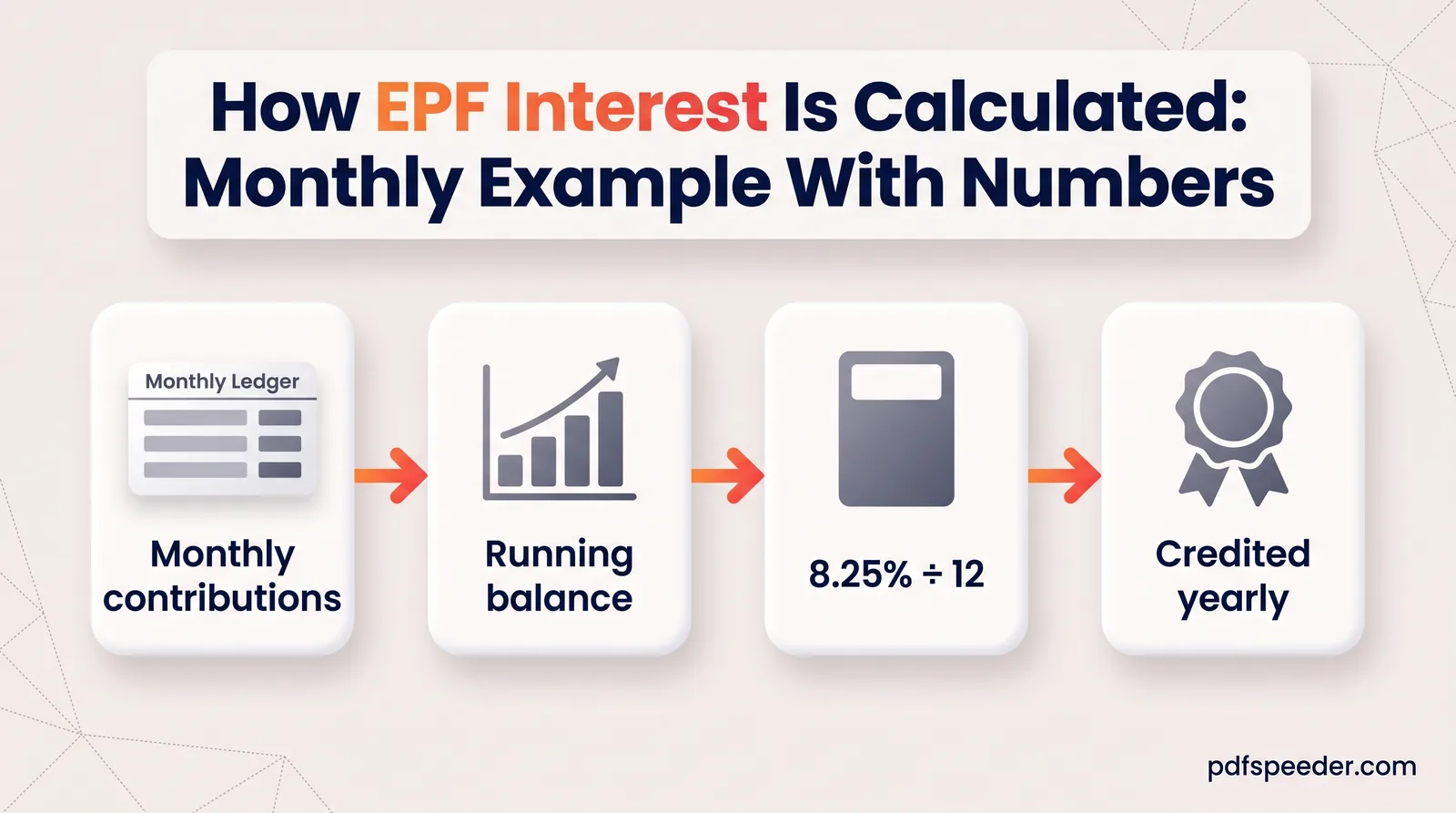
EPF interest is calculated month by month on your running balance, at the declared annual rate divided by 12, but it's added to your account only once a year, at the end of March. Your opening balance earns interest for all 12 months, while each new contribution starts earning from the month after it's credited. At 8.25%, the rate EPFO's board recommended for 2025-26, a ₹2 lakh balance plus ₹7,517 of contributions a month earns ₹19,911 in a year, and the example below shows how EPF interest is calculated, step by step.
On this page
Where your PF money goes each month
Both you and your employer contribute 12% of your basic pay plus dearness allowance (DA), but the two shares don't end up in the same place. Yours goes entirely into your EPF account. Your employer's is split: 8.33% goes to the Employees' Pension Scheme (EPS) and the remaining 3.67% to your EPF account, as the Press Information Bureau sets out. The central government adds another 1.16% to the pension fund for EPS members.
The EPS share is capped by the wage ceiling. A Gazette notification of 17 September 2026 (S.O. 5109(E), circulated by EPFO) raised the ceiling from ₹15,000 to ₹25,000 a month, so the most that can go to EPS is now 8.33% of ₹25,000 = ₹2,083 a month, up from ₹1,250. When your employer contributes on wages above the ceiling, everything beyond ₹2,083 goes to your EPF account instead.
Here's the EPF contribution calculation as a formula, with each amount rounded to the nearest rupee:
Employee share (all to EPF)   = 12% × (basic + DA)
Employer share                = 12% × (basic + DA)
   to EPS                     = 8.33% × the smaller of (basic + DA) and ₹25,000
   to EPF                     = employer share − EPS part
Added to your EPF each month  = employee share + employer's EPF part
And here's the employer contribution EPF/EPS split at three wage levels, assuming contributions on the full basic plus DA:
| Basic + DA a month | Your 12% | Employer's 12% | Employer's share to EPS | Employer's share to EPF | Added to your EPF account |
|---|---|---|---|---|---|
| ₹15,000 | ₹1,800 | ₹1,800 | ₹1,250 | ₹550 | ₹2,350 |
| ₹25,000 | ₹3,000 | ₹3,000 | ₹2,083 | ₹917 | ₹3,917 |
| ₹40,000 | ₹4,800 | ₹4,800 | ₹2,083 | ₹2,717 | ₹7,517 |
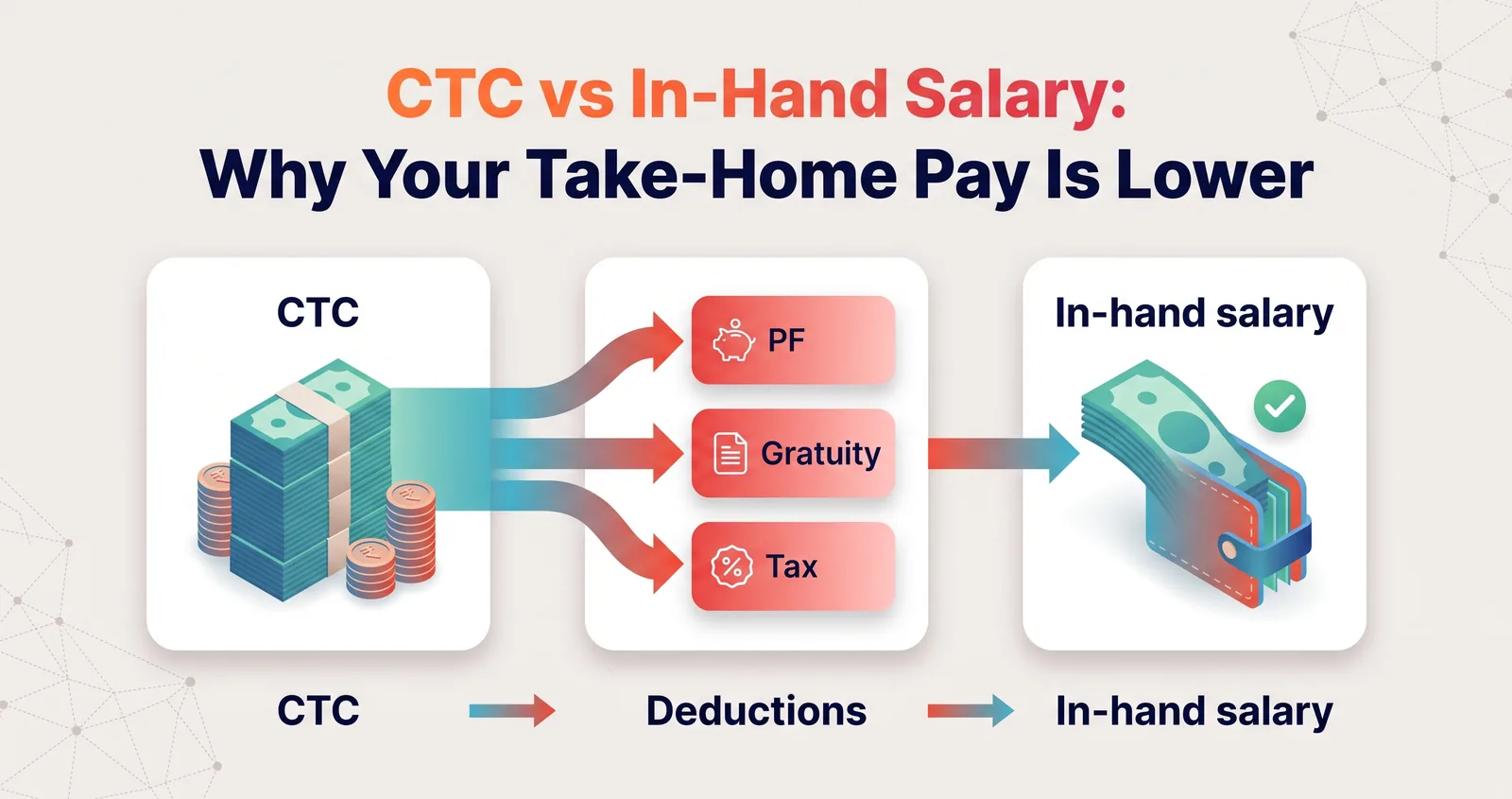
Some employers contribute only on the ₹25,000 ceiling even when you earn more, which puts you on the middle row. Which method yours uses, and how the labour codes define "wages" for PF, both change your take-home pay; our guide to CTC vs in-hand salary covers that side.
How EPF interest is calculated: monthly balance, yearly credit
Paragraph 60 of the Employees' Provident Fund Scheme, 1952 sets out the EPF interest calculation:
- Your opening balance (what you had on 31 March, less anything withdrawn during the year) earns interest for all 12 months.
- Each sum credited during the year earns interest from the first day of the month after it's credited, until 31 March.
- Money you withdraw earns interest up to the end of the month before the withdrawal.
- The total is rounded to the nearest rupee and credited on the last day of the year.
So the PF calculation formula for interest is simple, even if the bookkeeping isn't:
Interest for a month = balance at the start of that month × annual rate ÷ 1200
Interest for the year = the sum of the 12 monthly figures, credited on 31 March
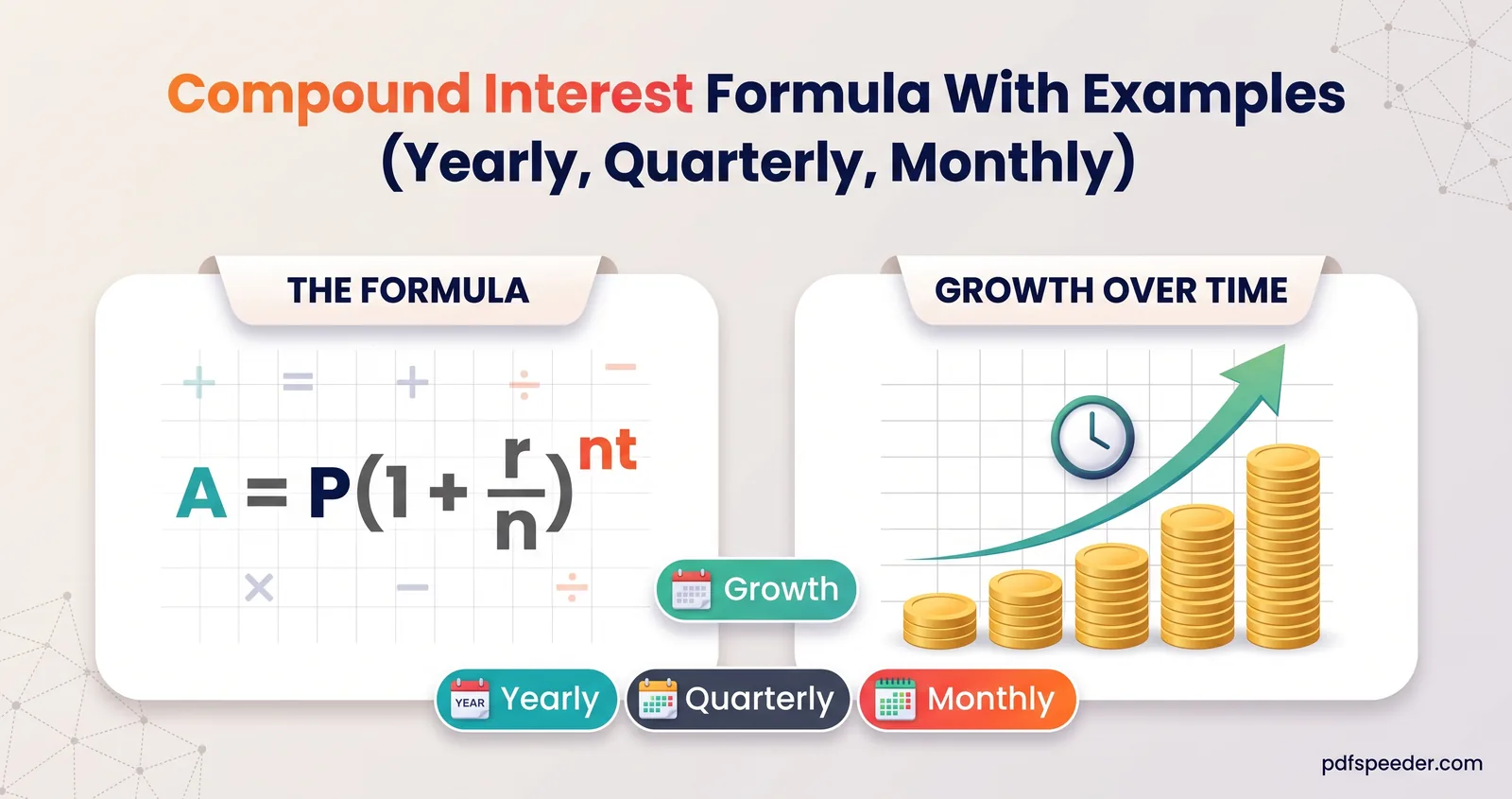
Because the interest is added only once a year, it compounds yearly: next year's opening balance includes this year's interest, and from then on the interest earns interest too.
The EPF interest rate is set every year. EPFO's Central Board of Trustees recommends a rate, the government notifies it, and EPFO then credits it to members' accounts. In March 2026 the board recommended 8.25% for 2025-26, the same rate declared for 2024-25, according to the PIB release on the board meeting. Treat 8.25% as an example for later years, and check your passbook for the rate actually credited.
The same meeting approved new EPF, EPS and EDLI schemes aligned with the Code on Social Security, so watch EPFO's notices for any change to these rules once they take effect.
Worked example: one year of contributions
Take basic plus DA of ₹40,000 a month, with contributions on the full amount, so ₹7,517 is added to the EPF account each month (the last row of the table above). The opening balance on 1 April is ₹2,00,000, the rate is 8.25% a year (0.6875% a month), and each month's contributions are credited within that month:
| Month | Balance earning interest | Interest for the month | Credited this month | Balance at month end |
|---|---|---|---|---|
| April | ₹2,00,000 | ₹1,375.00 | ₹7,517 | ₹2,07,517 |
| May | ₹2,07,517 | ₹1,426.68 | ₹7,517 | ₹2,15,034 |
| June | ₹2,15,034 | ₹1,478.36 | ₹7,517 | ₹2,22,551 |
| July | ₹2,22,551 | ₹1,530.04 | ₹7,517 | ₹2,30,068 |
| August | ₹2,30,068 | ₹1,581.72 | ₹7,517 | ₹2,37,585 |
| September | ₹2,37,585 | ₹1,633.40 | ₹7,517 | ₹2,45,102 |
| October | ₹2,45,102 | ₹1,685.08 | ₹7,517 | ₹2,52,619 |
| November | ₹2,52,619 | ₹1,736.76 | ₹7,517 | ₹2,60,136 |
| December | ₹2,60,136 | ₹1,788.43 | ₹7,517 | ₹2,67,653 |
| January | ₹2,67,653 | ₹1,840.11 | ₹7,517 | ₹2,75,170 |
| February | ₹2,75,170 | ₹1,891.79 | ₹7,517 | ₹2,82,687 |
| March | ₹2,82,687 | ₹1,943.47 | ₹7,517 | ₹2,90,204 |
The twelve monthly figures add up to ₹19,910.84, which rounds to ₹19,911. On 31 March that interest is credited, and the year closes at 2,00,000 + 90,204 + 19,911 = ₹3,10,115.
You can reach the same total without the table:
Opening balance:   2,00,000 × 8.25 ÷ 100                    = 16,500.00
Contributions:     7,517 × (0 + 1 + … + 11) × 8.25 ÷ 1200    =  3,410.84
Interest for year:                                             19,910.84
April's contribution earns 11 months of interest and March's earns none this year, so the year's ₹90,204 of contributions is invested for 5.5 months on average and earns only ₹3,411. If your employer deposits contributions in the month after your salary, each one starts earning a month later; your passbook shows when every amount was credited.
Checking it with the EPF Calculator
Our EPF Calculator projects your balance year by year until retirement, at a rate and contribution rates you choose. It opens at 8.25%. Leave the employer EPF share at 3.67%: above the ₹25,000 ceiling, the calculator moves everything over the ₹2,083 EPS share into EPF itself and says so under the results (₹2,717 a month at ₹40,000).
It works out interest month by month on the running balance, as above, so each contribution earns 0 to 11 months of interest in its first year. It starts from a zero balance, so at ₹40,000 its first year shows ₹3,411 of interest, the contributions line of the sum above.
Over a career, the yearly compounding adds up. If ₹7,517 a month went in from a zero balance and the rate stayed at 8.25% (neither stays fixed in real life), the exact method gives:
| After | Total contributed | EPF balance | Share that is interest |
|---|---|---|---|
| 10 years | ₹9,02,040 | ₹13,72,362 | 34% |
| 20 years | ₹18,04,080 | ₹44,04,495 | 59% |
| 30 years | ₹27,06,120 | ₹1,11,03,761 | 76% |
It's the same snowball our guide to the compound interest formula describes, applied once a year to a balance that keeps growing.
EPS: the part that doesn't earn interest
The EPS share never reaches your EPF balance. It goes into the pooled Employees' Pension Fund, so no interest is credited on it for you; in the example, ₹2,083 of your employer's ₹4,800 each month works this way.
What you earn instead is a pension right. Under the Employees' Pension Scheme, 1995, the monthly pension is worked out with a formula rather than from a balance:
Monthly pension = pensionable salary × pensionable service (years) ÷ 70The pensionable salary is capped, with different caps for service in different periods, and the full pension starts at 58; members with 10 or more years of service can take an early pension before that. If you leave covered employment before qualifying for a pension, you can claim a withdrawal benefit instead; an amendment during 2024-25 made it available after even one month of contribution.
VPF and other ways to grow your PF
- Voluntary Provident Fund (VPF). The EPF Scheme lets you contribute more than 12% of your basic plus DA; your employer doesn't have to match it. VPF money earns the EPF rate under the same monthly-balance rule, so an extra ₹5,000 a month from April would add ₹2,269 of interest in the first year at 8.25%.
- Transfer, don't withdraw, when you change jobs. A balance that stays invested keeps compounding every year.
- Check your passbook after each credit. Interest is credited once the rate is notified, which can be some months after 31 March, so compare the credited amount with the method above.
- Watch the tax rules. Interest on very large employee contributions can be taxable; check the current limits with the Income Tax Department if you contribute heavily through VPF.
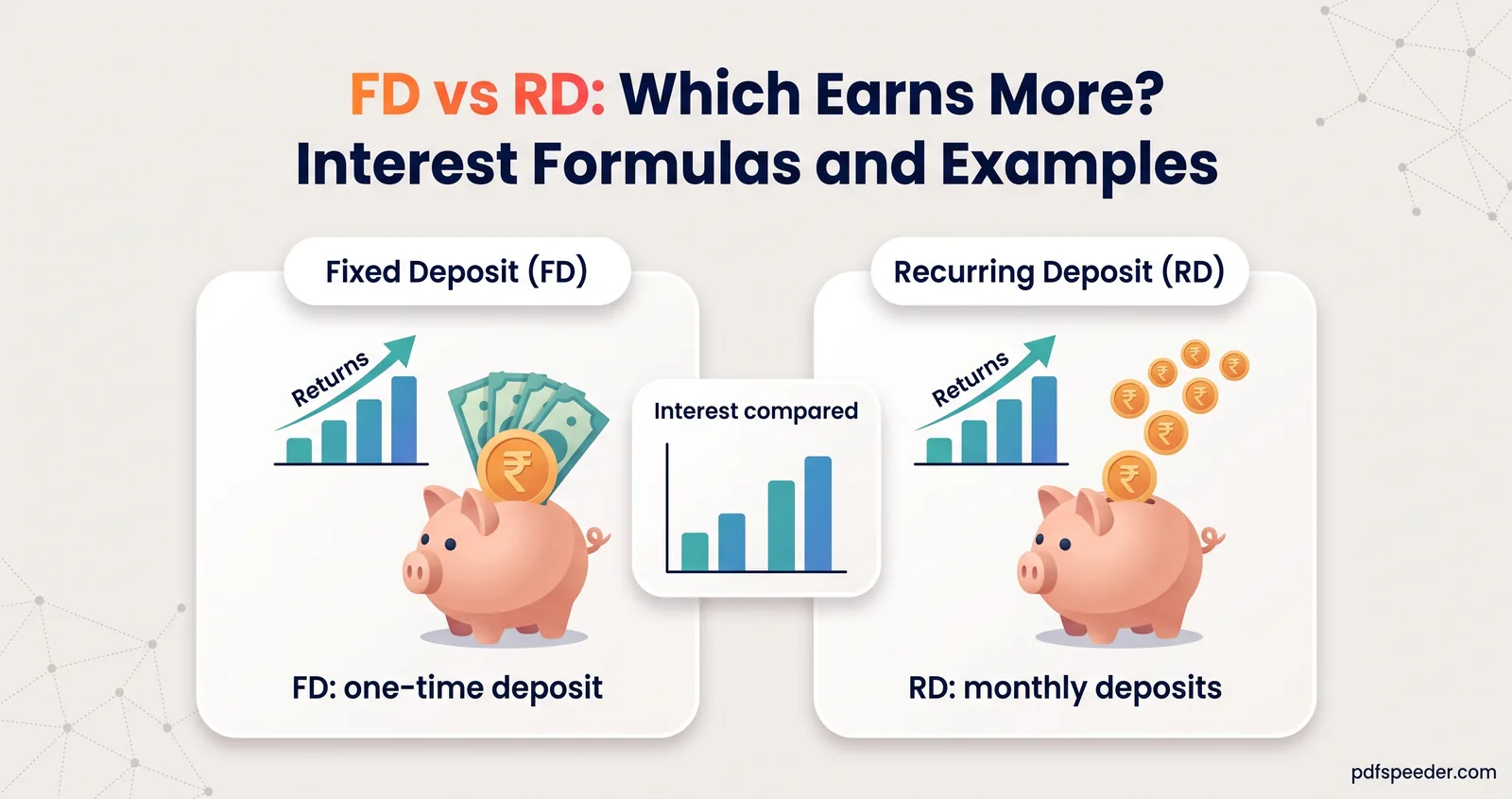
For the bigger picture, the Salary Calculator shows how PF fits into your monthly pay, and the Retirement Calculator estimates how much you'll need in total, of which your EPF can be one part. If you also hold bank deposits, our FD vs RD comparison shows how their interest is worked out.
Note: This article is for information only and is not financial advice. EPF rates and rules are set by the government and EPFO; your passbook and EPFO's notices are the final word.
Next step: download your EPF passbook, take last year's opening balance and monthly credits, and check the interest credited against the monthly-balance method above.
Frequently asked questions
How is EPF interest calculated?
Each month, the balance at the start of the month is multiplied by the annual rate ÷ 1200, and the twelve monthly amounts are added up and credited on 31 March. Contributions start earning from the month after they're credited.
What is the EPF interest rate for 2025-26?
EPFO's Central Board of Trustees recommended 8.25% for 2025-26 in March 2026, the same as the rate declared for 2024-25. Check your passbook or EPFO's notices for the rate actually credited.
Is EPF interest credited monthly?
No. It's calculated on the monthly running balance but credited once a year, at the end of the financial year, so it compounds yearly.
Does the EPS part of my PF earn interest?
No. The EPS share goes into a pooled pension fund and earns you a pension worked out with a formula, not interest on a balance.
How much of the employer's contribution goes to EPS now?
8.33% of your basic plus DA up to the ₹25,000 wage ceiling in force from 17 September 2026, so at most ₹2,083 a month. The rest of the employer's 12% goes to your EPF account.