Discount Calculation Formula: Find the Real Price and Real Discount
The discount calculation formula both ways, with worked examples: discount %, original price, stacked offers, bank offer caps, GST and which deal is best.

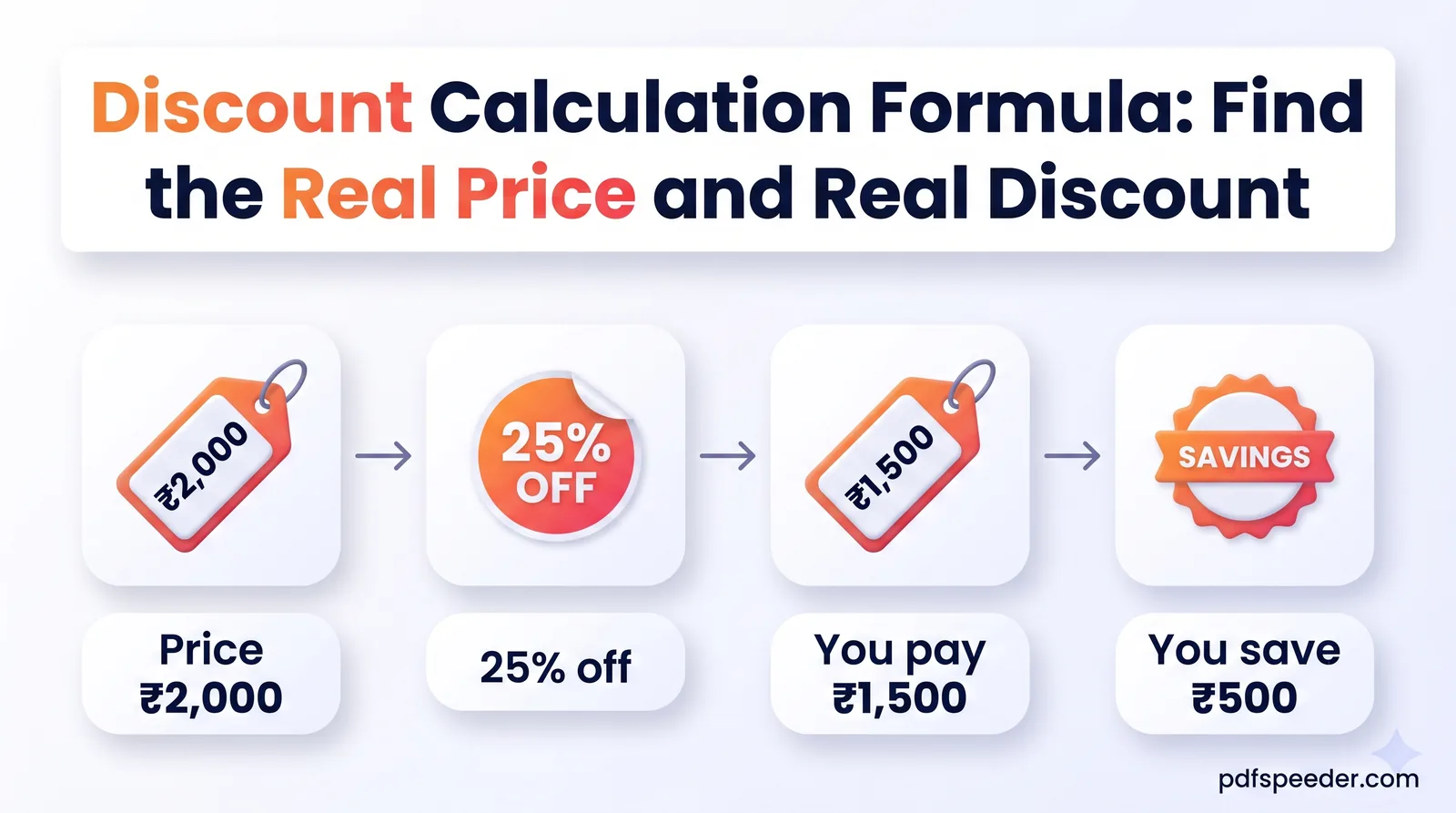
The discount calculation formula is: discount = original price × discount % ÷ 100, and sale price = original price − discount. So ₹3,499 shoes at 35% off carry a ₹1,224.65 discount and cost ₹2,274.35. Below you'll find the reverse formulas too, for the discount percentage and the original price, plus the shopping traps that make deals look better than they are: stacked discounts, capped bank offers, GST and buy-one-get-one offers.
On this page
The discount calculation formula, four ways
Four versions of one formula cover every discount question:
discount amount  = original price × discount % ÷ 100
sale price       = original price × (1 − discount % ÷ 100)
discount %       = (original price − sale price) ÷ original price × 100
original price   = sale price ÷ (1 − discount % ÷ 100)
For the shoes, step by step:
- Discount: 3,499 × 35 ÷ 100 = ₹1,224.65
- Sale price: 3,499 − 1,224.65 = ₹2,274.35
- Check in one step: 3,499 × 0.65 = ₹2,274.35
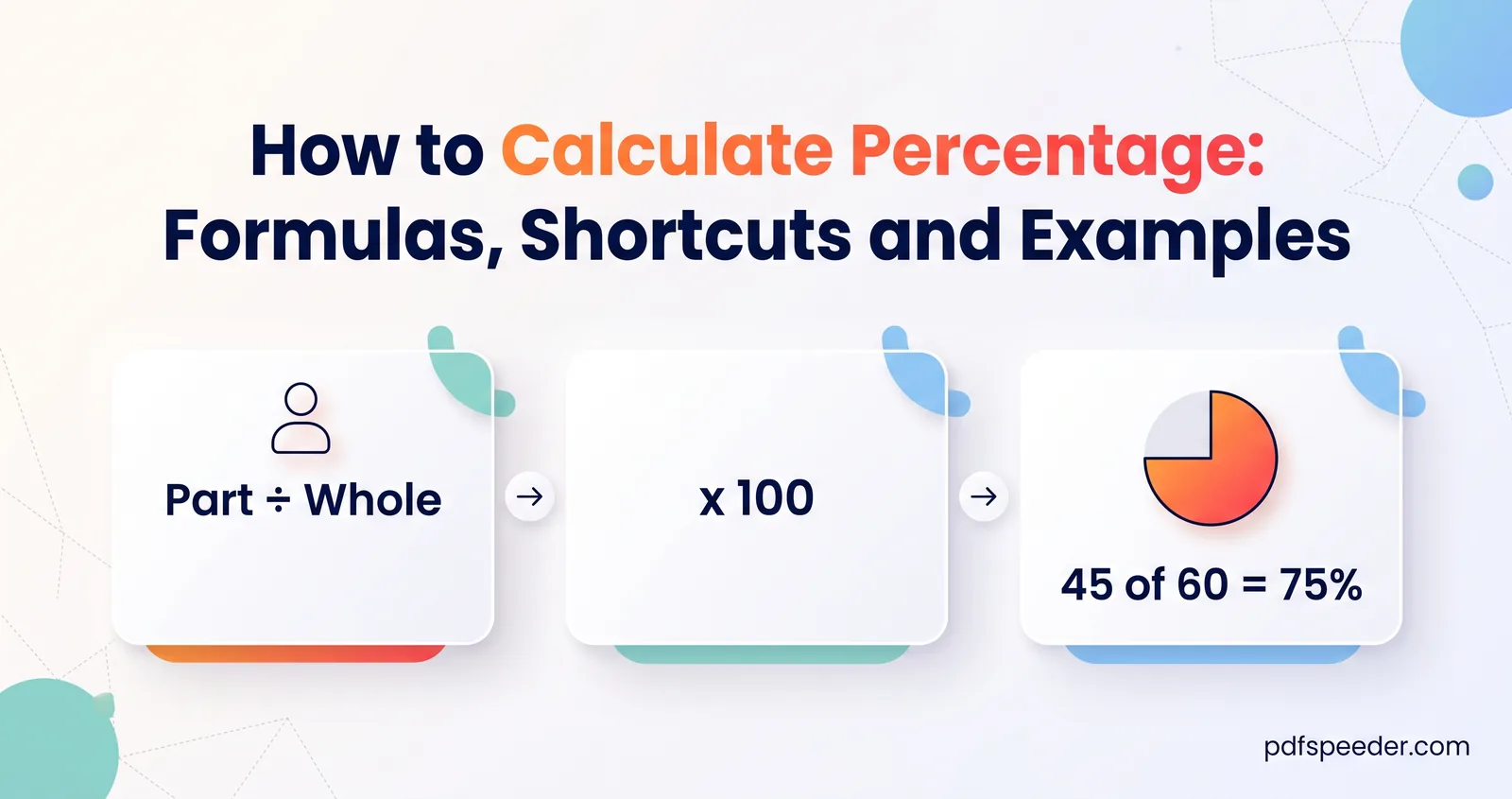
The shortcut in step 3 is worth remembering: at 35% off you pay 65% of the price, so multiply by 0.65. Our Percentage Calculator has rows for both directions, a price with a discount taken off and the original price from what you paid, and shows the formula with your numbers in it.
How to calculate discount percentage from two prices
When a tag says "was ₹4,999, now ₹3,199", work out the real discount yourself:
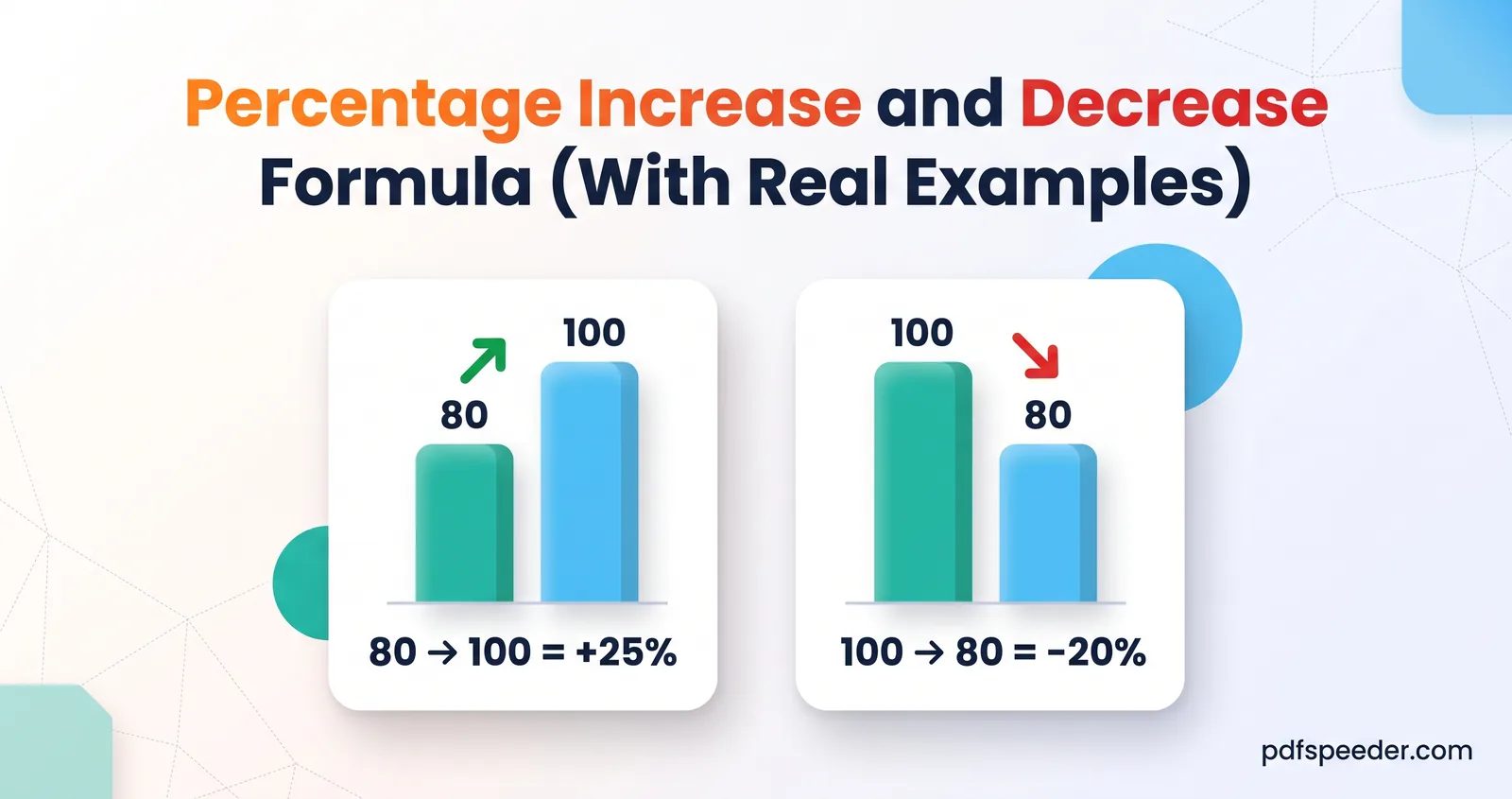
discount % = (4,999 − 3,199) ÷ 4,999 × 100 = 1,800 ÷ 4,999 × 100 = 36.01%Always divide by the original price, not the sale price. Dividing by ₹3,199 would give 56.27%, which is how much more the old price was, not how much you saved.
A discount percentage is only as honest as the "before" price it starts from. If the item usually sells for less than the crossed-out price, the real saving is smaller than the tag says, so compare with what the same item costs elsewhere.
Find the original price after a discount
If you know what you paid and the discount, divide by what's left after the discount. Say you paid ₹2,520 for something sold at "30% off, plus an extra 10% off":
- What's left after both discounts: 0.70 × 0.90 = 0.63, so you paid 63% of the price.
- Original price: 2,520 ÷ 0.63 = ₹4,000.
The two tempting shortcuts both fail. Treating it as a single 40% discount gives 2,520 ÷ 0.60 = ₹4,200, and adding 40% back gives 2,520 × 1.40 = ₹3,528. Neither matches, because the discounts didn't add up to 40% in the first place, which is the next trap.
Stacked discounts don't add up
When a shop offers one discount on top of another, the second comes off the already-reduced price. A ₹2,800 jacket at 30% off, with an extra 10% off at the checkout:
- After 30% off: 2,800 × 0.70 = ₹1,960
- After the extra 10%: 1,960 × 0.90 = ₹1,764
- Total saved: ₹1,036, which is 37% of ₹2,800, not 40%
The general rule for two percentage discounts, a and b, is:
combined discount = 1 − (1 − a) × (1 − b)| Offer | Combined discount |
|---|---|
| 20% + 20% | 36% |
| 30% + 10% | 37% |
| 40% + 20% | 52% |
| 50% + extra 10% | 55% |
| 60% + extra 10% | 64% |
| 50% + 50% | 75% |
So 50% off plus an extra 10% off is 55% off, not 60%. With two percentages, the order doesn't change the result. Mixing a percentage with a flat coupon is different: on the ₹2,800 jacket, 20% off and then a ₹300 coupon leaves ₹1,940, but the coupon first and 20% off afterwards leaves ₹2,000, because the percentage then applies to a bigger amount.
Our Discount Calculator applies any number of percentage and flat discounts in the order you list them and shows every step, plus the single effective discount they add up to. It runs in your browser.
Bank offers, caps and GST
Offers with a cap
Card offers often read like "10% instant discount, up to ₹1,500". The cap changes everything on bigger purchases:
bank discount = the smaller of (price × 10%) and ₹1,500| Price after other discounts | 10% would be | You get | Effective discount |
|---|---|---|---|
| ₹12,000 | ₹1,200 | ₹1,200 | 10% |
| ₹15,000 | ₹1,500 | ₹1,500 | 10% |
| ₹40,000 | ₹4,000 | ₹1,500 | 3.75% |
The cap kicks in at ₹1,500 ÷ 10% = ₹15,000; above that, the offer is worth less and less in percentage terms. A ₹40,000 phone at 15% off costs ₹34,000, and the capped bank offer takes it to ₹32,500, a total saving of 18.75%, not the 25% the two numbers suggest.
The Discount Calculator has no cap field, so work out the smaller amount yourself and enter it as an Amount off line. Read the offer's terms too: minimum order values, eligible cards and whether it applies to EMI payments all vary.
GST on discounted prices
Under section 15(3) of the CGST Act, a discount given before or at the time of sale and recorded on the invoice is left out of the value GST is charged on, according to CBIC's text of the Act. In practice, GST is worked out on the discounted price.
For a percentage discount, the final total comes out the same either way. At an example GST rate of 5%, a ₹1,500 item at 20% off costs 1,500 × 0.80 × 1.05 = ₹1,260, with ₹60 of it tax. A flat discount is where the order matters: ₹300 off before tax gives ₹1,260, but adding tax to the full ₹1,500 first and then taking ₹300 off gives ₹1,275.
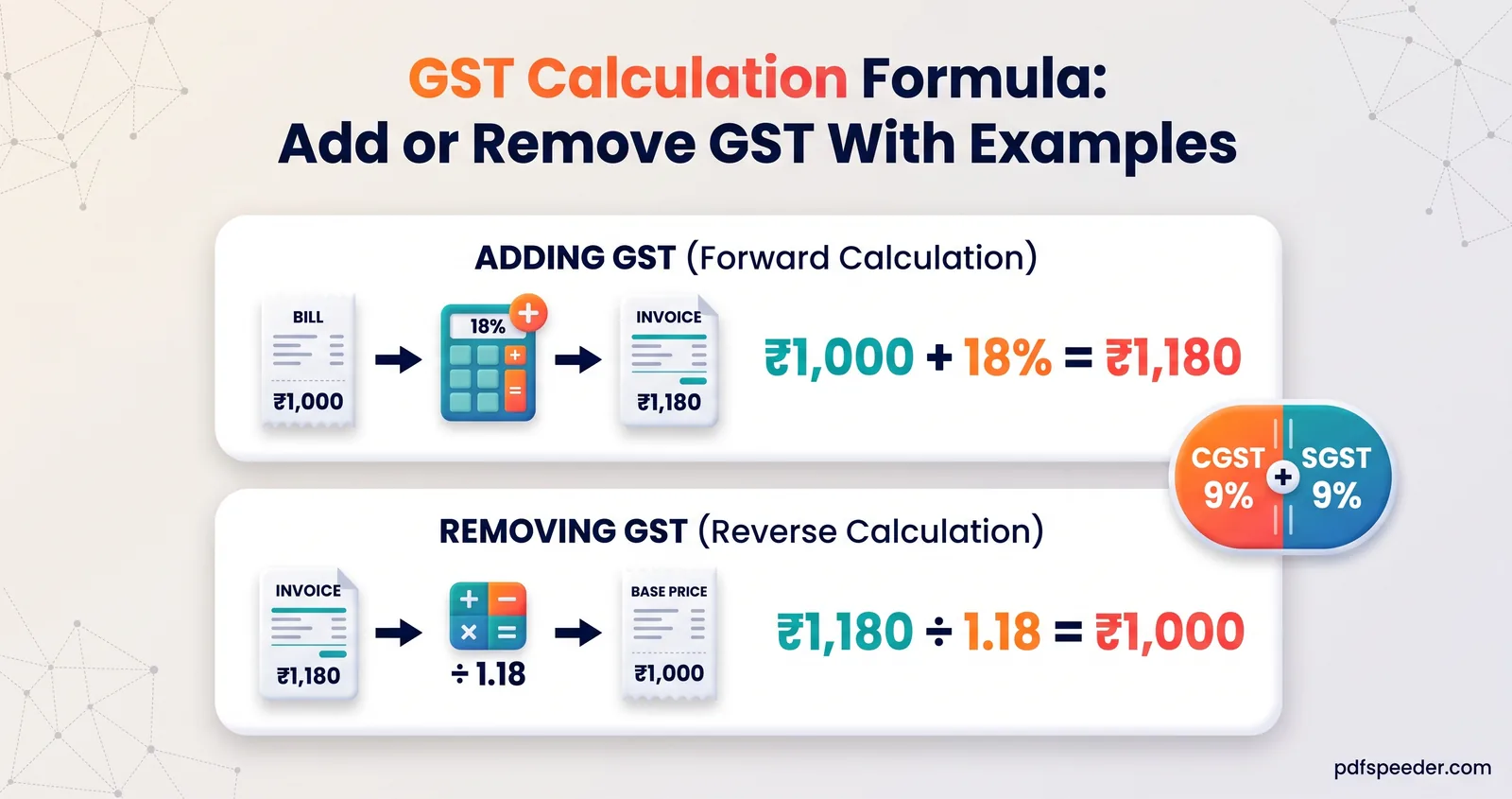
Retail prices in India are often marked inclusive of all taxes, and then the tax is already inside the price you're discounting. An item marked ₹1,180 including 18% GST (an example rate), at 25% off, costs ₹885, of which ₹750 is the price and ₹135 the GST. The Discount Calculator handles both cases: choose Add tax on top of the discounted price or Price already includes tax, tap 5%, 18% or 40%, or type another rate. For invoices, the GST Calculator adds or removes GST and shows the CGST and SGST or IGST split, and our GST calculation formula guide explains the rates and the rounding rules.
Which deal is actually better?
Different kinds of offer only compare fairly once you turn each one into a price per item. Take an item that normally costs ₹999:
| Offer | Price per item | Discount per item |
|---|---|---|
| Buy 1 get 1 free | ₹499.50 | 50% |
| 40% off | ₹599.40 | 40% |
| ₹350 off | ₹649.00 | 35.04% |
| Buy 2 get 1 free | ₹666.00 | 33.33% |
Buy one get one free wins here, but only if you actually want two. If you need one, you're paying ₹999 for something you'd get for ₹599.40 at 40% off. The rule for "buy X get Y free" is Y ÷ (X + Y) × 100: buy 1 get 1 is 50% off, buy 2 get 1 is 33.33%, and buy 3 get 1 is 25%.
Threshold offers, such as "₹500 off on orders above ₹2,500", work the same way: if you have to add things you don't need to qualify, count them as part of the price.
The Discount Calculator's Which deal is better? panel compares up to three offers, as a percentage off, an amount off or buy X get Y free, and names the cheapest per item. For other percentage questions, our guide to the percentage increase formula covers price rises and percentage points, and how to calculate percentage covers the basics.
Before you pay, put the real price, every discount and any tax into the Discount Calculator, and compare the final figure with what the same item costs elsewhere.
Frequently asked questions
How do I calculate the discount percentage?
Subtract the sale price from the original price, divide by the original price and multiply by 100. From ₹4,999 down to ₹3,199 is 1,800 ÷ 4,999 × 100 = 36.01%.
How do I find the original price after a discount?
Divide the price you paid by 1 minus the discount as a decimal. After 30% and then 10% off, you paid 0.70 × 0.90 = 63% of the price, so ₹2,520 ÷ 0.63 = ₹4,000.
Is 50% off plus an extra 10% off the same as 60% off?
No. The extra 10% comes off the already-halved price, so the total is 55% off: a ₹1,000 item costs ₹450, not ₹400.
Is buy one get one free the same as 50% off?
Per item, yes: you pay for one and take home two. It's only a better deal than a percentage discount if you actually want both items.
Is GST charged before or after the discount?
After. A discount recorded on the invoice at the time of sale is left out of the value GST is charged on, so tax is worked out on the discounted price.