CGPA to Percentage: The CBSE Formula and University Rules
Convert CGPA to percentage the right way: CBSE's CGPA × 9.5 rule with worked examples, why universities differ, SGPA vs CGPA, and how to convert back.

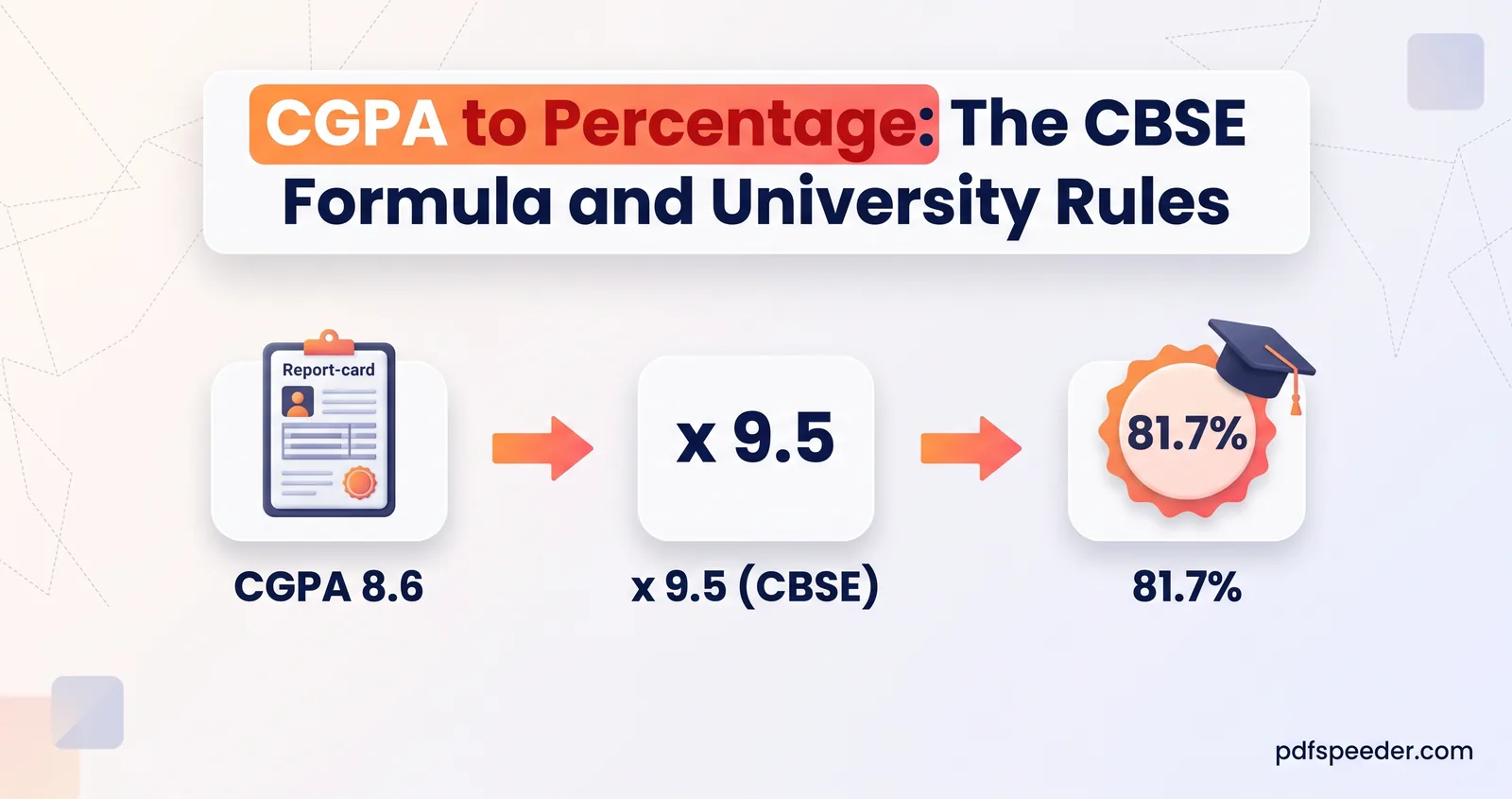
To convert a CBSE CGPA to percentage, multiply it by 9.5: a CGPA of 8.4 is 8.4 × 9.5 = 79.8%. That rule comes from CBSE's own circulars and belongs to CBSE's grading system, so a college or university CGPA needs the formula your own institution publishes. Below you'll find worked examples, where the 9.5 comes from, how SGPA and CGPA differ, and how to convert a percentage back to CGPA.
On this page
The CBSE CGPA to percentage formula: CGPA × 9.5
CBSE introduced a nine-point grading system for Classes IX and X from the 2009-10 academic year. Its Circular No. 24 of 28 May 2010 sets out how to turn grades back into percentages (CBSE circular):
Overall indicative percentage of marks       = 9.5 × CGPA
Subject-wise indicative percentage of marks  = 9.5 × grade point of the subject
Your CGPA is the average of the grade points in your main subjects, leaving out the additional sixth subject, as the same circular explains. Each grade point stands for a band of marks, set out in CBSE's Circular No. 40 of 2009 (CBSE circular):
| Marks range | Grade | Grade point | Indicative % (grade point × 9.5) |
|---|---|---|---|
| 91-100 | A1 | 10 | 95 |
| 81-90 | A2 | 9 | 85.5 |
| 71-80 | B1 | 8 | 76 |
| 61-70 | B2 | 7 | 66.5 |
| 51-60 | C1 | 6 | 57 |
| 41-50 | C2 | 5 | 47.5 |
| 33-40 | D | 4 | 38 |
| 21-32 | E1 | none | none |
| 20 and below | E2 | none | none |
Notice the word CBSE uses: indicative. An A2 tells you that you scored somewhere from 81 to 90 in that subject, and 85.5% is an estimate in the middle of that band, not your exact mark. If your marksheet already shows marks, use them; the conversion is only for marksheets that show a CGPA.
Where does the 9.5 come from?
CBSE's circulars give the multiplier without explaining it. The explanation you'll most often see is that students in the top grade, A1, scored about 95 marks on average, and 95 ÷ 10 grade points = 9.5. Treat that as background rather than an official rule.
What you can check for yourself is how the multiplier fits the bands. For an A2, 9 × 9.5 = 85.5, exactly the middle of 81-90, and for an A1, 95 is half a mark below the middle of 91-100.
Lower down, the estimate sits above the middle of each band: a B2 gives 66.5 against a midpoint of 65.5, and a C2 gives 47.5 against 45.5. So the conversion is fairest near the top of the scale, and it's an approximation everywhere.
Worked examples
From a CGPA: a CGPA of 8.4 converts to 8.4 × 9.5 = 79.8%.
From subject grades: say your five main subjects show A1, A2, A2, B1 and A1.
- Turn each grade into its grade point: 10, 9, 9, 8 and 10.
- Average them: (10 + 9 + 9 + 8 + 10) ÷ 5 = 46 ÷ 5 = 9.2 CGPA.
- Convert: 9.2 × 9.5 = 87.4%.
For one subject: a B1 in Science is grade point 8, so 8 × 9.5 = 76%.
At the top: a perfect CGPA of 10 converts to 95%, not 100%, because the conversion is an average estimate, not a record of full marks.
| CGPA | Indicative percentage |
|---|---|
| 10.0 | 95.0% |
| 9.6 | 91.2% |
| 9.2 | 87.4% |
| 9.0 | 85.5% |
| 8.4 | 79.8% |
| 8.0 | 76.0% |
| 7.0 | 66.5% |
| 6.0 | 57.0% |
| 5.0 | 47.5% |
Any calculator does the sum; our Percentage Calculator is handy for the related questions, such as what percentage of an eligibility cut-off your converted score is.
University formulas differ: check yours
There's no single national CGPA to percentage formula. Universities and autonomous colleges set their own rules for their own grading schemes, and the multiplier, any adjustment and even the grading scale can differ. Using CBSE's 9.5 on a university CGPA, or one university's formula on another's grade card, can put your percentage several points out.
To find the right one:
- Read your grade card or transcript. Some print the conversion formula in the notes, often on the back.
- Check the university's own website for its examination or academic regulations, which usually define the grading scheme and how percentages are worked out.
- Ask the examination section. If no formula is published, it can tell you the official method, and some institutions issue a certificate stating your equivalent percentage.
- Follow the form you're filling in. If an employer or admissions office states its own conversion rule, use theirs, even if it differs from your university's.
Keep a copy, or a link, of wherever the formula came from. If anyone questions your percentage, the source settles it.
SGPA, CGPA and percentage: the difference
SGPA (semester grade point average) covers a single semester. Each course's grade point is weighted by its credits:
SGPA = Σ (credits × grade point) ÷ Σ creditsFor a semester with five courses carrying 4, 4, 3, 3 and 2 credits, and grade points of 9, 8, 10, 7 and 8:
SGPA = (4×9 + 4×8 + 3×10 + 3×7 + 2×8) ÷ 16 = 135 ÷ 16 = 8.44CGPA (cumulative grade point average) covers every semester so far, weighted by credits in the same way. If your second semester had 22 credits and an SGPA of 7.90:
CGPA = (135 + 7.90 × 22) ÷ (16 + 22) = 308.8 ÷ 38 = 8.13A simple average of the two SGPAs would give 8.17, which overstates it, because the heavier second semester should count for more. Take each semester's credits from your grade card. Our Scientific Calculator handles the whole bracketed sum in one line, and it runs in your browser.
To turn an SGPA or CGPA into a percentage, use your institution's rule from the section above. For SGPA to percentage, check whether your regulations give one formula for both or a separate one for each.
Converting a percentage back to CGPA
For CBSE, reverse the formula: CGPA ≈ percentage ÷ 9.5. An 88% score works out to 88 ÷ 9.5 = 9.26.
Two cautions apply. First, CBSE's CGPA was an average of grade bands, not a precise figure, so a percentage converted back is only an estimate of what the CGPA would have been. Second, anything above 95% gives a result over 10, such as 97 ÷ 9.5 = 10.21, which shows the conversion isn't meant to run perfectly in both directions. For a university, rearrange that university's own formula rather than dividing by 9.5.
What to write on admission and job forms
Forms ask for this in different ways, and the instructions on the form come first:
- If the form asks for CGPA, enter it exactly as your marksheet shows it, with the scale, such as 8.4 out of 10.
- If it asks for a percentage and you have a CBSE CGPA, enter CGPA × 9.5 (79.8% for 8.4), and keep the CBSE circular handy as your reference.
- If it gives its own conversion formula, use that, even if you've seen a different one elsewhere.
- Don't round up. Write 79.8, not 80, unless the form tells you to round. Near an eligibility cut-off, that decimal can matter.
For other mark calculations, such as working out an overall percentage from subject marks, see our guide on how to calculate percentage, and for comparing scores across years, our guide to the percentage increase formula.
Frequently asked questions
How do I convert CBSE CGPA to percentage?
Multiply your CGPA by 9.5, as CBSE's 2010 circular sets out. A CGPA of 9.2 is 9.2 × 9.5 = 87.4%.
Why does CBSE multiply by 9.5?
CBSE's circulars give the factor without a derivation. The usual explanation is that top-grade students averaged about 95 marks, and 95 divided by the top grade point of 10 is 9.5.
Can I use 9.5 for my university CGPA?
Only if your university says so. Universities set their own conversion rules, so check your grade card, the university's regulations or its examination section.
What is the difference between SGPA and CGPA?
SGPA is the credit-weighted average of your grade points for one semester; CGPA is the credit-weighted average across all your semesters so far.
How do I convert percentage to CGPA?
For CBSE, divide the percentage by 9.5, so 88% is about 9.26. For a university, rearrange its own published formula.