Rule of 72: How Long Will Your Money Take to Double?
The rule of 72 says money doubles in 72 ÷ rate years. See how accurate it is from 4% to 15%, how to use it for inflation and debt, and when 70 or 69.3 fits.

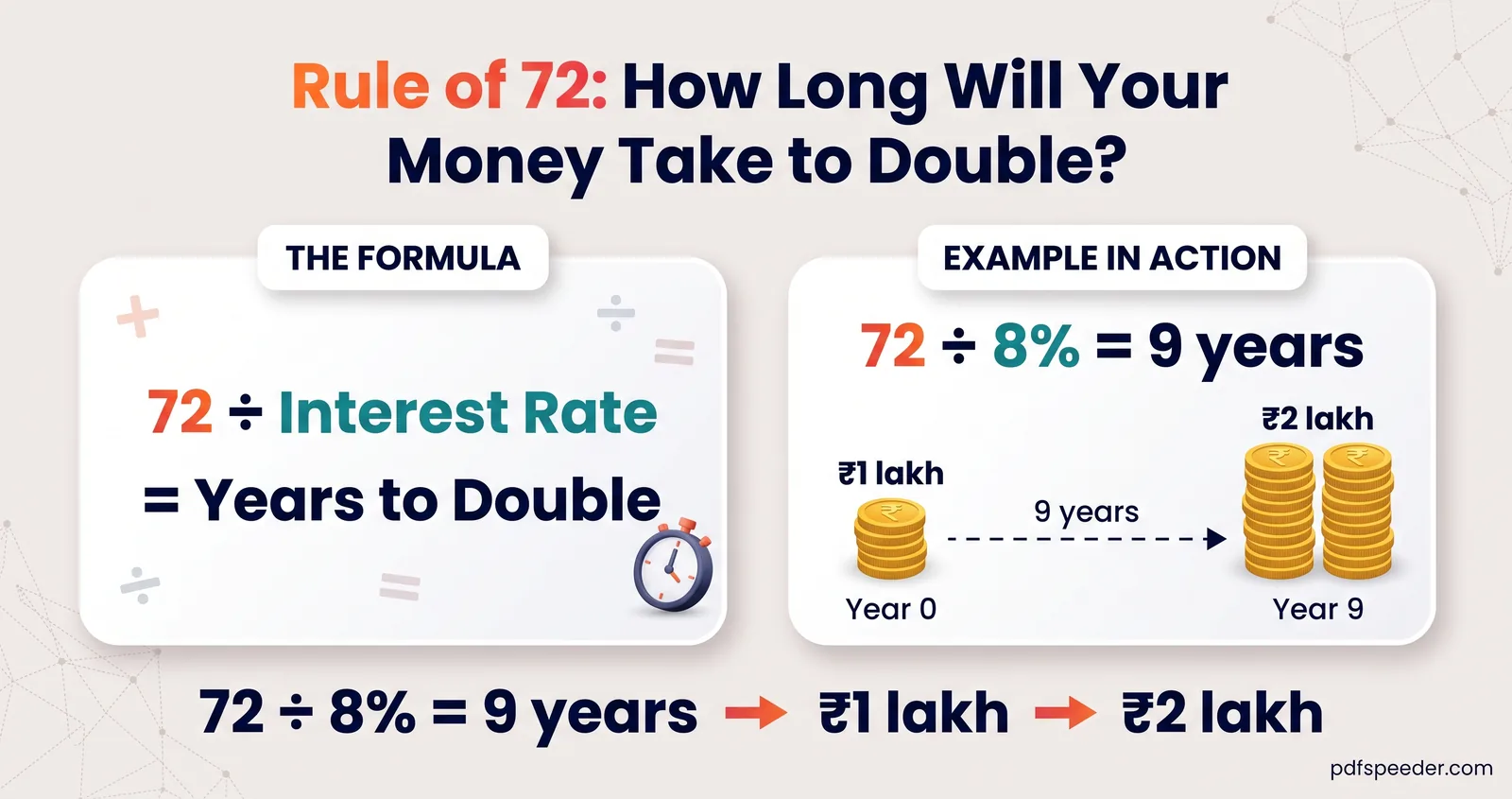
The rule of 72 says your money doubles in roughly 72 ÷ the annual rate in per cent: at 8% a year, that's 72 ÷ 8 = 9 years, and the exact answer is 9.01. It works for anything that compounds, from deposits and investments to inflation and unpaid debt. Between 4% and 15% it's never more than about four months out, and the table below shows exactly how close it gets.
On this page
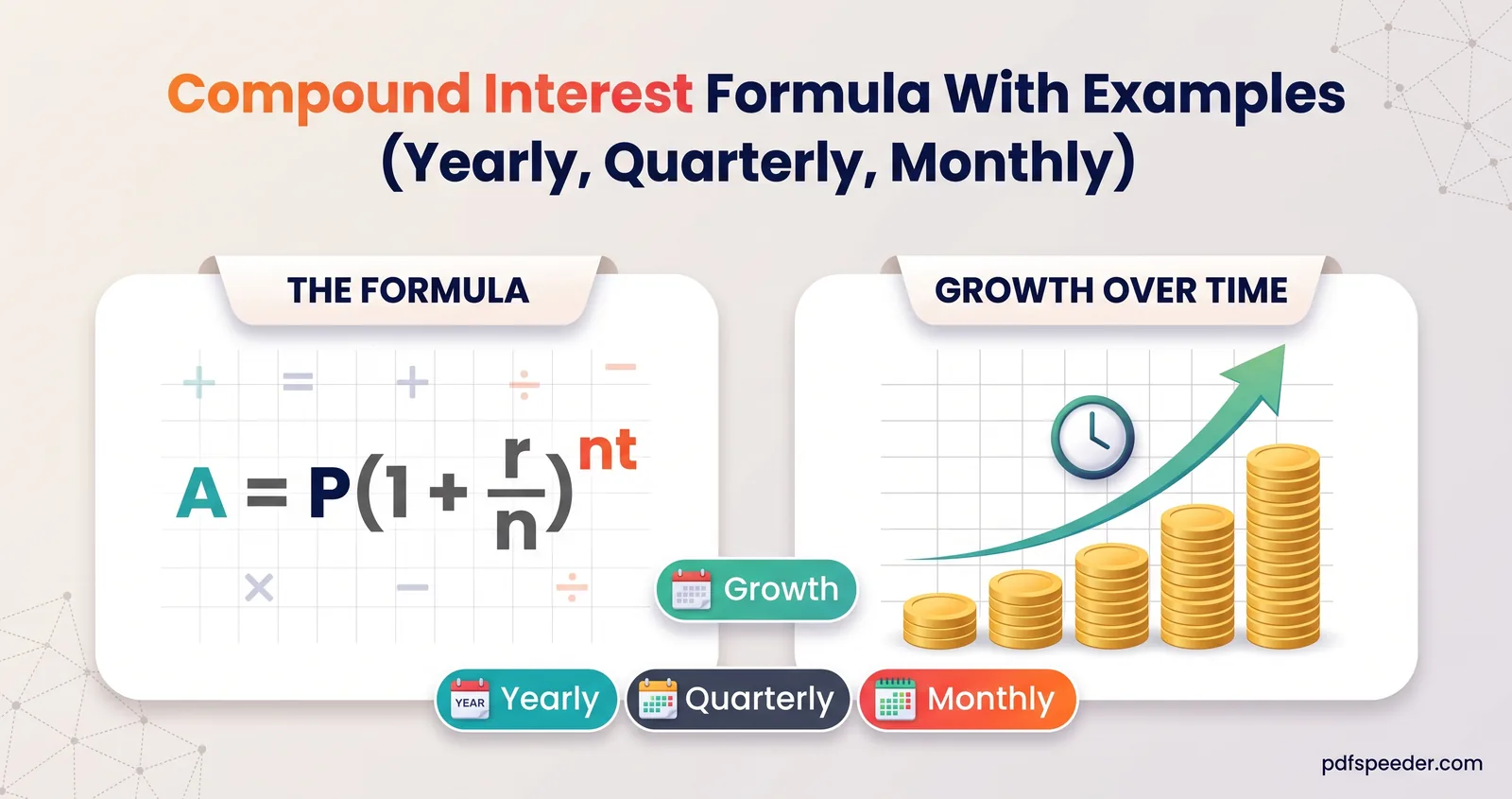
The doubling formula in one line
Years to double ≈ 72 ÷ annual rate (%)
Exact answer:     years = ln 2 ÷ ln(1 + rate ÷ 100)
At 8%, the exact version is 0.6931 ÷ ln 1.08 = 0.6931 ÷ 0.07696 = 9.006 years, so the shortcut's 9 is off by about two days. Because the exact formula needs logarithms, this shortcut is the quick answer to "how long to double money?" that you can do in your head.
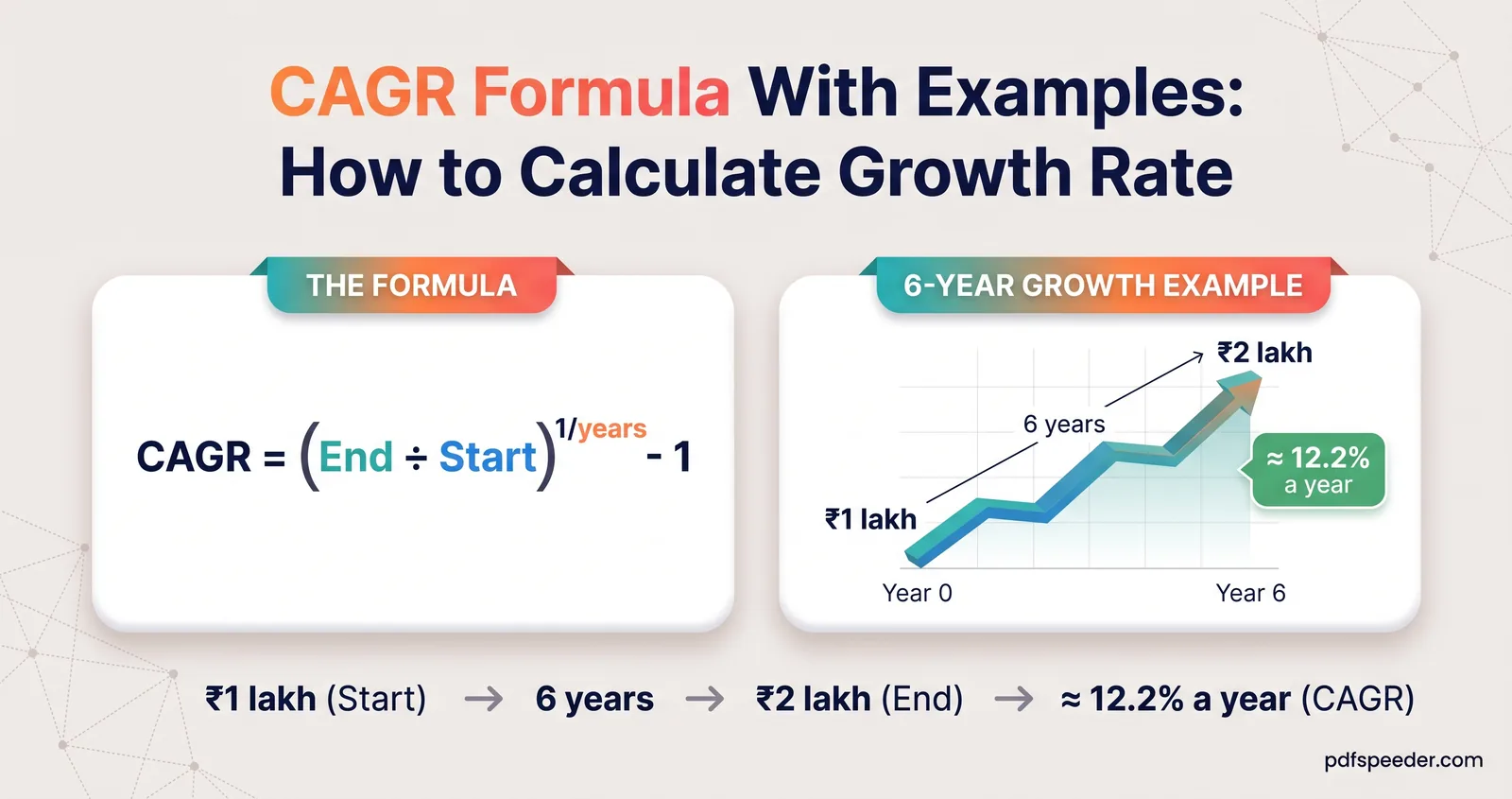
It also runs backwards. To double your money in 6 years, you need about 72 ÷ 6 = 12% a year; the exact figure is 12.25%. Turning a doubling time into a yearly rate like this is a CAGR calculation, which our CAGR formula guide works through in full.
Use the effective yearly rate when interest compounds more than once a year. A fixed deposit at 7% compounded quarterly really earns 7.19% a year, and 72 ÷ 7.19 = 10.0 years matches its exact doubling time of 9.99 years; plain 72 ÷ 7 would say 10.3.
How accurate is the rule of 72? A quick table
Here's the money doubling time with yearly compounding, worked out exactly and with the rule:
| Annual rate | Exact years to double | 72 ÷ rate | Shortcut is off by |
|---|---|---|---|
| 4% | 17.67 | 18.00 | 3.9 months too long |
| 5% | 14.21 | 14.40 | 2.3 months too long |
| 6% | 11.90 | 12.00 | 1.3 months too long |
| 7% | 10.24 | 10.29 | 0.5 months too long |
| 8% | 9.01 | 9.00 | 0.1 months too short |
| 9% | 8.04 | 8.00 | 0.5 months too short |
| 10% | 7.27 | 7.20 | 0.9 months too short |
| 12% | 6.12 | 6.00 | 1.4 months too short |
| 15% | 4.96 | 4.80 | 1.9 months too short |
The rule is spot on at about 7.85%, a little slow below that and a little quick above. Why 72 and not some other number? The exact constant for continuous compounding is 69.3 (100 × ln 2), yearly compounding nudges it upwards, and 72 divides neatly by 2, 3, 4, 6, 8, 9 and 12, which makes the mental maths easy.
For high rates, there's a simple fix: add 1 to 72 for every 3 points the rate is above 8%. At 20%, that's 76 ÷ 20 = 3.80 years, exactly right, where plain 72 ÷ 20 says 3.6.
To see a doubling for yourself, open the Compound Interest Calculator, check that the currency is INR, and set ₹1,00,000 at 8% for 9 years with annual compounding: it shows ₹1,99,900, a whisker short of double.
Use it for inflation
Inflation compounds too, so the same division tells you how fast prices double, and how fast the buying power of your money halves:
| Inflation rate (example) | Prices double in (72 ÷ rate) | Exact |
|---|---|---|
| 4% | 18 years | 17.7 years |
| 5% | 14.4 years | 14.2 years |
| 6% | 12 years | 11.9 years |
| 7% | 10.3 years | 10.2 years |
At 6% inflation, something that costs ₹10,000 today costs ₹20,122 in 12 years, and ₹1 lakh kept as cash then buys only what about ₹49,700 buys now. The Inflation Calculator shows the year-by-year rise: set ₹10,000, 6% and 12 years (it opens in rupees in India; elsewhere, switch the currency to INR).
The same idea applies to returns after inflation. A deposit earning 7% while prices rise 6% grows your buying power by only about 0.94% a year, so it takes around 74 years to double in real terms. That's the hidden cost of keeping long-term savings somewhere that barely beats inflation. Our FD vs RD comparison shows what bank deposits actually earn.
Use it for loans and credit cards
Anything you owe and don't pay compounds against you at the same speed. Unpaid debt at 18% a year doubles in about 72 ÷ 18 = 4 years (exactly 4.19), and at 24% in about 3 years.
Credit cards usually state their rate per month, and the rule works with any period, as long as you keep the units straight: a monthly rate gives a doubling time in months. If a card charges 3.5% a month on a balance you carry, an example rate (check yours in the card's most important terms and conditions), that's 72 ÷ 3.5 ≈ 20.6 months, and the exact figure is 20.1 months. Over a year, 3.5% a month compounds to about 51%, far above the 42% you'd get by multiplying by 12.
For an EMI loan you're repaying, the balance shrinks rather than doubles, so the rule doesn't apply directly. It's for money that's left to compound: savings you don't touch, or debts you don't pay.
Rule of 72 vs 70 vs 69.3
Three divisors are in common use, and each is best in its own range:
| Rate | Exact (yearly compounding) | 69.3 ÷ r + 0.35 | 70 ÷ r | 72 ÷ r |
|---|---|---|---|---|
| 2% | 35.00 years | 35.00 | 35.00 | 36.00 |
| 5% | 14.21 years | 14.21 | 14.00 | 14.40 |
| 8% | 9.01 years | 9.01 | 8.75 | 9.00 |
| 12% | 6.12 years | 6.13 | 5.83 | 6.00 |
- 72: best for everyday rates of about 6% to 10%, and the easiest to divide.
- 70: exact at about 2%, so it suits low rates such as real returns or inflation in a low-inflation year. For the 0.94% real return above, 70 gives 74.2 years against an exact 73.8, while 72 says 76.3.
- 69.3: exact for continuous compounding. For yearly compounding it always comes out about 0.35 years short, so add 0.35: 69.3 ÷ r + 0.35 stays within about a week of the exact answer from 1% to 36%.
Two cousins are handy too. Money roughly triples in 114 ÷ rate years (at 8%, 14.25 against an exact 14.27) and quadruples in 144 ÷ rate, which is just two doublings in a row.
If you'd rather skip the shortcuts, our guide to the compound interest formula shows the exact maths, and the CAGR Calculator works backwards from a doubling: set ₹1,00,000 growing to ₹2,00,000 over 9 years and it shows 8.01% a year.
Note: This article is for information only and is not financial advice. The rates used are examples; real returns and inflation vary from year to year.
Try it now: divide 72 by the rate on your own deposit, loan or card, then check the answer in the Compound Interest Calculator.
Frequently asked questions
What is the rule of 72?
A shortcut for compound growth: divide 72 by the annual rate in per cent to estimate how many years it takes money to double. At 8%, that's 9 years.
How accurate is the rule of 72?
Very, for normal rates. With yearly compounding it's within about four months of the exact answer anywhere from 4% to 15%, and almost exact at 8%.
How long will it take to double my money at 7%?
About 72 ÷ 7 = 10.3 years by the rule, and 10.24 years exactly with yearly compounding. If the 7% is compounded quarterly, as many fixed deposits are, it takes about 10 years.
What is the rule of 72 for inflation?
Divide 72 by the inflation rate to see how long prices take to double, which is also how long your money's buying power takes to halve. At 6% inflation, that's about 12 years.
When should I use the rule of 70 instead of 72?
At low rates, roughly 1% to 4%, where the rule of 70 is closer. Above about 5%, 72 gives the better answer.